Kirjojen hintavertailu – 12 859 819 kirjaa ja 27 kauppaa
Kirjailija
Luce Irigaray
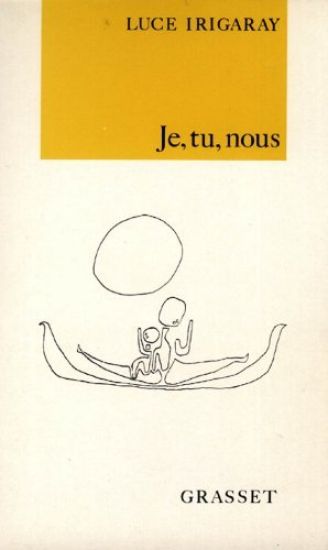
Kirjat ja teokset yhdessä paikassa: 55 kirjaa, julkaisuja vuosilta 1973–2024, suosituimpiin kuuluu Je, Tu, Nous. Vertaile teosten hintoja ja tarkista saatavuus suomalaisista kirjakaupoista.
French philosopher Luce Irigaray has become one of the twentieth century's most influential feminist thinkers. Among her many writings are three books (with a projected fourth) in which she challenges the Western tradition's construals of human beings' relations to the four elements-earth, air, fire, and water-and to nature. In answer to Heidegger's undoing of Western metaphysics as a "forgetting of Being," Irigaray seeks in this work to begin to think out the Being of sexedness and the sexedness of Being. This volume is the first English translation of L'oubli de l'air chez Martin Heidegger (1983). In this complex, lyrical, meditative engagement with the later work of the eminent German philosopher, Irigaray critiques Heidegger's emphasis on the element of earth as the ground of life and speech and his "oblivion" or forgetting of air. With the other volumes (Elemental Passions and Marine Lover of Friedrich Nietzsche, published elsewhere) in Irigaray's "elemental" series, The Forgetting of Air offers a fundamental rereading of basic tenets in Western metaphysics. And with its emphasis on dwelling and human habitation, it will be important reading not only in the humanities but also in architecture and the environmental sciences.

In this book, one of the foremost contemporary scholars in the fields of feminist thought and linguistics, explores the possibility of a new liberating language and hence a new relationship between the sexes. In I Love to You, Luce Irigaray moves from the critique of patriarchy to an exploration of the ground for a possible inter-subjectivity between the two sexes. Continuing her rejection of demands for equality, Irigaray poses the question: how can we move to a new era of sexual difference in which women and men establish lasting relations with one another without reducing the other to the status of object?
In Thinking The Difference, Luce Irigaray examines the ways in which women are failed by the cultural, political and legal institutions set up to protect and preserve, regardless of sex. Here Irigaray addresses the civil domain--where women's bodies, nature, space, symbolism and representation are appropriated by "the people of men"-- --and the need for concrete changes so that women may share in culture as women themselves, thereby gaining an as-yet-unfound full citizenship in the world.
"Who or what the other is, I never know. But the other who is forever unknowable is the one who differs from me sexually. This feeling of surprise, astonishment, and wonder in the face of the unknowable ought to be returned to its locus: that of sexual difference." Thus Luce Irigaray undertakes a searching inquiry into what may be the philosophical problem of our age. Irigaray approaches the question of sexual difference by looking at the ways in which thought and language—whether in philosophy, science, or psychoanalysis—are gendered. She juxtaposes evocative readings of classic texts, including Plato's Symposium, Aristotle's Physics, Descartes's "On Wonder" in The Passions of the Soul, Spinoza's Ethics, Merleau-Ponty's The Visible and the Invisible, and Levinas's Totality and Infinity, with meditations on experiences of love: between fetus and mother, between heterosexual lovers, between women, and between women and their own bodies. Exploding traditional dualities such as inside/outside, form/content, subject/object, and self/other, Irigaray shows how an understanding of such experiences points to gender blindness in both classic and contemporary theory. Asserting that women have never known a love of self out of which a non-dominated love of the other is possible, Irigaray argues that only when women insist on the integrity of their own spaces of embodiment can love become the basis of a revolution in ethics. Published in French in 1984, An Ethics of Sexual Difference is now available in English in a superb translation by Carolyn Burke and Gillian C. Gill. Readers interested in feminist theory, literary theory, and philosophy—indeed anyone deeply concerned with gender relations—will be challenged by the brilliance and boldness of Irigaray's analyses.
In the tradition of Simone de Beauvoir and Julia Kristeva, Luce Irigaray is one of France's most versatile feminist critics. Sexes and Genealogies, a collection of lectures delivered throughout Canada and Europe, introduces her writing to a wider American audience. Irigaray's most famous work, Speculum of the Other Woman, prompted her expulsion from the Lacanin Ecole Freudienne because of its searing depiction of Platonic and Freudian representations of women. Now Sexes and Genealogies analyzes sexual difference according to what she terms the double dimension of gender and ideology. Irigaray covers major issues in religion, the law, psychoanalysis, and literature, such as: the continued neglect by psychoanalysts of the sexual and gender dimensions of therapy, the urgency of female divinity for contemporary feminist movements, and a reconsideration of women's relation to the market economy. Sexes and Genealogies also includes Irigaray's dazzling reading of the Oresteia, "Body Against Body: In Relation to the Mother," now acknowleged as a feminist classic.
Elemental Passions explores the man/woman relaitonship in a series of meditations of the senses and the formal elements. Its form resembles a series of love letters in which, however, the identity-and even the reality-of the adressee are deliberately obscured.
Published in France in 1980, Marine Lover is the first in a trilogy in which Luce Irigaray links the interrogation of the feminine in post-Hegelian philosophy with a pre-Socratic investigation of the elements. Irigaray undertakes to interrogate Nietzche, the grandfather of poststructuralist philosophy, from the point of view of water. According to Irigaray, water is the element Nietzsche fears most. She uses this element in her narrative because for her there is a complex relationship between the feminine and the fluid. Irigaray's method is to engage in an amorous dialogue with the male philosopher. In this dialogue, she ruptures conventional discourse and writes in a lyrical style that defies distinction between theory, fiction, and philosophy.
"The publication of these two translations is an event to be celebrated by feminists of all persuasions." - Women's Review of Books In This Sex Which Is Not One, Luce Irigaray elaborates on some of the major themes of Speculum of the Other Woman, her landmark work on the status of woman in Western philosophical discourse and in psychoanalytic theory, In eleven acute and widely ranging essays, Irigaray reconsiders the question of female sexuality in a variety of contexts that are relevant to current discussion of feminist theory and practice. Among the topics she treats are the implications of the thought of Freud and Lacan for understanding womanhood and articulating a feminine discourse; classic views on the significance of the difference between male and female sex organs; and the experience of erotic pleasure in men and in women. She also takes up explicitly the question of economic exploitation of women; in an astute reading of Marx she shows that the subjection of woman has been institutionalized by her reduction to an object of economic exchange. Throughout Irigaray seeks to dispute and displace male-centered structures of language and thought through a challenging writing practice that takes a first step toward a woman's discourse, a discourse that would put an end to Western culture's enduring phallocentrism. Making more direct and accessible the subversive challenge of Speculum of the Other Woman, this volume-skillfully translated by Catherine Porter (with Carolyn Burke)-will be essential reading for anyone seriously concerned with contemporary feminist issues.
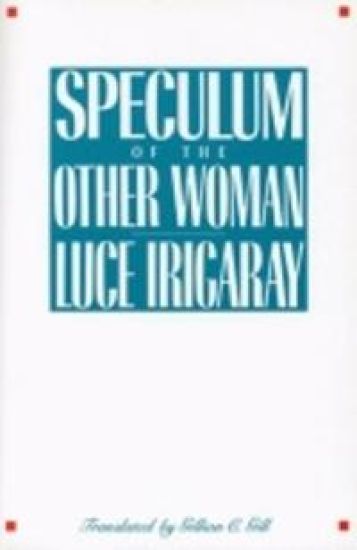
"Speculum of the Other Woman is a major text in the post-1968 feminist inquiry in France. It will be of interest to feminists, psychoanalysts, philosophers, and literary critics. There is no other text that attempts to do readings of major texts within the Western philosophical tradition using Lacanian, Derridean, and feminist tools. Gillian C. Gill offers a remarkable performance in translating without betraying a very challenging text." -Elaine Marks, Department of French and Italian and Women's Studies Program, University of Wisconsin, Madison Speculum of the Other Woman by Luce Irigaray is incontestably one of the most important works in feminist theory to have been published in this generation. For the profession of psychoanalysis, Irigaray believes, female sexuality has remained a "dark continent," unfathomable and unapproachable; its nature can only be misunderstood by those who continue to regard women in masculine terms. In the first section of the book, "The Blind Spot of an Old Dream of Symmetry," Irigaray rereads Freud's essay "Femininity," and his other writings on women, bringing to the fore the masculine ideology implicit in psychoanalytic theory and in Western discourse in general: woman is defined as a disadvantaged man, a male construct with no status of her own. In the last section, "Plato's Hystera," Irigaray reinterprets Plato's myth of the cave, of the womb, in an attempt to discover the origins of that ideology, to ascertain precisely the way in which metaphors were fathered that henceforth became vehicles of meaning, to trace how woman came to be excluded from the production of discourse. Between these two sections is "Speculum"-ten meditative, widely ranging, and freely associational essays, each concerned with an aspect of the history of Western philosophy in its relation to woman, in which Irigaray explores woman's essential difference from man.