Kirjojen hintavertailu – 12 903 725 kirjaa ja 27 kauppaa

Kirjailija

Luciano L'Abate

Kirjat ja teokset yhdessä paikassa: 30 kirjaa, julkaisuja vuosilta 1982–2016, suosituimpiin kuuluu Concreteness and Specificity in Clinical Psychology. Vertaile teosten hintoja ja tarkista saatavuus suomalaisista kirjakaupoista.

30 kirjaa

Kirjojen julkaisuvuodet: 1982–2016.

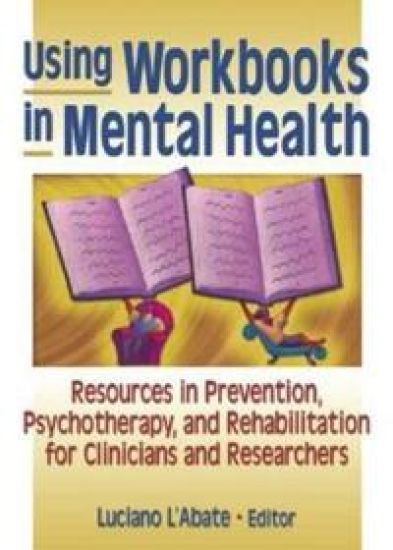
Using Workbooks in Mental Health

Using Workbooks in Mental Health

Luciano L'Abate

Routledge Member of the Taylor and Francis Group
2004
sidottu
The use of workbooks in therapy might represent one of the biggest breakthroughs that has occurred in decades. Using Workbooks in Mental Health: Resources in Prevention, Psychotherapy, and Rehabilitation for Clinicians and Researchers examines the effectiveness of mental health workbooks designed to address problems ranging from dementia and depression to addiction, spousal abuse, eating disorders, and more. Compiled by Dr. Luciano L’Abate, a leading authority on mental health workbooks, this resource will help clinicians and researchers become aware of the supportive evidence for the use of workbooks. Using Workbooks in Mental Health examines workbooks designed to specifically help: clients affected by dementia or depression abused women gambling addicts women who have substance-abuse addictions incarcerated felons couples preparing for marriage children with school refusal disorder and more! An essential reference for mental health professionals, graduate students, administrators, and researchers, Using Workbooks in Mental Health also explores the role of workbooks in psychological intervention over the past decade. Although workbooks are not yet part of the mainstream of psychological intervention, they are growing in popularity as their many advantages are recognized. They are easy to use by almost any client, they are cost-effective to both therapist and client in terms of money and time, they provide therapists with written assignments to use as homework for individuals, couples, and families, and they can be used in any setting, especially in computer-assisted offline or online interventions. In addition, this book shows how workbooks can be used to administer therapy to previously unreachable clients such as: people who are reluctant to talk to an authoritative figure or a stranger people who cannot afford face-to-face treatments incarcerated offenders who have not been helped by talk therapies Internet users who are searching for help via computer rather than in person
Using Workbooks in Mental Health

Using Workbooks in Mental Health

Luciano L'Abate

Routledge Member of the Taylor and Francis Group
2004
nidottu
The use of workbooks in therapy might represent one of the biggest breakthroughs that has occurred in decades. Using Workbooks in Mental Health: Resources in Prevention, Psychotherapy, and Rehabilitation for Clinicians and Researchers examines the effectiveness of mental health workbooks designed to address problems ranging from dementia and depression to addiction, spousal abuse, eating disorders, and more. Compiled by Dr. Luciano L’Abate, a leading authority on mental health workbooks, this resource will help clinicians and researchers become aware of the supportive evidence for the use of workbooks. Using Workbooks in Mental Health examines workbooks designed to specifically help: clients affected by dementia or depression abused women gambling addicts women who have substance-abuse addictions incarcerated felons couples preparing for marriage children with school refusal disorder and more! An essential reference for mental health professionals, graduate students, administrators, and researchers, Using Workbooks in Mental Health also explores the role of workbooks in psychological intervention over the past decade. Although workbooks are not yet part of the mainstream of psychological intervention, they are growing in popularity as their many advantages are recognized. They are easy to use by almost any client, they are cost-effective to both therapist and client in terms of money and time, they provide therapists with written assignments to use as homework for individuals, couples, and families, and they can be used in any setting, especially in computer-assisted offline or online interventions. In addition, this book shows how workbooks can be used to administer therapy to previously unreachable clients such as: people who are reluctant to talk to an authoritative figure or a stranger people who cannot afford face-to-face treatments incarcerated offenders who have not been helped by talk therapies Internet users who are searching for help via computer rather than in person
A Guide to Self-Help Workbooks for Mental Health Clinicians and Researchers

A Guide to Self-Help Workbooks for Mental Health Clinicians and Researchers

Luciano L'Abate

Routledge Member of the Taylor and Francis Group
2004
sidottu
Never has the need for a compendium of self-help workbooks been so great! From the founder of the world’s first PhD program in Family Psychology comes an extensive guide to nearly all of the mental health workbooks published through 2002. Placed together in one volume for the first time, A Guide to Self-Help Workbooks for Mental Health Clinicians and Researchers includes reviews and evaluates the complexity of each workbook in regards to its form, content, and usability by the client. From abuse to women’s issues, this annotated bibliography is alphabetized by author, but can also be researched by subject. While self-help workbooks are currently not as popular or as mainstream as self-help books and video, that could soon change. Self-help workbooks are versatile, cost-effective, and can be mass-produced. The workbook user is active rather than passive, and the mental healthcare worker can analyze a more personal response from the user, whether in the office or via the Internet. A Guide to Self-Help Workbooks for Mental Health Clinicians and Researchers brings these workbooks together into one sourcebook to suit anyone’s needs. Each self-help workbook is reviewed according to specific criteria: contents structure specificity goal level of abstraction a subjective evaluation usually concludes the review of the workbook A Guide to Self-Help Workbooks for Mental Health Clinicians and Researchers also includes: an in-depth introduction discussing the need for workbooks in mental health practices indices for subject as well as author an address list of the publishing houses for the workbooks annotated in the bibliography an Informed Consent Form to verify compliance with ethical and professional regulations before administering a workbook to a clientA Guide to Self-Help Workbooks for Mental Health Clinicians and Researchers offers you a complete resource to self-help workbooks for all mental health subjects. Dr. L’Abate’s highly selective review process helps you find exactly what you need. This unique sourcebook is vital for mental health clinicians, counselors, schoolteachers, and college and graduate students.
A Guide to Self-Help Workbooks for Mental Health Clinicians and Researchers

A Guide to Self-Help Workbooks for Mental Health Clinicians and Researchers

Luciano L'Abate

Routledge Member of the Taylor and Francis Group
2004
nidottu
Never has the need for a compendium of self-help workbooks been so great! From the founder of the world’s first PhD program in Family Psychology comes an extensive guide to nearly all of the mental health workbooks published through 2002. Placed together in one volume for the first time, A Guide to Self-Help Workbooks for Mental Health Clinicians and Researchers includes reviews and evaluates the complexity of each workbook in regards to its form, content, and usability by the client. From abuse to women’s issues, this annotated bibliography is alphabetized by author, but can also be researched by subject. While self-help workbooks are currently not as popular or as mainstream as self-help books and video, that could soon change. Self-help workbooks are versatile, cost-effective, and can be mass-produced. The workbook user is active rather than passive, and the mental healthcare worker can analyze a more personal response from the user, whether in the office or via the Internet. A Guide to Self-Help Workbooks for Mental Health Clinicians and Researchers brings these workbooks together into one sourcebook to suit anyone’s needs. Each self-help workbook is reviewed according to specific criteria: contents structure specificity goal level of abstraction a subjective evaluation usually concludes the review of the workbook A Guide to Self-Help Workbooks for Mental Health Clinicians and Researchers also includes: an in-depth introduction discussing the need for workbooks in mental health practices indices for subject as well as author an address list of the publishing houses for the workbooks annotated in the bibliography an Informed Consent Form to verify compliance with ethical and professional regulations before administering a workbook to a clientA Guide to Self-Help Workbooks for Mental Health Clinicians and Researchers offers you a complete resource to self-help workbooks for all mental health subjects. Dr. L’Abate’s highly selective review process helps you find exactly what you need. This unique sourcebook is vital for mental health clinicians, counselors, schoolteachers, and college and graduate students.
Beyond Psychotherapy

Beyond Psychotherapy

Luciano L'Abate

Praeger Publishers Inc
2001
sidottu
The field of psychotherapy is beset by a variety of problems including relative ineffectiveness, relatively high cost, and low availability. Hence, a more cost-effective, efficient and mass-producible method is needed that the current talk-based approach lacks. This volume explains that programmed distance writing - workbooks - can fill that need. Workbooks are inexpensive, specific, controllable, verifiable, and can be transmitted via the Internet to be used in clinical treatment, prevention, rehabilitation and research, all at a cost saving over talk therapy. The rationale behind workbooks for children, adolescents, adults, couples, and families is explained. Professionals in the fields of psychology, psychiatry, counseling, and social work will find this approach intriguing, as will academics and researchers seeking economic ways to link theory with practice. This volume will also interest graduate students studying alternative methods of behavioral intervention.
Distance Writing and Computer-Assisted Interventions in Psychiatry and Mental Health
Directed to mental health professionals and graduate students in the mental health disciplines, we present a new way to augment the cost-effectiveness of current face-to-face (f2f) mental health based on talk, and, offer an alternative in primary, secondary, and tertiary prevention approaches. Distance writing (DW) and computer-assisted interventions (CAI) through the Internet opens up new vistas to those unable to be reached using traditional talk-based f2f approaches, i.e., living abroad, handicapped, the military, missionary families, Peace Corps volunteers, English speaking respondents (individuals, couples, and families), and most importantly incarcerated prisoners who do not seem to improve through conventional verbal, f2f approaches. DW and CAI vary in their structure (from high to low) and in levels of goals, content, specificity, and abstraction. Positive research evidence finds that DW and CAI is effective and actually cost-effective, with relatively healthy undergraduates, psychiatric outpatients, incarcerated felons, and physically handicapped patients supporting the use of this relatively new approach. This evolutionary step or paradigmatic shift cannot take place overnight, professionals suspicious of this new technology, will find this work a way to assuage their fears and help start this new cure on an experiential basis, utilizing structured interviews before starting to use writing and CAI at a distance. It presents an ample field of applications that will make research more cost-effective than traditional talk-based, f2f approaches. DW/CAI represents one way in which MH professionals can progress to meet managed care companies demands for accountability. Progress in most realms of business, science, education, law is based on the written record. The talking cure has occupied the last century as one of the greatest advances in how to help distressed people. By the same token, the writing cure represents the breakthrough for this coming century. Up to the present talk was conceived as the main if not the only vehicle of communication and healing. Adding DW/CAI to preventive and therapeutic armamentaria represents a distinct advance in how MH services will be delivered, to be accountable for professionals, and to conduct research economically, i. e., doing well while doing good. This work, therefore, combines theory, research, and practice to demonstrate the many advantages that DW/CAI offers as either an alternative, substitute, or supplement for talk therapy. Cyberspace is coming, instead of seeing it as a threat to traditional talk-based f2f practices, MH professionals will have to start to see the advantages of working with patients, clients, subjects, or respondents at a distance. Ethical and professional issues will present themselves in this new way, and should not detract professionals from starting this relatively new way to intervene, and to ensure that this new way to practice is delivered compassionately, responsibly, and effectively.
The Self in the Family

The Self in the Family

Luciano L'Abate

John Wiley Sons Inc
1997
sidottu
In his acclaimed book A Theory of Personality Development, Luciano L'Abate introduced a revolutionary theory of personality development and functioning that departed radically from traditional theories. In place of hypothetical traits existing in an empirical vacuum, Dr. L'Abate offered an image of observable interpersonal competencies functioning within the basic contexts of home, work, leisure, and the marketplace. Central to his theory was a developmental model that posited the family as the primordial setting in which propensities are formed and behavior patterns set. By defining personality in terms of the growth and interplay of interpersonal competencies, the L'Abate theory provided an epistemologically and empirically sound basis for understanding personality function and dysfunction as corollaries and extensions of one another. In The Self in the Family, Luciano L'Abate and Margaret Baggett again break new ground by expanding the L'Abate theory of personality development to encompass criminal and psychopathological behavior. Drawing upon mounting empirical evidence that the family paradigm is the major determinant of personality socialization throughout the life span, the authors develop a selfhood model with demonstrable links between the three domains of personality function, criminality, and psychopathology. With the help of the model, they show how it is now possible to arrive at a personality-based interpretation of most deviant behaviors, including criminality, psychopathology, addictions, and even psychosomatic illnesses, and they describe various preventive and psychotherapeutic applications for this expanded theory of family-based personality development. The authors further elaborate on the theories developed in Dr. L'Abate's previous books by introducing the core concepts of hurt—the basic feeling underlying much of personality functioning and dysfunctioning—and a continuum of likeness—the fundamental determinant of interpersonal choices and behavior in friendships, parent-child relations, and marital relations. Offering an empirically rigorous, developmentally based, unified field theory of personality function, criminality, and psychopathology, The Self in the Family is essential reading for developmental and clinical psychologists, family therapists, personality theorists, and criminality and psychopathology researchers. CHILD-CENTERED FAMILY THERAPY Lucille L. Andreozzi This book is the first complete introduction to the Child-Centered Structural Dynamic Therapy Model—a revolutionary, short-term treatment model which helps integrate child and family system development into a comprehensive framework for self-guided, family-initiated change. This guide, with its numerous case illustrations, works to build knowledge from within the family by engaging family members in structured activities that help them translate family system principles into practical, everyday reality. Child-Centered Family Therapy is an important resource for couples and family therapists, child psychologists, counselors, and social workers. 1996 (0-471-14858-X) 374 pp. TREATING THE CHANGING FAMILY Handling Normative and Unusual Events Edited by Michele Harway This inimitable book offers a broad-ranging, carefully integrated review of contemporary trends in family therapy, research, and practice. It reexamines the family and the many challenges to its function and provides practical advice for therapists who treat troubled families. It explores the impact that non-normative events such as violence and abuse, addiction, long-term and chronic illness, divorce, adoption, trauma, and many others can have on family function and provides proven intervention strategies and techniques for treating these families. With the special attention given to the structure, dynamics, and unique problems of families that do not fit the traditional mold, such as binuclear, single-parent, and gay and lesbian families, Treating the Changing Family is a valuable resource for all mental health professionals and families. 1995 (0-471-07905-7) 374 pp. Also in the Series: HANDBOOK OF RELATIONAL DIAGNOSIS AND DYSFUNCTIONAL FAMILY PATTERNS Florence W. Kaslow, Editor 1996 (0-471-08078-0) 592 pp.
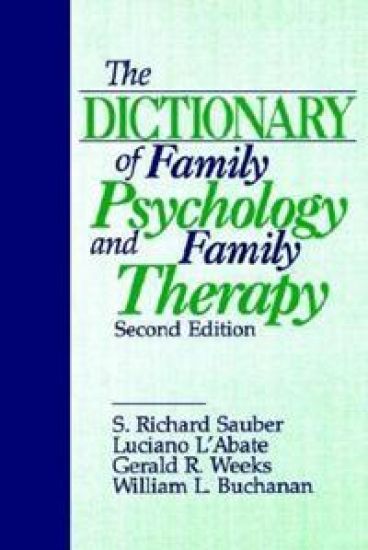
The Dictionary of Family Psychology and Family Therapy

The Dictionary of Family Psychology and Family Therapy

S . Richard Sauber; Luciano L'Abate; Gerald R. Weeks; William L. Buchanan

SAGE Publications Inc
1993
nidottu
As the field of the family has expanded, so has the need for an up-to-date volume that pulls together and defines major salient words, phrases, and concepts. This second edition of The Dictionary of Family Psychology and Family Therapy provides an expanded, handy reference for all family professionals--theoreticians, students, researchers, or clinicians. There is no other source like it. Each entry includes a definition of the term, an example relevant to its usage, the origin of the term, an early source using the term, and if pertinent, a recent source. "Borrowed" terms from other such fields as family law, sex therapy, clinical child psychology, and group psychology are also included. The Dictionary of Family Psychology and Family Therapy is an essential resource intended for use by students, faculty, family psychologists, family therapists, and others engaged in the family field. "The authors have succeeded in defining clearly and accessibly the major theoretical, and methodological concepts in the field of family studies, including operational definitions where appropriate." --Clinical Psychology Forum "This wonderful book actually is a dictionary, defining family psychology concepts and terms from A ('abortive runaway') to Z ('zero-sum game'). . . . Anyone who reads professional material in this field would find this dictionary invaluable. . . . The concise format will allow the reader to stay informed. . . . The application of concepts in examples and the provision of references are invaluable. This book also does a good job of representing, in an unbiased way, different theories or schools of thought. I would recommend The Dictionary of Family Psychology and Family Therapy as a reference for any professional in the family field and see it as a great supplemental text for a graduate course or student." --Family Relations "This is a timely book, and it should be on the library shelves of professionals who deal with people in the areas of clinical practice, research, and education. It should stand alongside textbooks and other dictionaries. It should be read and used as reference and source material. It complements our understandings of human behavior and interactions, particularly the interpersonal and intergroup inevitabilities in families as representing core societies. Workers with families in terms of the psychology and the therapy of such fundamental organizations of genetically and other related people will find in this volume a most valuable asset in furthering their understandings and enhancing their effectiveness as therapists." --Jess V. Cohn, M. D., Emeritus Professor of Psychiatry, University of Miami Medical School, in The American Journal of Family Therapy
Family Psychology II

Family Psychology II

Luciano L'Abate

University Press of America
1987
nidottu
This second collection of writings covers the main topics that define the newly created specialty of family psychology. Family therapy is limited to a single approach devoted to the treatment of families in trouble; family psychology encompasses the entire range of family functioning, from optimal to pathological.
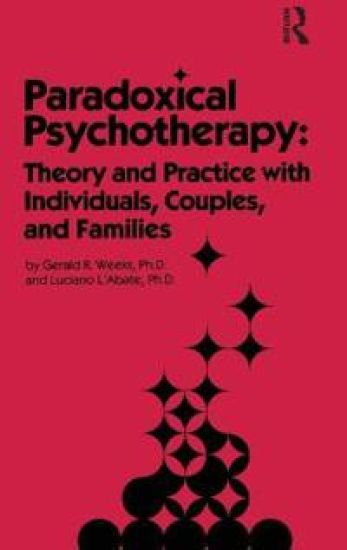
Paradoxical Psychotherapy

Paradoxical Psychotherapy

Gerald R. Weeks; Luciano L'Abate

Brunner-Mazel Inc
1982
sidottu
First published in 1982. Paradoxical psychotherapy has rapidly become one of the most· important approaches to family therapy and psychotherapy during the past few years. The aim of this book is to present an overview of paradoxical therapy. Paradoxical Psychotherapy: Theory and Practice with Individuals, Couples, and Families Is designed for all clinical psychologists. Applications are offered for the individual, marital, and family therapist.