Kirjailija
Lucretius
Kirjat ja teokset yhdessä paikassa: 38 kirjaa, julkaisuja vuosilta 1924–2021, suosituimpiin kuuluu Traduction Libre de Lucrèce [Par C.-J. Panckoucke], Avec Un Discours Préliminaire (Éd.1768). Vertaile teosten hintoja ja tarkista saatavuus suomalaisista kirjakaupoista.
38 kirjaa
Kirjojen julkaisuvuodet: 1924–2021.
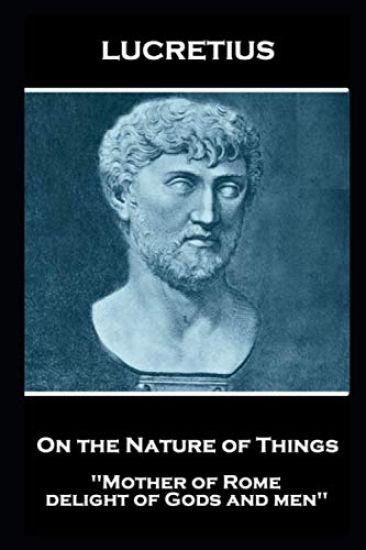
Lucretius - On the Nature of Things: "Mother of Rome, delight of Gods and men''
Lucretius
Portable Poetry
2020
nidottu
The Roman poet and philosopher Titus Lucretius Carus better known as Lucretius was born in approximately 99 BCE. Much of the events in his life are unknown. What is known is that is is the author of one of the great classics of poetry. The epic didactic poem in hexameters, On the Nature of Things (De Rerum Natura). Within its six books Lucretius makes a bold sweep through the scientific theories of the Greek philosopher Epicurus in poetic form to give man a firm base from which to attain a peace and stability from all of the competing elements in society, life and the heavens. The poem was a significant influence on the Latin Augustan poets, particularly Virgil (in his Aeneid and Georgics) and Horace. With the fall of the Empire the work disappeared. It was only in 1417 that a copy was re-discovered in a monastery in Germany and it once more became an important influence, this time in the Enlightenment era. In its scope and breadth it achieves much, both as a purveyor of scientific principles but also as a majestic poetry classic.
On the Nature of Things by Roman philosopher and poet Lucretius outlines classical theories of physics and the natural world. Drawing on the atomism theory of Democritus, which dates over 400 years prior to his masterwork, Lucretius aim with his poem is to explain various theories on why the world is as it is. Designed to be read publicly by educators and by solitary readers, the wide ranging and lengthy poem examines the nature of existence, of sensation, of human consciousness, and of the celestial bodies above us. Conversations on matter, space and reality were unusual in ancient times, with many ordinary citizens encouraged to lay the responsibility for such with the Roman Gods. In writing this poem, Lucretius aimed to popularise the theories and explanations of individual physicists and thinkers, over those of the temple priests. Lucretius himself held logic and reason in high regard, championing the philosophers who sought to discover and refine their view of the world.
On the Nature of Things (De Rerum Natura) (Hardcover)
Lucretius; William Ellory Leonard
Lulu.com
2018
sidottu
On the Nature of Things by Roman philosopher and poet Lucretius outlines classical theories of physics and the natural world. Drawing on the atomism theory of Democritus, which dates over 400 years prior to his masterwork, Lucretius aim with his poem is to explain various theories on why the world is as it is. Designed to be read publicly by educators and by solitary readers, the wide ranging and lengthy poem examines the nature of existence, of sensation, of human consciousness, and of the celestial bodies above us. Conversations on matter, space and reality were unusual in ancient times, with many ordinary citizens encouraged to lay the responsibility for such with the Roman Gods. In writing this poem, Lucretius aimed to popularise the theories and explanations of individual physicists and thinkers, over those of the temple priests. Lucretius himself held logic and reason in high regard, championing the philosophers who sought to discover and refine their view of the world.
Traduction Libre de Lucrèce, Avec Un Discours Préliminaire
Lucretius
Hachette Livre - BNF
2017
pokkari
The First and Second Books of Lucretius - Translated is an unchanged, high-quality reprint of the original edition of 1879. Hansebooks is editor of the literature on different topic areas such as research and science, travel and expeditions, cooking and nutrition, medicine, and other genres. As a publisher we focus on the preservation of historical literature. Many works of historical writers and scientists are available today as antiques only. Hansebooks newly publishes these books and contributes to the preservation of literature which has become rare and historical knowledge for the future.
de Rerum Natura: Latin Text
Lucretius
Createspace Independent Publishing Platform
2016
nidottu
Halvin toimitettuna 16,40 €
Selections from Lucretius, being a golden treasury of his poem 'De rerum Natura'
Lucretius
Createspace Independent Publishing Platform
2016
nidottu
On the Nature of Things (Translated by William Ellery Leonard with an Introduction by Cyril Bailey)
Lucretius
Digireads.com
2015
nidottu
One of a major new Classics series - books that have changed the history of thought, in sumptuous, clothbound hardbacks. Lucretius' poem On the Nature of Things combines a scientific and philosophical treatise with some of the greatest poetry ever written. With intense moral fervour he demonstrates to humanity that in death there is nothing to fear since the soul is mortal, and the world and everything in it is governed by the mechanical laws of nature and not by gods; and that by believing this men can live in peace of mind and happiness. He bases this on the atomic theory expounded by the Greek philosopher Epicurus, and continues with an examination of sensation, sex, cosmology, meteorology, and geology, all of these subjects made more attractive by the poetry with which he illustrates them.
The third book of Lucretius' great poem on the workings of the universe is devoted entirely to expounding the implications of Epicurus' dictum that death does not matter, 'is nothing to us'. The soul is not immortal: it no more exists after the dissolution of the body than it had done before its birth. Only if this fact is accepted can men rid themselves of irrational fears and achieve the state of ataraxia, freedom from mental disturbance, on which the Epicurean definition of pleasure was based. To present this case Lucretius deploys the full range of poetic and rhetorical registers, soberly prohibitive, artfully decorative or passionately emotive as best suits his argument, reinforcing it with vivid and compelling imagery. This new edition has been completely revised, with a considerably enlarged Commentary and a new supplementary introduction taking account of the great amount of new scholarship of the last forty years.
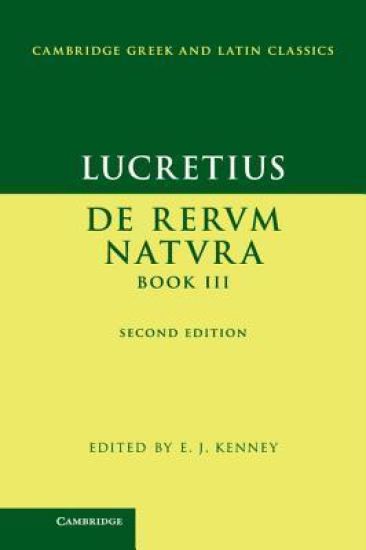
The third book of Lucretius' great poem on the workings of the universe is devoted entirely to expounding the implications of Epicurus' dictum that death does not matter, 'is nothing to us'. The soul is not immortal: it no more exists after the dissolution of the body than it had done before its birth. Only if this fact is accepted can men rid themselves of irrational fears and achieve the state of ataraxia, freedom from mental disturbance, on which the Epicurean definition of pleasure was based. To present this case Lucretius deploys the full range of poetic and rhetorical registers, soberly prohibitive, artfully decorative or passionately emotive as best suits his argument, reinforcing it with vivid and compelling imagery. This new edition has been completely revised, with a considerably enlarged Commentary and a new supplementary introduction taking account of the great amount of new scholarship of the last forty years.
Lucretius On The Nature Of Things is a philosophical treatise written by the Roman poet and philosopher, Lucretius. The book explores the principles of Epicurean philosophy, which emphasizes the pursuit of pleasure and the avoidance of pain as the ultimate goal of human life. Lucretius argues that the universe is made up of atoms and void, and that everything in existence can be explained by the interactions of these fundamental particles. He also discusses the nature of the soul, the role of religion in society, and the importance of living a virtuous life. The book is written in poetic form and is considered a masterpiece of ancient literature. It has had a significant influence on the development of modern science and philosophy, and continues to be studied and debated by scholars today. This is a new release of the original 1926 edition. This scarce antiquarian book is a facsimile reprint of the old original and may contain some imperfections such as library marks and notations. Because we believe this work is culturally important, we have made it available as part of our commitment for protecting, preserving, and promoting the world's literature in affordable, high quality, modern editions, that are true to their original work.
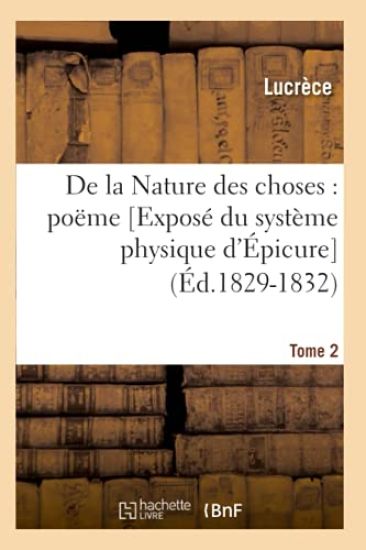
de la Nature Des Choses: Poëme. [Exposé Du Système Physique d'Épicure]. Tome 2 (Éd.1829-1832)
Lucretius
Hachette Livre - BNF
2012
pokkari
de la Nature Des Choses: Poëme. [Exposé Du Système Physique d'Épicure]. Tome 1 (Éd.1829-1832)
Lucretius
Hachette Livre - BNF
2012
pokkari
Traduction Libre de Lucrèce [Par C.-J. Panckoucke], Avec Un Discours Préliminaire (Éd.1768)
Lucretius
Hachette Livre - BNF
2012
pokkari