Kirjojen hintavertailu – 12 903 724 kirjaa ja 27 kauppaa

Kirjailija

Luke Glanville

Kirjat ja teokset yhdessä paikassa: 4 kirjaa, julkaisuja vuosilta 2013–2024, suosituimpiin kuuluu Prioritizing Global Responsibilities. Vertaile teosten hintoja ja tarkista saatavuus suomalaisista kirjakaupoista.

4 kirjaa

Kirjojen julkaisuvuodet: 2013–2024.

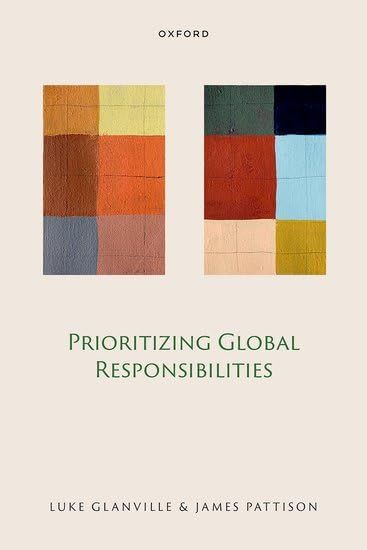
Prioritizing Global Responsibilities

Prioritizing Global Responsibilities

Luke Glanville; James Pattison

Oxford University Press
2024
sidottu
States face multiple ongoing and emerging challenges, from climate change to global disease, mass atrocities to forced displacement, humanitarian crises to entrenched global poverty, and are constrained by material and political limits to the amount of resources that they can devote to these issues. How should states decide which issues to prioritize and which crises to address? Prioritizing Global Responsibilities answers this question by proposing a two-level account of just prioritization that aims to be both philosophically sound and practically relevant. The authors assess several potential prioritization principles, including diversification, culpability, urgency, disadvantage, and national interest, and argue that states should prioritize issues where they can assist most effectively and where they can help those who are most underprivileged.

Sharing Responsibility

Sharing Responsibility

Luke Glanville

PRINCETON UNIVERSITY PRESS
2021
sidottu
A look at the duty of nations to protect human rights beyond borders, why it has failed in practice, and what can be done about itThe idea that states share a responsibility to shield people everywhere from atrocities is presently under threat. Despite some early twenty-first century successes, including the 2005 United Nations endorsement of the Responsibility to Protect, the project has been placed into jeopardy due to catastrophes in such places as Syria, Myanmar, and Yemen; resurgent nationalism; and growing global antagonism. In Sharing Responsibility, Luke Glanville seeks to diagnose the current crisis in international protection by exploring its long and troubled history. With attention to ethics, law, and politics, he measures what possibilities remain for protecting people wherever they reside from atrocities, despite formidable challenges in the international arena. With a focus on Western natural law and the European society of states, Glanville shows that the history of the shared responsibility to protect is marked by courageous efforts, as well as troubling ties to Western imperialism, evasion, and abuse. The project of safeguarding vulnerable populations can undoubtedly devolve into blame shifting and hypocrisy, but can also spark effective burden sharing among nations. Glanville considers how states should support this responsibility, whether it can be coherently codified in law, the extent to which states have embraced their responsibilities, and what might lead them to do so more reliably in the future. Sharing Responsibility wrestles with how countries should care for imperiled people and how the ideal of the responsibility to protect might inspire just behavior in an imperfect and troubled world.
Refuge Reimagined – Biblical Kinship in Global Politics

Refuge Reimagined – Biblical Kinship in Global Politics

Mark R. Glanville; Luke Glanville; Matthew Soerens

IVP Academic
2021
nidottu
The global crisis of forced displacement is growing every year. At the same time, Western Christians' sympathy toward refugees is increasingly overshadowed by concerns about personal and national security, economics, and culture. We urgently need a perspective that understands both Scripture and current political realities and that can be applied at the levels of the church, the nation, and the globe. In Refuge Reimagined, Mark R. Glanville and Luke Glanville offer a new approach to compassion for displaced people: a biblical ethic of kinship. God's people, they argue, are consistently called to extend kinship—a mutual responsibility and solidarity—to those who are marginalized and without a home. Drawing on their respective expertise in Old Testament studies and international relations, the two brothers engage a range of disciplines to demonstrate how this ethic is consistently conveyed throughout the Bible and can be practically embodied today. Glanville and Glanville apply the kinship ethic to issues such as the current mission of the church, national identity and sovereignty, and possibilities for a cooperative global response to the refugee crisis. Challenging the fear-based ethic that often motivates Christian approaches, they envision a more generous, creative, and hopeful way forward. Refuge Reimagined will equip students, activists, and anyone interested in refugee issues to understand the biblical model for communities and how it can transform our world.
Sovereignty and the Responsibility to Protect

Sovereignty and the Responsibility to Protect

Luke Glanville

University of Chicago Press
2013
nidottu
In 2011, the United Nations Security Council adopted Resolution 1973, authorizing its member states to take measures to protect Libyan civilians from Muammar Gadhafi's forces. In invoking the "responsibility to protect," the resolution draws on the principle that sovereign states are responsible and accountable to the international community for the protection of their populations and specifies that the international community can act to protect populations when national authorities fail to do so. The idea that sovereignty includes the responsibility to protect is often seen as a departure from the classic definition, but it actually has deep historical roots. In Sovereignty and the Responsibility to Protect, Luke Glanville argues that this responsibility extends back to the sixteenth and seventeenth centuries, and that states have since been accountable to God, the people, and the international community. Over time, the right to national self-governance came to take priority over the protection of individual liberties, but the noninterventionist understanding of sovereignty was only firmly established in the twentieth century, and it remained for only a few decades before it was challenged by renewed claims that sovereigns are responsible for protection. Glanville traces the relationship between sovereignty and responsibility from the early modern period to the present day, and offers a new history with profound implications for the present.