

Kirjojen hintavertailu – 12 903 725 kirjaa ja 27 kauppaa

Kirjailija

M. Eigen

Kirjat ja teokset yhdessä paikassa: 2 kirjaa, julkaisuja vuosilta 1979–2011, suosituimpiin kuuluu Physical Approaches to Biological Evolution. Vertaile teosten hintoja ja tarkista saatavuus suomalaisista kirjakaupoista.

2 kirjaa

Kirjojen julkaisuvuodet: 1979–2011.

Physical Approaches to Biological Evolution

Physical Approaches to Biological Evolution

Mikhail V. Volkenstein; M. Eigen

Springer-Verlag Berlin and Heidelberg GmbH Co. K
2011
nidottu
"Mr. Wolkenstein's Physical Approaches to Biological Evolution, whether or not it proves to give the ultimate truth on the matters with which it deals, certainly deserves, by its breadth and scope and profundity, to be considered an impor­ tant event in the philosophical world." This is a quotation from an introduction written by Bertrand Russell for Ludwig Wittgenstein's Tractatus Logico-Philosophicus. I exchanged only name and subject. As for the rest, I could continue quoting Russell, but I would rather say something myself. As Wittgenstein did with formal logic, Wolkenstein rectifies our views on how to approach the logic of life from a formal theoretical basis. Many bio­ logists do not believe that their subject lends itself to the scrutiny of physical theory. They certainly admit that one can simulate biological phenomena by models that can be expressed in a mathematical form. However, they do not believe that biology can be given a theoretical foundation that is defined within the general framework of physics. Rather, they insist on a holistic approach, banning any reduction to fundamental principles subject to physical theory.
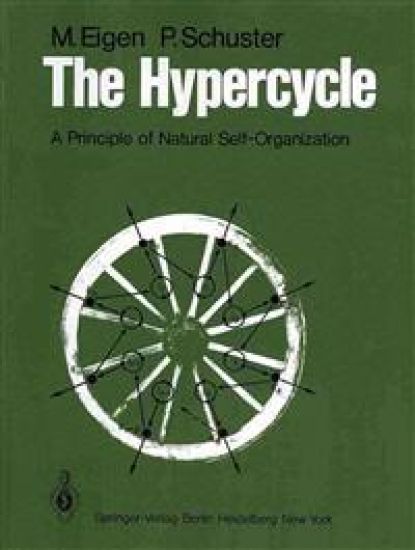
The Hypercycle

The Hypercycle

M. Eigen; Peter Schuster

Springer-Verlag Berlin and Heidelberg GmbH Co. K
1979
nidottu
This book originated from a series of papers which were published in "Die Naturwissenschaften" in 1977178. Its division into three parts is the reflection of a logic structure, which may be abstracted in the form of three theses: A. Hypercycles are a principle of natural selforganization allowing an inte­ gration and coherent evolution of a set of functionally coupled self-rep­ licative entities. B. Hypercycles are a novel class of nonlinear reaction networks with unique properties, amenable to a unified mathematical treatment. C. Hypercycles are able to originate in the mutant distribution of a single Darwinian quasi-species through stabilization of its diverging mutant genes. Once nucleated hypercycles evolve to higher complexity by a process analogous to gene duplication and specialization. In order to outline the meaning of the first statement we may refer to another principle of material selforganization, namely to Darwin's principle of natural selection. This principle as we see it today represents the only understood means for creating information, be it the blue print for a complex living organism which evolved from less complex ancestral forms, or be it a meaningful sequence of letters the selection of which can be simulated by evolutionary model games.