Kirjojen hintavertailu – 12 859 829 kirjaa ja 27 kauppaa

Kirjailija

M.S. Sriram

Kirjat ja teokset yhdessä paikassa: 8 kirjaa, julkaisuja vuosilta 2002–2026, suosituimpiin kuuluu Ganita-Yukti-Bha?a (Rationales in Mathematical Astronomy) of Jye??hadeva. Vertaile teosten hintoja ja tarkista saatavuus suomalaisista kirjakaupoista.

Nimi esiintyy myös muodoissa: M. S. Sriram, M S Sriram

8 kirjaa

Kirjojen julkaisuvuodet: 2002–2026.

Ganita-Yukti-Bha?a (Rationales in Mathematical Astronomy) of Jye??hadeva

Ganita-Yukti-Bha?a (Rationales in Mathematical Astronomy) of Jye??hadeva

K.V. Sarma; K. Ramasubramanian; M. D. Srinivas; M. S. Sriram

Springer London Ltd
2009
sidottu
Ganita-yukti-bhasa (Rationales in Mathematical Astronomy) of Jyesthadeva (c.1530) is a seminal text of the Kerala school of astronomy. It is composed in the Malayalam language and presents detailed yuktis or explanations and demonstrations for the results and processes of mathematical astronomy. The text, comprising fifteen chapters, is naturally divided into two parts, mathematics and astronomy, and purports to give an exposition of the techniques and theories employed in the computation of planetary motions as set forth in the great treatise Tantrasangraha (c.1500) of Nilakantha Somayaji. Even though the importance of Ganita-yukti-bhasa was brought to the attention of modern scholarship by C. M Whish in the 1830s, a critical edition of the entire Malayalam text is published here for the first time along with an English translation and detailed explanatory notes.
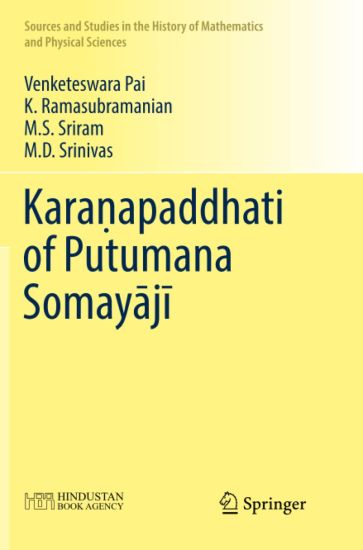
Kara?apaddhati of Putumana Somayaji

Kara?apaddhati of Putumana Somayaji

Venketeswara Pai; K. Ramasubramanian; M.S. Sriram; M.D. Srinivas

Springer Verlag, Singapore
2018
nidottu
This book is an important text of the Kerala school of astronomy and mathematics, probably composed in the 16th century. In the Indian astronomical tradition, the kara?a texts are essentially computational manuals, and they often display a high level of ingenuity in coming up with simplified algorithms for computing planetary longitudes and other related quantities. Kara?apaddhati, however, is not a kara?a text. Rather, it discusses the paddhati or the rationale for arriving at suitable algorithms that are needed while preparing a kara?a text for a given epoch. Thus the work is addressed not to the almanac maker but to the manual maker. Kara?apaddhati presents the theoretical basis for the vakya system, where the true longitudes of the planet are calculated directly by making use of certain auxiliary notions such as the kha??a, ma??ala and dhruva along with tabulated values of changes in the true longitude over certain regular intervals which are expressed in the form of vakyas or mnemonic phrases. The text also discusses the method of vallyupasa?hara, which is essentially a technique of continued fraction expansion for obtaining optimal approximations to the rates of motion of planets and their anomalies, involving ratios of smaller numbers. It also presents a new fast convergent series for p which is not mentioned in the earlier works of the Kerala school. As this is a unique text presenting the rationale behind the vakya system and the computational procedures used in the kara?a texts, it would serve as a useful companion for all those interested in the history of astronomy. The authors have provided a translation of the text followed by detailed notes which explain all the computational procedures, along with their rationale, by means of diagrams and equations.
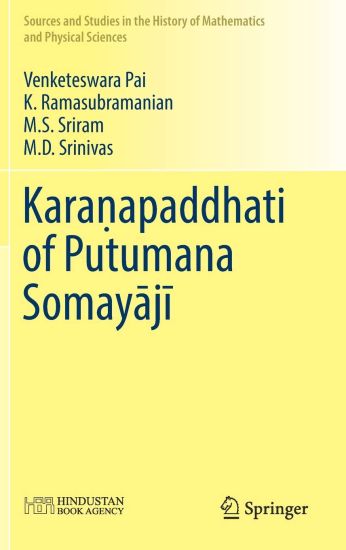
Kara?apaddhati of Putumana Somayaji

Kara?apaddhati of Putumana Somayaji

Venketeswara Pai; K. Ramasubramanian; M.S. Sriram; M.D. Srinivas

Springer Verlag, Singapore
2018
sidottu
This book is an important text of the Kerala school of astronomy and mathematics, probably composed in the 16th century. In the Indian astronomical tradition, the kara?a texts are essentially computational manuals, and they often display a high level of ingenuity in coming up with simplified algorithms for computing planetary longitudes and other related quantities. Kara?apaddhati, however, is not a kara?a text. Rather, it discusses the paddhati or the rationale for arriving at suitable algorithms that are needed while preparing a kara?a text for a given epoch. Thus the work is addressed not to the almanac maker but to the manual maker. Kara?apaddhati presents the theoretical basis for the vakya system, where the true longitudes of the planet are calculated directly by making use of certain auxiliary notions such as the kha??a, ma??ala and dhruva along with tabulated values of changes in the true longitude over certain regular intervals which are expressed in the form of vakyas or mnemonic phrases. The text also discusses the method of vallyupasa?hara, which is essentially a technique of continued fraction expansion for obtaining optimal approximations to the rates of motion of planets and their anomalies, involving ratios of smaller numbers. It also presents a new fast convergent series for p which is not mentioned in the earlier works of the Kerala school. As this is a unique text presenting the rationale behind the vakya system and the computational procedures used in the kara?a texts, it would serve as a useful companion for all those interested in the history of astronomy. The authors have provided a translation of the text followed by detailed notes which explain all the computational procedures, along with their rationale, by means of diagrams and equations.
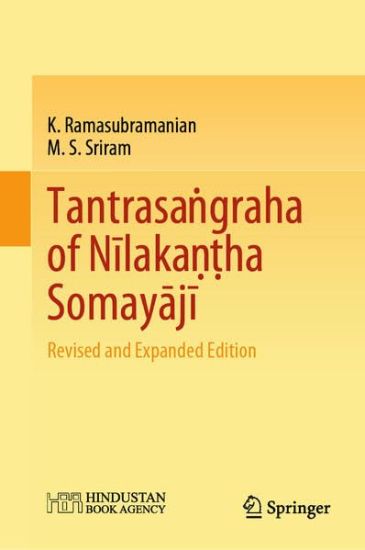
Tantrasa?graha of Nilaka??ha Somayaji

Tantrasa?graha of Nilaka??ha Somayaji

K. Ramasubramanian; M. S. Sriram

Springer London Ltd
2011
sidottu
Tantrasangraha, composed by the renowned Kerala astronomer Nilakantha Somayaji (c.1444-1545 AD) ranks along with Aryabhatiya of Aryabhata and Siddhantasiromani of Bhaskaracarya as one of the major works which significantly influenced further work on astronomy in India. One of the distinguishing features is the introduction of a major revision of the traditional Indian planetary model. Nilakantha arrived at a unified theory of planetary latitudes and a better formulation of the equation of centre for the interior planets (Mercury and Venus) than was previously available. In preparing the translation and explanatory notes, K. Ramasubramanian and M. S. Sriram have used authentic Sanskrit editions of Tantrasangraha by Surand Kunjan Pillai and K V Sarma. All verses have been translated into English, which have been supplemented with detailed explanations including all necessary mathematical relations, illustrative examples, figures and tables using modern mathematical notation.
Beyond Micro-Credit

Beyond Micro-Credit

Thomas Fisher; M S Sriram

Oxfam
2002
nidottu
Micro-finance is one of the fastest growing development strategies, in many ways it is already outgrowing development with several micro-finance institutions becoming banks. But it is becoming clear that the provision of credit for enterprise development is not on its own leading to development. Beyond Micro-Credit sets out how Indian Micro-Finance Initiatives are combining micro-finance with a wide range of development goals, these include not only poverty alleviation through providing savings, credit and insurance services but also promoting livelihoods, empowering women, building people's organizations and changing institutions. It illustrates each of these from actual microfinance practice and explores the organizational challenges of combining such development goals with financial service provision. It includes detailed analysis of "self-help groups"; comparisons with microfinance practice in Bangladesh and contemporary methods of assessing performance and impact.