Kirjojen hintavertailu – 12 859 827 kirjaa ja 27 kauppaa

Kirjailija

M. Schmid

Kirjat ja teokset yhdessä paikassa: 4 kirjaa, julkaisuja vuosilta 1996–2017, suosituimpiin kuuluu Architecture minoenne à Malia. Les bâtiments principaux du Quartier Mu (A,B,D,E) (Minoen Moyen II). Vertaile teosten hintoja ja tarkista saatavuus suomalaisista kirjakaupoista.

4 kirjaa

Kirjojen julkaisuvuodet: 1996–2017.

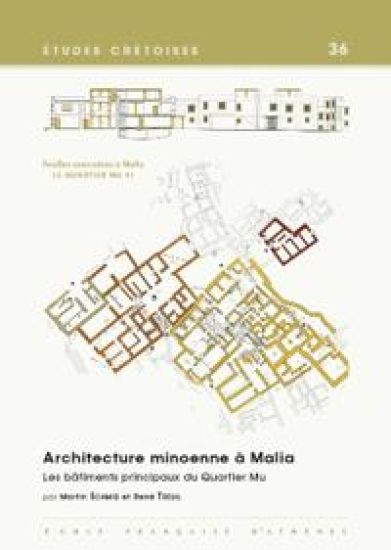
Architecture minoenne à Malia. Les bâtiments principaux du Quartier Mu (A,B,D,E) (Minoen Moyen II)
Une architecture d’exception de l'époque des premiers palais minoens: le Quartier Mu à Malia nous offre les vestiges d'un ensemble de bâtiments, indépendants tout en étant juxtaposés, qui ont été découverts dans un état de conservation remarquable, dû au violent incendie qui les a détruits. Les informations précieuses qu’ils révèlent et qui suscitent l'admiration apportent de nouvelles connaissances non seulement sur les matériaux employés et leur mise en oeuvre, sur la structure des éléments architecturaux les composant – murs, ouvertures, planchers, escaliers, colonnes et piliers, corniches, puits de lumière – mais encore sur la circulation, l'articulation et la fonction des pièces à l'intérieur de ces unités de construction. Les installations encore en place comme les plates-formes et banquettes ainsi que le mobilier recueilli participent à l'identification de la fonction de certains espaces, mais les pièces les plus importantes se distinguent moins par leur grande taille que par leur décoration – panneaux en creux, dispositif tripartite de colonnettes, décor de plinthes – qui témoigne du souci esthétique des constructeurs minoens et par là des habitants du quartier. L'étude architecturale nous a conduits à proposer une restitution relativement bien assurée des volumes des bâtiments à partir des plans, du sous-sol, du rez-de-chaussée et du 1er étage. En revanche la restitution des niveaux supérieurs, 2ème étage ou terrasses, reste plus hypothétique. Ce sixième et dernier volume de la publication du Quartier Mu, consacré à l'architecture, souligne l'importance de cet ensemble exceptionnel dans l'histoire de l'architecture minoenne, dans l'évolution de la ville de Malia et dans l'histoire minoenne dans son ensemble. Quartier Mu of Malia is an exceptional architectural ensemble of the time of the First Minoan Palaces. Excavations brought to light the remains of a group of adjacent but independent buildings, remarkably well preserved by the violent fire that caused their destruction. They provide precious information, often provoking admiration, not only about the materials and building techniques, or the arrangement of the various architectural components — walls, openings, floors, staircases, columns, pillars, cornices, light wells — but also about the layout, communication and function of the individual rooms inside these units. The remaining built structures, e.g. platforms or benches, and the mobile finds collected help to identify the function of some spaces. What seems to distinguish however the most important rooms is not so much their large dimensions but their internal decoration — imprinted lines in the stucco that form rectangular panels, three-columned partitions, mouldings. These elements attest to the aesthetic preoccupations of the Minoan builders as well as to those of the Quartier Mu inhabitants. Based on the results of their analysis, the authors propose to “translate” the two-dimensional building plans into a series of three-dimensional restitutions: those of the basement, the ground floor and the first floor are quite well ascertained, those of the upper levels (second floor, roofs) are more hypothetical. This sixth and last volume of the publication of Quartier Mu, dedicated to the architectural study, stresses the significance of this exceptional group of buildings in the history of Minoan architecture, the evolution of the town of Malia, and the Minoan history as a whole.
Les abords Nord-Est  du palais I. Les recherches et l'histoire du secteur

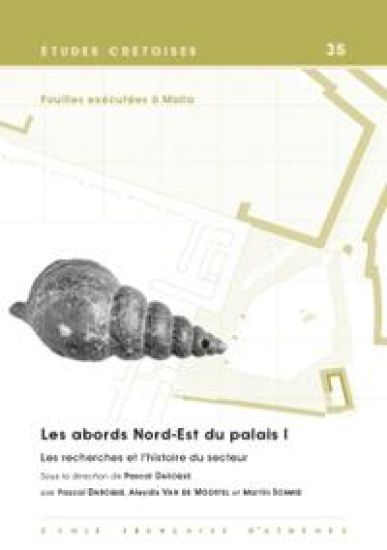
Les abords Nord-Est du palais I. Les recherches et l'histoire du secteur

P. Darcque; A. Van De Moortel; M. Schmid

Ecole francaise d'Athenes
2014
nidottu
Ce premier volume d'une série consacrée aux fouilles des abords Nord-Est du palais de Malia présente l'histoire des recherches dans le secteur, puis décrit, suivant l'ordre stratigraphique, chaque bâtiment, pièce ou espace, en fournissant un inventaire complet du mobilier, ainsi qu'une série de datations 14C. Les principaux acquis de ces recherches touchent non seulement l’histoire du palais de Malia, mais aussi l'évolution d’ensemble du site. D'une part, l'identification de maisons-ateliers de même date que celles du Quartier Mu (Minoen Moyen II) confirme l'homogénéité de l'habitat protopalatial. D'autre part, l'étude des vestiges architecturaux du Minoen Récent I révèle la monumentalité surprenante d'une entrée du palais considérée précédemment comme secondaire; les aménagements ultérieurs du secteur témoignent de l'emprise croissante du palais sur ses abords. Enfin, l'étude de la stratigraphie aux abords Nord-Est du palais permet de fonder une nouvelle chronologie de la céramique néopalatiale. This volume is the first in a series publishing the results of the excavations carried out in the area immediately northeast of the palace of Malia. It presents the history of research and a period-by-period overview describing each building, room, and space with a complete inventory of the associated finds, including some 14C-dated samples. The main results of these researches concern the history of the palace of Malia, as well as the evolution of the entire site. On one hand, the identification of houses-with-workshops of the same date as those of Quartier Mu (Middle Minoan II) confirms the homogeneous character of the Malia Protopalatial settlement. On the other hand, the study of the Late Minoan I architectural remains reveals a surprising degree of monumentality for a palace entrance that was previously considered as secondary; the subsequent changes in its exterior arrangements can be interpreted as a gradual encroachment of the palace onto this area of the town. Moreover a new stratigraphically based Neopalatial pottery chronology is presented.
Die chronische Hepatitis

Die chronische Hepatitis

M. Schmid

Springer-Verlag Berlin and Heidelberg GmbH Co. K
2012
nidottu
Was ich in der Schrift von Dr. SCHMID besonders schätze, ist die darin vertretene ganzheitliche Auffassung der Medizin. Der Verfasser zeigt am Beispiel der chronischen Hepatitis, daß man nur dann einen Gesamt­ überblick über diese Krankheit zu gewinnen vermag, wenn man Klinik, Biochemie, Morphologie und Immunologie - um nur diese Disziplinen zu nennen - miteinander verbindet, während eine fragmentarische Be­ urteilung der Krankheit den Kliniker, Histopathologen und manchmal auch den Immunologen irreführt. Wenn wir diese Monographie lesen, sehen wir uns von der rein klinischen Auffassung der Krankheiten, wie sie vor einem halben Jahrhundert noch allgemein gültig war, weit ent­ fernt, in einer Zeit, in der jeder Kliniker von Ruf glaubte, einen meist abschätzenden Artikel mit dem Titel "Medizin und Laboratorium" schrei­ ben zu müssen . . . Durch seine berufliche Ausbildung war Dr. SCHMID gleichsam dazu bestimmt, sich zum Verfechter einer solchen Gesamtschau der Medizin zu machen, hat er doch den großen Vorzug, zugleich ein erfahrener Internist und ein kundiger Pathologe zu sein. Es war höchste Zeit, auf dem weiten Gebiet der chronischen Hepatitis Ordnung zu schaffen und neue Wege zu bahnen, deren Ziel unter anderem die Trennung der gutartigen Formen dieses Leidens von den bösartigen ist, welche sich so oft zur post-hepatitischen Cirrhose weiterentwickeln. Diese Arbeit konnte indessen nur durchgeführt werden, indem der Ver­ fasser zahlreiche Patienten monate-oder jahrelang persönlich beobachtete, während er zur Lösung des Problems die verschiedenartigsten Forschungs­ methoden anwandte.