Kirjojen hintavertailu – 12 903 724 kirjaa ja 27 kauppaa

Kirjailija

M. Vidyasagar

Kirjat ja teokset yhdessä paikassa: 8 kirjaa, julkaisuja vuosilta 1981–2020, suosituimpiin kuuluu Robot Dynamics and Control. Vertaile teosten hintoja ja tarkista saatavuus suomalaisista kirjakaupoista.

8 kirjaa

Kirjojen julkaisuvuodet: 1981–2020.

Robot Modeling and Control

Robot Modeling and Control

Mark W. Spong; Seth Hutchinson; M. Vidyasagar

Wiley-Blackwell
2020
sidottu

Halvin toimitettuna 167,90 €

A New Edition Featuring Case Studies and Examples of the Fundamentals of Robot Kinematics, Dynamics, and Control In the 2nd Edition of Robot Modeling and Control, students will cover the theoretical fundamentals and the latest technological advances in robot kinematics. With so much advancement in technology, from robotics to motion planning, society can implement more powerful and dynamic algorithms than ever before. This in-depth reference guide educates readers in four distinct parts; the first two serve as a guide to the fundamentals of robotics and motion control, while the last two dive more in-depth into control theory and nonlinear system analysis. With the new edition, readers gain access to new case studies and thoroughly researched information covering topics such as: ? Motion-planning, collision avoidance, trajectory optimization, and control of robots ? Popular topics within the robotics industry and how they apply to various technologies ? An expanded set of examples, simulations, problems, and case studies ? Open-ended suggestions for students to apply the knowledge to real-life situations A four-part reference essential for both undergraduate and graduate students, Robot Modeling and Control serves as a foundation for a solid education in robotics and motion planning.
An Introduction to Compressed Sensing

An Introduction to Compressed Sensing

M. Vidyasagar

Society for Industrial Applied Mathematics,U.S.
2020
nidottu
Compressed sensing is a relatively recent area of research that refers to the recovery of high-dimensional but low-complexity objects from a limited number of measurements. The topic has applications to signal/image processing and computer algorithms, and it draws from a variety of mathematical techniques such as graph theory, probability theory, linear algebra, and optimization. The author presents significant concepts never before discussed as well as new advances in the theory, providing an in-depth initiation to the field of compressed sensing. An Introduction to Compressed Sensing contains substantial material on graph theory and the design of binary measurement matrices, which is missing in recent texts despite being poised to play a key role in the future of compressed sensing theory. It also covers several new developments in the field and is the only book to thoroughly study the problem of matrix recovery. The book supplies relevant results alongside their proofs in a compact and streamlined presentation that is easy to navigate. The core audience for this book is engineers, computer scientists, and statisticians who are interested in compressed sensing. Professionals working in image processing, speech processing, or seismic signal processing will also find the book of interest.
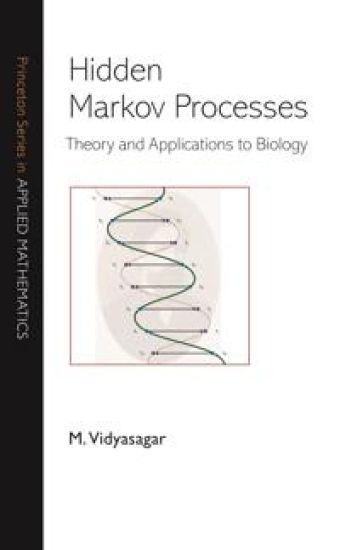
Hidden Markov Processes

Hidden Markov Processes

M. Vidyasagar

Princeton University Press
2014
sidottu
This book explores important aspects of Markov and hidden Markov processes and the applications of these ideas to various problems in computational biology. The book starts from first principles, so that no previous knowledge of probability is necessary. However, the work is rigorous and mathematical, making it useful to engineers and mathematicians, even those not interested in biological applications. A range of exercises is provided, including drills to familiarize the reader with concepts and more advanced problems that require deep thinking about the theory. Biological applications are taken from post-genomic biology, especially genomics and proteomics. The topics examined include standard material such as the Perron-Frobenius theorem, transient and recurrent states, hitting probabilities and hitting times, maximum likelihood estimation, the Viterbi algorithm, and the Baum-Welch algorithm. The book contains discussions of extremely useful topics not usually seen at the basic level, such as ergodicity of Markov processes, Markov Chain Monte Carlo (MCMC), information theory, and large deviation theory for both i.i.d and Markov processes. The book also presents state-of-the-art realization theory for hidden Markov models. Among biological applications, it offers an in-depth look at the BLAST (Basic Local Alignment Search Technique) algorithm, including a comprehensive explanation of the underlying theory. Other applications such as profile hidden Markov models are also explored.
Feedback Systems

Feedback Systems

Charles A. Desoer; M. Vidyasagar

Cambridge University Press
2009
nidottu
This book was the first and remains the only book to give a comprehensive treatment of the behavior of linear or nonlinear systems when they are connected in a closed-loop fashion, with the output of one system forming the input of the other. The study of the stability of such systems requires one to draw upon several branches of mathematics but most notably functional analysis. Feedback Systems: Input-Output Properties includes the most basic concepts of matrices and norms, the important fundamental theorems in input-output stability, and the requisite background material in advanced topics such as the small gain theorem and the passivity theorem.
Feedback Systems

Feedback Systems

Charles A. Desoer; M. Vidyasagar

Society for Industrial Applied Mathematics,U.S.
2008
pokkari
This book was the first and remains the only book to give a comprehensive treatment of the behavior of linear or nonlinear systems when they are connected in a closed-loop fashion, with the output of one system forming the input of the other. The study of the stability of such systems requires one to draw upon several branches of mathematics but most notably functional analysis. Feedback Systems includes the most basic concepts of matrices and norms, the important fundamental theorems in input-output stability, and the requisite background material in advanced topics such as the small gain theorem and the passivity theorem. Feedback Systems covers:* The most basic concepts of matrices nd norms* The important fundamental theorems in input-output stability. * The requisite background material in advanced topics such as the small gain theorem and passivity theorem.
Nonlinear Systems Analysis

Nonlinear Systems Analysis

M. Vidyasagar

Society for Industrial Applied Mathematics,U.S.
2002
pokkari
When M. Vidyasagar wrote the first edition of this book, most control theorists considered the subject of nonlinear systems a mystery. Since then, advances in the application of differential geometric methods to nonlinear analysis have matured to a stage where every control theorist needs to possess knowledge of the basic techniques because virtually all physical systems are nonlinear in nature. The second edition, now republished in SIAM's Classics in Applied Mathematics series, provides a rigorous mathematical analysis of the behavior of nonlinear control systems under a variety of situations. It develops nonlinear generalizations of a large number of techniques and methods widely used in linear control theory. The book contains three extensive chapters devoted to the key topics of Lyapunov stability, input-output stability, and the treatment of differential geometric control theory. In addition, it includes valuable reference material in these chapters that is unavailable elsewhere. The text also features a large number of problems that allow readers to test their understanding of the subject matter and self-contained sections and chapters that allow readers to focus easily on a particular topic.
Robot Dynamics and Control

Robot Dynamics and Control

Mark W. Spong; M. Vidyasagar

John Wiley Sons Inc
1991
nidottu
This self-contained introduction to practical robot kinematics and dynamics includes a comprehensive treatment of robot control. Provides background material on terminology and linear transformations, followed by coverage of kinematics and inverse kinematics, dynamics, manipulator control, robust control, force control, use of feedback in nonlinear systems, and adaptive control. Each topic is supported by examples of specific applications. Derivations and proofs are included in many cases. Includes many worked examples, examples illustrating all aspects of the theory, and problems.