Kirjojen hintavertailu – 12 903 735 kirjaa ja 27 kauppaa

Kirjailija

Maarten Marx

Kirjat ja teokset yhdessä paikassa: 4 kirjaa, julkaisuja vuosilta 1996–2014, suosituimpiin kuuluu Finite Model Theory and Its Applications. Vertaile teosten hintoja ja tarkista saatavuus suomalaisista kirjakaupoista.

4 kirjaa

Kirjojen julkaisuvuodet: 1996–2014.

Finite Model Theory and Its Applications

Finite Model Theory and Its Applications

Erich Grädel; Phokion G. Kolaitis; Leonid Libkin; Maarten Marx; Joel Spencer; Moshe Y. Vardi; Yde Venema; Scott Weinstein

Springer-Verlag Berlin and Heidelberg GmbH Co. K
2014
nidottu
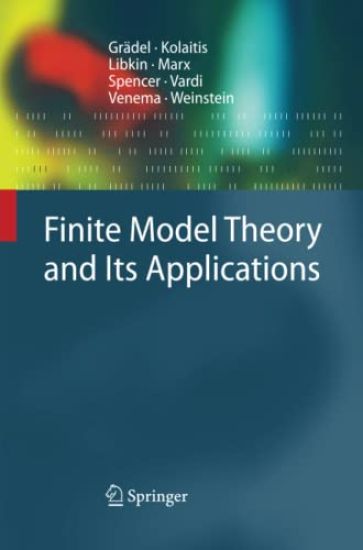
Finite model theory,as understoodhere, is an areaof mathematicallogic that has developed in close connection with applications to computer science, in particular the theory of computational complexity and database theory. One of the fundamental insights of mathematical logic is that our understanding of mathematical phenomena is enriched by elevating the languages we use to describe mathematical structures to objects of explicit study. If mathematics is the science of patterns, then the media through which we discern patterns, as well as the structures in which we discern them, command our attention. It isthis aspect oflogicwhichis mostprominentin model theory,“thebranchof mathematical logic which deals with the relation between a formal language and its interpretations”. No wonder, then, that mathematical logic, and ?nite model theory in particular, should ?nd manifold applications in computer science: from specifying programs to querying databases, computer science is rife with phenomena whose understanding requires close attention to the interaction between language and structure. This volume gives a broadoverviewof some central themes of ?nite model theory: expressive power, descriptive complexity, and zero–one laws, together with selected applications to database theory and arti?cial intelligence, es- cially constraint databases and constraint satisfaction problems. The ?nal chapter provides a concise modern introduction to modal logic,which emp- sizes the continuity in spirit and technique with ?nite model theory.
Multi-Dimensional Modal Logic

Multi-Dimensional Modal Logic

Maarten Marx; Yde Venema

Springer
2012
nidottu
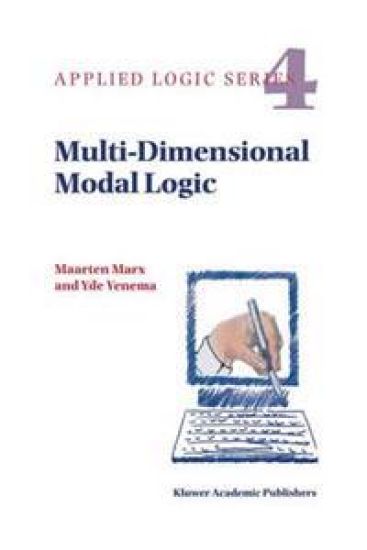
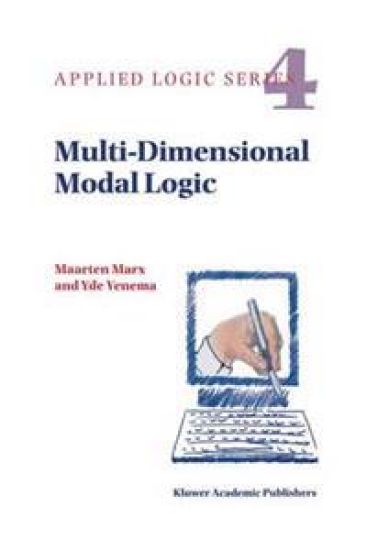
Modal Logic is a branch of logic with applications in many related disciplines such as computer science, philosophy, linguistics and artificial intelligence. Over the last twenty years, in all of these neighbouring fields, modal systems have been developed that we call multi-dimensional. (Our definition of multi-dimensionality in modal logic is a technical one: we call a modal formalism multi-dimensional if, in its intended semantics, the universe of a model consists of states that are tuples over some more basic set.) This book treats such multi-dimensional modal logics in a uniform way, linking their mathematical theory to the research tradition in algebraic logic. We will define and discuss a number of systems in detail, focusing on such aspects as expressiveness, definability, axiomatics, decidability and interpolation. Although the book will be mathematical in spirit, we take care to give motivations from the disciplines mentioned earlier on.
Finite Model Theory and Its Applications

Finite Model Theory and Its Applications

Erich Grädel; Phokion G. Kolaitis; Leonid Libkin; Maarten Marx; Joel Spencer; Moshe Y. Vardi; Yde Venema; Scott Weinstein

Springer-Verlag Berlin and Heidelberg GmbH Co. K
2007
sidottu
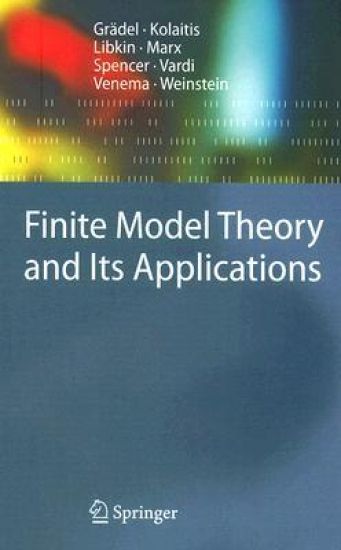
Finite model theory,as understoodhere, is an areaof mathematicallogic that has developed in close connection with applications to computer science, in particular the theory of computational complexity and database theory. One of the fundamental insights of mathematical logic is that our understanding of mathematical phenomena is enriched by elevating the languages we use to describe mathematical structures to objects of explicit study. If mathematics is the science of patterns, then the media through which we discern patterns, as well as the structures in which we discern them, command our attention. It isthis aspect oflogicwhichis mostprominentin model theory,“thebranchof mathematical logic which deals with the relation between a formal language and its interpretations”. No wonder, then, that mathematical logic, and ?nite model theory in particular, should ?nd manifold applications in computer science: from specifying programs to querying databases, computer science is rife with phenomena whose understanding requires close attention to the interaction between language and structure. This volume gives a broadoverviewof some central themes of ?nite model theory: expressive power, descriptive complexity, and zero–one laws, together with selected applications to database theory and arti?cial intelligence, es- cially constraint databases and constraint satisfaction problems. The ?nal chapter provides a concise modern introduction to modal logic,which emp- sizes the continuity in spirit and technique with ?nite model theory.
Multi-Dimensional Modal Logic

Multi-Dimensional Modal Logic

Maarten Marx; Yde Venema

Springer
1996
sidottu
Modal Logic is a branch of logic with applications in many related disciplines such as computer science, philosophy, linguistics and artificial intelligence. Over the last twenty years, in all of these neighbouring fields, modal systems have been developed that we call multi-dimensional. (Our definition of multi-dimensionality in modal logic is a technical one: we call a modal formalism multi-dimensional if, in its intended semantics, the universe of a model consists of states that are tuples over some more basic set.) This book treats such multi-dimensional modal logics in a uniform way, linking their mathematical theory to the research tradition in algebraic logic. We will define and discuss a number of systems in detail, focusing on such aspects as expressiveness, definability, axiomatics, decidability and interpolation. Although the book will be mathematical in spirit, we take care to give motivations from the disciplines mentioned earlier on.