Kirjojen hintavertailu – 12 903 735 kirjaa ja 27 kauppaa

Kirjailija

Machiel van Frankenhuijsen

Kirjat ja teokset yhdessä paikassa: 4 kirjaa, julkaisuja vuosilta 2012–2014, suosituimpiin kuuluu The Riemann Hypothesis for Function Fields. Vertaile teosten hintoja ja tarkista saatavuus suomalaisista kirjakaupoista.

4 kirjaa

Kirjojen julkaisuvuodet: 2012–2014.

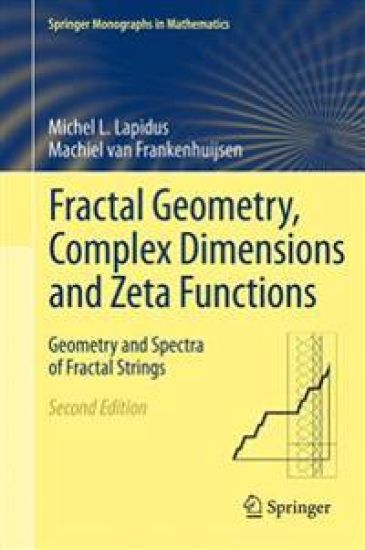
Fractal Geometry, Complex Dimensions and Zeta Functions

Fractal Geometry, Complex Dimensions and Zeta Functions

Michel L. Lapidus; Machiel van Frankenhuijsen

Springer-Verlag New York Inc.
2014
nidottu
Number theory, spectral geometry, and fractal geometry are interlinked in this in-depth study of the vibrations of fractal strings, that is, one-dimensional drums with fractal boundary. Key Features of this Second Edition:The Riemann hypothesis is given a natural geometric reformulation in the context of vibrating fractal stringsComplex dimensions of a fractal string, defined as the poles of an associated zeta function, are studied in detail, then used to understand the oscillations intrinsic to the corresponding fractal geometries and frequency spectraExplicit formulas are extended to apply to the geometric, spectral, and dynamical zeta functions associated with a fractalExamples of such explicit formulas include a Prime Orbit Theorem with error term for self-similar flows, and a geometric tube formulaThe method of Diophantine approximation is used to study self-similar strings and flows Analytical and geometric methodsare used to obtain new results about the vertical distribution of zeros of number-theoretic and other zeta functionsThroughout, new results are examined and a new definition of fractality as the presence of nonreal complex dimensions with positive real parts is presented. The new final chapter discusses several new topics and results obtained since the publication of the first edition. The significant studies and problems illuminated in this work may be used in a classroom setting at the graduate level. Fractal Geometry, Complex Dimensions and Zeta Functions, Second Edition will appeal to students and researchers in number theory, fractal geometry, dynamical systems, spectral geometry, and mathematical physics.

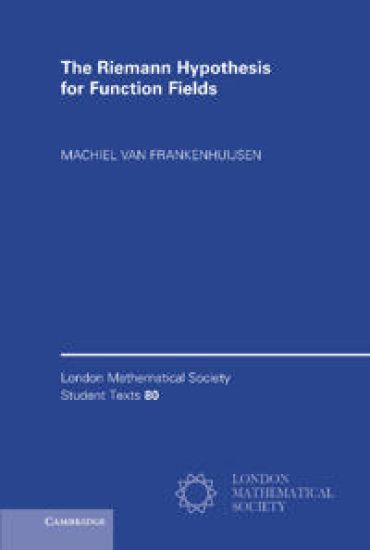
The Riemann Hypothesis for Function Fields

The Riemann Hypothesis for Function Fields

Machiel van Frankenhuijsen

Cambridge University Press
2014
pokkari
This book provides a lucid exposition of the connections between non-commutative geometry and the famous Riemann Hypothesis, focusing on the theory of one-dimensional varieties over a finite field. The reader will encounter many important aspects of the theory, such as Bombieri's proof of the Riemann Hypothesis for function fields, along with an explanation of the connections with Nevanlinna theory and non-commutative geometry. The connection with non-commutative geometry is given special attention, with a complete determination of the Weil terms in the explicit formula for the point counting function as a trace of a shift operator on the additive space, and a discussion of how to obtain the explicit formula from the action of the idele class group on the space of adele classes. The exposition is accessible at the graduate level and above, and provides a wealth of motivation for further research in this area.
The Riemann Hypothesis for Function Fields

The Riemann Hypothesis for Function Fields

Machiel van Frankenhuijsen

Cambridge University Press
2014
sidottu
This book provides a lucid exposition of the connections between non-commutative geometry and the famous Riemann Hypothesis, focusing on the theory of one-dimensional varieties over a finite field. The reader will encounter many important aspects of the theory, such as Bombieri's proof of the Riemann Hypothesis for function fields, along with an explanation of the connections with Nevanlinna theory and non-commutative geometry. The connection with non-commutative geometry is given special attention, with a complete determination of the Weil terms in the explicit formula for the point counting function as a trace of a shift operator on the additive space, and a discussion of how to obtain the explicit formula from the action of the idele class group on the space of adele classes. The exposition is accessible at the graduate level and above, and provides a wealth of motivation for further research in this area.
Fractal Geometry, Complex Dimensions and Zeta Functions

Fractal Geometry, Complex Dimensions and Zeta Functions

Michel L. Lapidus; Machiel van Frankenhuijsen

Springer-Verlag New York Inc.
2012
sidottu
Number theory, spectral geometry, and fractal geometry are interlinked in this in-depth study of the vibrations of fractal strings, that is, one-dimensional drums with fractal boundary. Key Features of this Second Edition:The Riemann hypothesis is given a natural geometric reformulation in the context of vibrating fractal stringsComplex dimensions of a fractal string, defined as the poles of an associated zeta function, are studied in detail, then used to understand the oscillations intrinsic to the corresponding fractal geometries and frequency spectraExplicit formulas are extended to apply to the geometric, spectral, and dynamical zeta functions associated with a fractalExamples of such explicit formulas include a Prime Orbit Theorem with error term for self-similar flows, and a geometric tube formulaThe method of Diophantine approximation is used to study self-similar strings and flows Analytical and geometric methodsare used to obtain new results about the vertical distribution of zeros of number-theoretic and other zeta functionsThroughout, new results are examined and a new definition of fractality as the presence of nonreal complex dimensions with positive real parts is presented. The new final chapter discusses several new topics and results obtained since the publication of the first edition. The significant studies and problems illuminated in this work may be used in a classroom setting at the graduate level. Fractal Geometry, Complex Dimensions and Zeta Functions, Second Edition will appeal to students and researchers in number theory, fractal geometry, dynamical systems, spectral geometry, and mathematical physics.