Kirjojen hintavertailu – 12 903 725 kirjaa ja 27 kauppaa

Kirjailija

Mads Andenas

Kirjat ja teokset yhdessä paikassa: 11 kirjaa, julkaisuja vuosilta 1998–2013, suosituimpiin kuuluu Delegated Legislation and the Role of Committees in the EC. Vertaile teosten hintoja ja tarkista saatavuus suomalaisista kirjakaupoista.

11 kirjaa

Kirjojen julkaisuvuodet: 1998–2013.

The Foundations and Future of Financial Regulation

The Foundations and Future of Financial Regulation

Mads Andenas; Iris H-Y Chiu

Routledge
2013
sidottu
Financial regulation has entered into a new era, as many foundational economic theories and policies supporting the existing infrastructure have been and are being questioned following the financial crisis. Goodhart et al’s seminal monograph "Financial Regulation: Why, How and Where Now?" (Routledge:1998) took stock of the extent of financial innovation and the maturity of the financial services industry at that time, and mapped out a new regulatory roadmap. This book offers a timely exploration of the "Why, How and Where Now" of financial regulation in the aftermath of the crisis in order to map out the future trajectory of financial regulation in an age where financial stability is being emphasised as a key regulatory objective. The book is split into four sections: the objectives and regulatory landscape of financial regulation; the regulatory regime for investor protection; the regulatory regime for financial institutional safety and soundness; and macro-prudential regulation. The discussion ranges from theoretical and policy perspectives to comprehensive and critical consideration of financial regulation in the specifics. The focus of the book is on the substantive regulation of the UK and the EU, as critical examination is made of the unravelling and the future of financial regulation with comparative insights offered where relevant especially from the US. Running throughout the book is consideration of the relationship between financial regulation, financial stability and the responsibility of various actors in governance. This book offers an important contribution to continuing reflections on the role of financial regulation, market discipline and corporate responsibility in the financial sector, and upon the roles of regulatory authorities, markets and firms in ensuring the financial health and security of all in the future.

The Foundations and Future of Financial Regulation

The Foundations and Future of Financial Regulation

Mads Andenas; Iris H-Y Chiu

Routledge
2013
nidottu
Financial regulation has entered into a new era, as many foundational economic theories and policies supporting the existing infrastructure have been and are being questioned following the financial crisis. Goodhart et al’s seminal monograph "Financial Regulation: Why, How and Where Now?" (Routledge:1998) took stock of the extent of financial innovation and the maturity of the financial services industry at that time, and mapped out a new regulatory roadmap. This book offers a timely exploration of the "Why, How and Where Now" of financial regulation in the aftermath of the crisis in order to map out the future trajectory of financial regulation in an age where financial stability is being emphasised as a key regulatory objective. The book is split into four sections: the objectives and regulatory landscape of financial regulation; the regulatory regime for investor protection; the regulatory regime for financial institutional safety and soundness; and macro-prudential regulation. The discussion ranges from theoretical and policy perspectives to comprehensive and critical consideration of financial regulation in the specifics. The focus of the book is on the substantive regulation of the UK and the EU, as critical examination is made of the unravelling and the future of financial regulation with comparative insights offered where relevant especially from the US. Running throughout the book is consideration of the relationship between financial regulation, financial stability and the responsibility of various actors in governance. This book offers an important contribution to continuing reflections on the role of financial regulation, market discipline and corporate responsibility in the financial sector, and upon the roles of regulatory authorities, markets and firms in ensuring the financial health and security of all in the future.

European Comparative Company Law

European Comparative Company Law

Mads Andenas; Frank Wooldridge

Cambridge University Press
2012
pokkari
Company law is undergoing fundamental change in Europe. All European countries have undertaken extensive reform of their company legislation. Domestic reform has traditionally been driven by corporate failures or scandals. Initiatives to make corporate governance more effective are a feature of recent European law reform, as are measures to simplify and ease burdens on smaller and medium-sized businesses (SMEs). An increasing EU harmonisation is taking place through the Company Law Directives, and the free movement of companies is also facilitated by the case law of the European Court of Justice on the directives and the right to free movement and establishment in the EC Treaty. New European corporate forms such as the European Economic Interest Grouping (EEIG) and the European Company (SE) have added new dimensions. At a time of rapid development of EU and national company laws, this book will aid the understanding of an emerging discipline.
Grundlagen des Europäischen Privatrechts

Grundlagen des Europäischen Privatrechts

Guido Alpa; Mads Andenas

Springer-Verlag Berlin and Heidelberg GmbH Co. KG
2009
sidottu
Das Buch ist die deutsche Ausgabe der „Fondamenti del diritto privato europeo". Es stellt in innovativer und umfassender Weise die derzeitige Stellung des Privatrechts in Europa vor, sowie die neuen Entwicklungen im Zuge der europäischen Vereinheitlichung und fortschreitenden Einigung. Geschrieben von zwei herausragenden europäischen Wissenschaftlern, Guido Alpa und Mads Andenas, die sich unermüdlich der Weiterentwicklung der länderübegreifenden Forschung und Lehre widmen, bietet es mehr als nur ein Handbuch zum europäischen Privatrecht. Es führt den Leser umfasssend in die geistes- und kulturhistorischen Hintergründe sowie in die Rechtstheorie der gegenwärtigen Privatrechtsvereinheitlichung und Modernisierung der rechtlichen Grundlagen des europäischen Wirtschaftsverkehrs ein.
European Comparative Company Law

European Comparative Company Law

Mads Andenas; Frank Wooldridge

Cambridge University Press
2009
sidottu
European Comparative Company Law examines important aspects of the company laws of seven European countries: the United Kingdom, France, Germany, Italy, Spain, Belgium, and the Netherlands. The book covers the European Economic Interest Grouping (EEIG) and the European Company (SE). There are currently major reforms underway or recently completed of company law within all the European jurisdictions, and the European Commission has adopted an extensive action plan. European Comparative Company Law is a contribution to the emerging discipline of European company law where both the harmonisation of company law by the EU, and also national jurisdictions are the important features. The EU Company Law Directives, the case law of the Court of Justice on the directives and the right to free movement and establishment in the Treaty of Rome, are considered. It makes a contribution to a better understanding of European company law at a time of reform and change.
Financial Markets in Europe: Towards a Single Regulator

Financial Markets in Europe: Towards a Single Regulator

Mads Andenas; Yannis Avgerinos

Kluwer Law International
2003
sidottu
Despite the high hopes for EU-wide financial stability invested in the European Economic and Monetary Union, it is becoming more and more evident that the limited supervisory role of the European Central Bank has added to an already overcomplicated situation. Although European regulatory competences are now increasingly formalized through detailed rule making, they remain broad and widely discretionary. It is still the many different national authorities that are regulating or supervising banks and other financial institutions. The root issue what is the relationship between an effective European supervisor and the supervisory functions that remain at the Member State level has not yet been adequately addressed. Among the core issues of relevance analyzed in the book are the following: the increase in systemic risk that accompanies the introduction of the Euro; the inability of mere cooperation between national authorities to handle crises; the European Central Bank as an organizational model for the development of a single European regulator; the persistence of a traditional national character in surrounding areas of law such as contract law and company law; the heretofore intractable problem of the double burden of having to follow more than one set of national rules; and the apparent inertia of major business players, in spite of the obvious benefits for them of EU level regulation. Financial Markets in Europe offers a large and welcome measure of clear thinking to the entire professional community regulators, bankers, scholars, insurance professionals, securities managers engaged in the complex field of activity guided by monetary policy and supervision of financial markets. Becauseit raises broad issues and perspectives for a globalised world, it will be of value not only in Europe but to financial services specialists everywhere.
Developments in European Company Law

Developments in European Company Law

Mads Andenas; David Sugarman

Kluwer Law International
2002
sidottu
The essays in this third volume of "Developments in European Company Law" are concerned with conflicts of interest and duty in company law. The first part provides a legal analysis of the duties of company directors, of their accountability and of the trustee's perspective. A second part provides a socio-legal analysis and a third part an economic analysis. The essays provide important contributions to law reform and scholarly debate of these pressing issues of company law. The contributors include leading judges with an interest in the field and academics from the UK and Australia.
Delegated Legislation and the Role of Committees in the EC
This book is the outcome of a research seminar with the title of "Delegation of Legislative Powers in the European Community: the Role of Committees" that was held in London on 16th and 17th January 1998. The seminar brought together academics from political and legal science in different countries of the European Community in order to provide as diverse as possible a set of perspectives on the topic. This interdisciplinary approach is also reflected in the book. Some of the chapters of the book are based on papers delivered in the seminar. The first part of the book is primarily devoted to a political science perspective on comitology and provides a general theoretical framework. The second part is concerned with a normative analysis in a legal tradition of the issue of delegation of legislative powers. The aim here is to explore to what extent the national concepts and institutes of delegation of powers can contribute to a better understanding of the Community concept of delegation. The third part of the book concerns the institutional perspective and deals with the history of comitology and the role of the Court of Justice in the development of the system. The fourth and final part of the book examines various areas of EC law, including environmental law, product safety and other areas.
Judicial Review in International Perspective

Judicial Review in International Perspective

Mads Andenas; Duncan Fairgrieve

Kluwer Law International
2000
sidottu
Lord Slynn of Hadley is one of the outstanding judges of his time. He has served as a High Court Judge, as an Advocate General and Owa Judge of the European Court of Justice, and he has been a Lord of Appeal for ten years. This Liber Amicorum bears testimony to the international reputation that he has achieved for his judgments and for his scholarship. In the many distinguished contributions, judges from international courts and from Supreme Courts and Constitutional Courts, together with academics from leading universities around the world, have taken the opportunity to celebrate the accomplishments of Lord Slynn's legal career thus far, and also to discuss areas of law where Lord Slynn can be expected to give important impulses to further development. The thirty years of the legal life of Lord Slynn of Hadley (Gordon Slynn as he is known to his friends) have seen remarkable developments and changes in the legal scenery, both domestic (British), and international. This book, by his friends, extends widely. Recollect that there is a separate volume covering the European Court of Justice, and yet there is enough in this publication to celebrate several separate careers. The reader will note that there are contributions from justices of eight Supreme Courts, plus the German Constitutional Court, the Conseil Constitutionel and the European Court of Human Rights, from ten universities, many of them multiple, together with famous institutions and individuals in many different fields. Even Lord Slynn's young lecturer interest in Air Law is reflected by a professional paper on the Law of Space. Many, if not most, of the contributions bear, appropriately, on the question of the role of courts in reviewing actions of the legislature and the executive, but there are also articles to attract other diverse specialists, several, no doubt to Lord Slynn's pleasure, provocative and forward-looking. Lord Slynn is happily still in office, so this is really a "Festschrift" of celebration.
The Changing World of International Law in the Twenty-First Century

The Changing World of International Law in the Twenty-First Century

Joseph J. Norton; Mary Footer; Mads Andenas

Kluwer Law International
1998
sidottu
This text draws together contributions of leading international legal scholars respecting major themes of the future of international law in the 21st century. The papers have been collected in honour of the late Professor Kenneth R. Simmonds, former Director of the British Institute of International and Comparative Law and Professor of Law at Queen Mary and Westfield College, University of London. The book is divided into three parts: public international law; international dispute resolution; and European and other regional integration, which constitute the important themes and currents in contemporary international law. The sections also represent the areas that were of personal interest to Professor Simmonds and in which he was a leading contributor until his death.
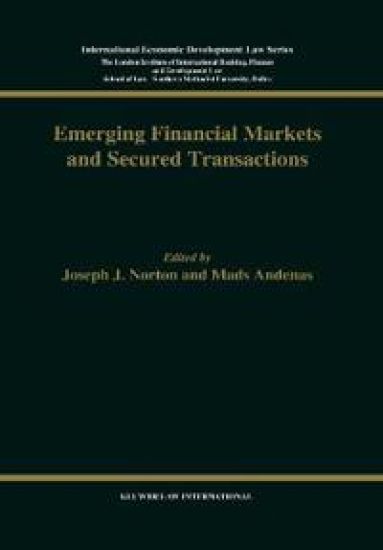
Emerging Financial Markets and Secured Transactions

Emerging Financial Markets and Secured Transactions

Joseph J. Norton; Mads Andenas

Kluwer Law International
1998
sidottu
This volume is comprised of a collection of papers dealing with various aspects of cross-border secured transactions, an important issue in the development of emerging financial markets and transitional market economies. A sound legal framework for lenders to effect and enforce secured transactions is called for in order to establish an investor-friendly climate. Special attention is paid to the EBRD Model Law on secured transactions, the UNCITRAL Draft Convention on Assignment in Receivables Financing, and the UNIDROIT model. The papers stress the importance to the transition process of the development of a modern framework for secured transactions.