Kirjojen hintavertailu – 12 903 724 kirjaa ja 27 kauppaa

Kirjailija

Mads Tofte

Kirjat ja teokset yhdessä paikassa: 3 kirjaa, julkaisuja vuosilta 1990–2011, suosituimpiin kuuluu Compiler Generators. Vertaile teosten hintoja ja tarkista saatavuus suomalaisista kirjakaupoista.

3 kirjaa

Kirjojen julkaisuvuodet: 1990–2011.

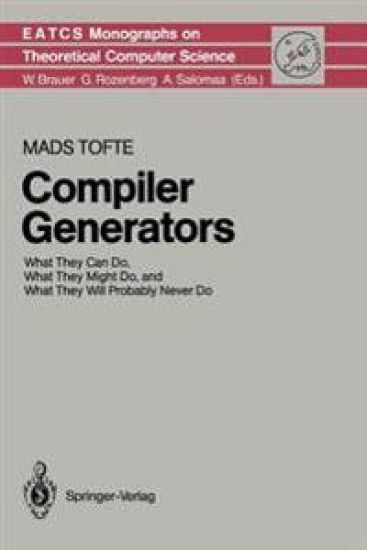
Compiler Generators

Compiler Generators

Mads Tofte

Springer-Verlag Berlin and Heidelberg GmbH Co. K
2011
nidottu
The OrIgIn of this monograph is a course entitled "Semantics­ directed Compiler Generation" which Professor Neil D. Jones gave in 1982 at Copenhagen University, where I was a student at the time. In this course, he described a compiler generator, called CERES, which he was developing. I immediately felt attracted to the unusual combination of mathematical reasoning about com­ pilers and the small intricate building blocks that made up the running system. As I came to understand the system I discovered that within the existing mathematical framework one could express compiler generation as a special case of compilation; this led to a specification of a compiler generator which was bootstrapped on itself resulting in a machine-generated compiler generator. The purpose of this monograph is to describe the CERES system we produced in 1983-84 and compare it with other systems, includ­ ing more recent ones. Also, it is as relevant today as it was then to discuss the role of compiler generators as an aid in the design and implementation of programming languages; this I do in Chap. 5. This monograph is a strongly revised version of the cando scient.
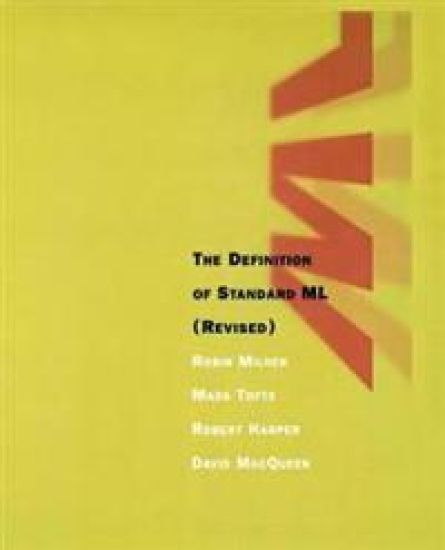
The Definition of Standard ML

The Definition of Standard ML

Robin Milner; Robert Harper; David MacQueen; Mads Tofte

MIT Press
1997
pokkari
Standard ML is a general-purpose programming language designed for large projects. This book provides a formal definition of Standard ML for the benefit of all concerned with the language, including users and implementers. Because computer programs are increasingly required to withstand rigorous analysis, it is all the more important that the language in which they are written be defined with full rigor. One purpose of a language definition is to establish a theory of meanings upon which the understanding of particular programs may rest. To properly define a programming language, it is necessary to use some form of notation other than a programming language. Given a concern for rigor, mathematical notation is an obvious choice. The authors have defined their semantic objects in mathematical notation that is completely independent of Standard ML. In defining a language one must also define the rules of evaluation precisely-that is, define what meaning results from evaluating any phrase of the language. The definition thus constitutes a formal specification for an implementation. The authors have developed enough of their theory to give sense to their rules of evaluation. The Definition of Standard ML is the essential point of reference for Standard ML. Since its publication in 1990, the implementation technology of the language has advanced enormously and the number of users has grown. The revised edition includes a number of new features, omits little-used features, and corrects mistakes of definition.
Compiler Generators

Compiler Generators

Mads Tofte

Springer-Verlag Berlin and Heidelberg GmbH Co. K
1990
sidottu
The OrIgIn of this monograph is a course entitled "Semantics­ directed Compiler Generation" which Professor Neil D. Jones gave in 1982 at Copenhagen University, where I was a student at the time. In this course, he described a compiler generator, called CERES, which he was developing. I immediately felt attracted to the unusual combination of mathematical reasoning about com­ pilers and the small intricate building blocks that made up the running system. As I came to understand the system I discovered that within the existing mathematical framework one could express compiler generation as a special case of compilation; this led to a specification of a compiler generator which was bootstrapped on itself resulting in a machine-generated compiler generator. The purpose of this monograph is to describe the CERES system we produced in 1983-84 and compare it with other systems, includ­ ing more recent ones. Also, it is as relevant today as it was then to discuss the role of compiler generators as an aid in the design and implementation of programming languages; this I do in Chap. 5. This monograph is a strongly revised version of the cando scient.