Kirjojen hintavertailu – 12 859 829 kirjaa ja 27 kauppaa

Kirjailija

Magdi S. Mahmoud

Kirjat ja teokset yhdessä paikassa: 32 kirjaa, julkaisuja vuosilta 1989–2021, suosituimpiin kuuluu Resilient Control of Uncertain Dynamical Systems. Vertaile teosten hintoja ja tarkista saatavuus suomalaisista kirjakaupoista.

Nimi esiintyy myös muodoissa: Magdi S Mahmoud

32 kirjaa

Kirjojen julkaisuvuodet: 1989–2021.

Control and Estimation Methods over Communication Networks

Control and Estimation Methods over Communication Networks

Magdi S. Mahmoud

Springer International Publishing AG
2014
sidottu
This book provides a rigorous framework in which to study problems in the analysis, stability and design of networked control systems. Four dominant sources of difficulty are considered: packet dropouts, communication bandwidth constraints, parametric uncertainty, and time delays. Past methods and results are reviewed from a contemporary perspective, present trends are examined, and future possibilities proposed. Emphasis is placed on robust and reliable design methods. New control strategies for improving the efficiency of sensor data processing and reducing associated time delay are presented. The coverage provided features:· an overall assessment of recent and current fault-tolerant control algorithms;· treatment of several issues arising at the junction of control and communications;· key concepts followed by their proofs and efficient computational methods for their implementation; and · simulation examples (including TrueTime simulations) to provide hands-on experience. In addition to the theoretical coverage, the author describes a number of applications that demonstrate the real-world relevance of this material, and these include:· a servo system;· a triple inverted pendulum;· power system control;· wireless control of a cart with inverted pendulum and wireless servo application with emphasis on controller area networks; and· switched ethernet and wireless area networks. Researchers and graduate students working in networked and distributed control will find this text a useful guide in avoiding and ameliorating common and serious problems with these systems. The increasing prevalence of networks in many fields of engineering will make Control and Estimation Methods over Communication Networks of interest to practitioners with backgrounds in communications, process engineering, robotics, power, automotive and other areas.
Analysis and Synthesis of Fault-Tolerant Control Systems

Analysis and Synthesis of Fault-Tolerant Control Systems

Magdi S. Mahmoud; Yuanqing Xia

John Wiley Sons Inc
2013
sidottu
In recent years, control systems have become more sophisticated in order to meet increased performance and safety requirements for modern technological systems. Engineers are becoming more aware that conventional feedback control design for a complex system may result in unsatisfactory performance, or even instability, in the event of malfunctions in actuators, sensors or other system components. In order to circumvent such weaknesses, new approaches to control system design have emerged which can tolerate component malfunctions while maintaining acceptable stability and performance. These types of control systems are often known as fault-tolerant control systems (FTCS). More precisely, FTCS are control systems which possess the ability to accommodate component failure automatically. Analysis and Synthesis of Fault-Tolerant Control Systems comprehensively covers the analysis and synthesis methods of fault tolerant control systems. It unifies the methods for developing controllers and filters for a wide class of dynamical systems and reports on the recent technical advances in design methodologies. MATLAB® is used throughout the book, to demonstrate methods of analysis and design. Key features: • Provides advanced theoretical methods and typical practical applications • Provides access to a spectrum of control design methods applied to industrial systems • Includes case studies and illustrative examples • Contains end-of-chapter problems Analysis and Synthesis of Fault-Tolerant Control Systems is a comprehensive reference for researchers and practitioners working in this area, and is also a valuable source of information for graduates and senior undergraduates in control, mechanical, aerospace, electrical and mechatronics engineering departments.
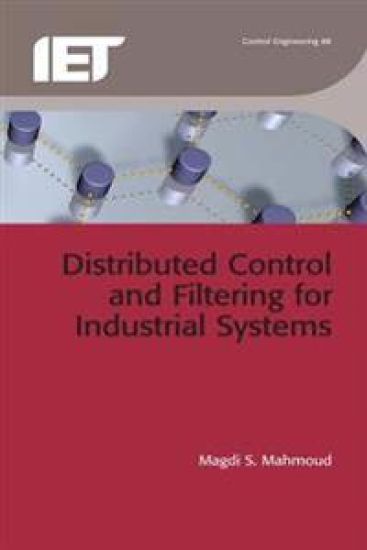
Distributed Control and Filtering for Industrial Systems

Distributed Control and Filtering for Industrial Systems

Magdi S. Mahmoud

Institution of Engineering and Technology
2012
sidottu
In recent years technological advancements in the design and fabrication of integrated circuits have led to the development of cost effective, low power, thumb-size devices that can be used for sensing/actuating, communication and computing. This trend is enabling a surge of new applications for which pervasive network architectures are being developed. A key feature of these systems is that they are decentralized and communication among different subsystems may be unreliable. From an engineering viewpoint, to ensure correct operation, the theoretical analysis requires a fundamental paradigm shift, as many of the typical assumptions of systems and control theory cease to hold. Distributed Control and Filtering for Industrial Systems provides an introduction to the control and filtering algorithms devised for distributed environments, with a particular emphasis on industrial applications. Topics covered include control architectures for interconnected systems, recent developments in distributed model predictive control for interconnected networked systems, methods for designing distributed linear quadratic controllers for various classes of systems, designing distributed dynamic output-feedback controllers, characterization of distributed consensus control methods, distributed estimation techniques, distributed Kalman filtering methods, experimental setups and simulation of pilot-scale industrial processes.
Applied Control Systems Design

Applied Control Systems Design

Magdi S. Mahmoud; Yuanqing Xia

Springer London Ltd
2012
sidottu
Applied Control System Design examines several methods for building up systems models based on real experimental data from typical industrial processes and incorporating system identification techniques. The text takes a comparative approach to the models derived in this way judging their suitability for use in different systems and under different operational circumstances. A broad spectrum of control methods including various forms of filtering, feedback and feedforward control is applied to the models and the guidelines derived from the closed-loop responses are then composed into a concrete self-tested recipe to serve as a check-list for industrial engineers or control designers. System identification and control design are given equal weight in model derivation and testing to reflect their equality of importance in the proper design and optimization of high-performance control systems. Readers’ assimilation of the material discussed is assisted by the provision of problems and examples. Most of these exercises use MATLAB® to make computation and visualization more straightforward. Applied Control System Design will be of interest to academic researchers for its comparison of different systems models and their response to different control methods and will assist graduate students in learning the practical necessities of advanced control system design. The consistent reference to real systems coupled with self-learning tools will assist control practitioners who wish to keep up to date with the latest control design ideas.
Discrete Systems

Discrete Systems

Magdi S Mahmoud; M.G. Singh

Springer-Verlag Berlin and Heidelberg GmbH Co. K
2011
nidottu
More and more digital devices are being used for informa­ tion processing and control purposes in a variety of systems applications, including industrial processes, power networks, biological systems and communication networks. This trend has been helped by the advent of microprocessors and the consequent availability of cheap distributed computing power. For those applications, where digital devices are used, it is reasonable to model the system in discrete-time. In addition there are other application areas, e.g. econometric systems, business systems, certain command and control systems, environmental systems, where the underlying models are in discrete-time and here discrete-time approaches to analysis and control are the most appropriate. In order to deal with these two situations, there has been a lot of interest in developing techLiques which allow us to do analysis, design and control of discrete-time systems. This book provides a comprehensive treatment of discrete­ time dynamical systems. It covers the topics of modelling, optimization techniques and control design. The book is designed to serve as a text for teaching at the first year graduate level. The material included is organized into eight chapters.
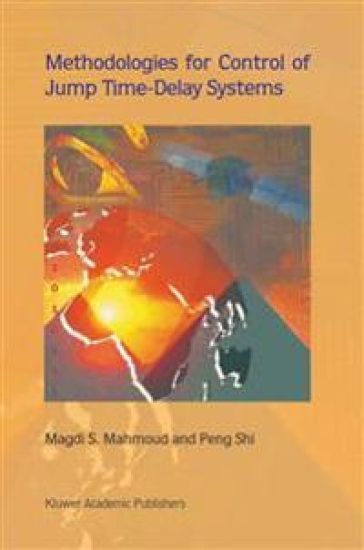
Methodologies for Control of Jump Time-Delay Systems

Methodologies for Control of Jump Time-Delay Systems

Magdi S. Mahmoud

Springer-Verlag New York Inc.
2011
nidottu
Jump Time-Delay Systems (JTDS) represent a new class of piece-wise deterministic systems, in which the underlying dynamics is governed by delay-differential equations and it possesses multiple modes of operation depending on the value of an associated Markov random process. This book is about the time-domain modeling, stability, stabilization, control design and filtering for JTDS. It gives readers a thorough understanding of the basic mathematical analysis and fundamentals of JTDS. Additionally, it offers a straightforward treatment of the different topics and provides a broad coverage of the recent methodologies. The prime concern has been on the interplay between delay factors, jumping behavior and parametric uncertainties. The cases of single and interconnected JTDS are considered and numerous examples are worked out. The relationship to previous results on time-delay systems (TDS) and Markovian jump systems (MJS) are revealed.
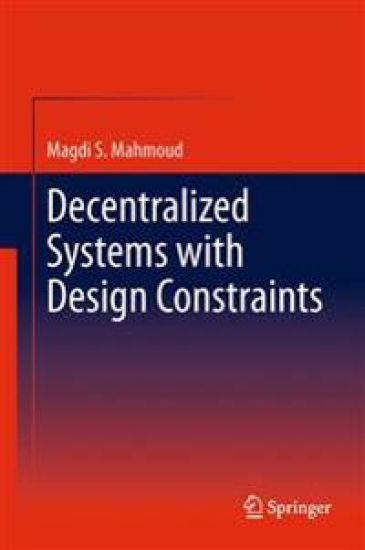
Decentralized Systems with Design Constraints

Decentralized Systems with Design Constraints

Magdi S. Mahmoud

Springer London Ltd
2011
sidottu
Decentralized Control and Filtering provides a rigorous framework for examining the analysis, stability and control of large-scale systems, addressing the difficulties that arise because dimensionality, information structure constraints, parametric uncertainty and time-delays. This monograph serves three purposes: it reviews past methods and results from a contemporary perspective; it examines presents trends and approaches and to provide future possibilities; and it investigates robust, reliable and/or resilient decentralized design methods based on a framework of linear matrix inequalities. As well as providing an overview of large-scale systems theories from the past several decades, the author presents key modern concepts and efficient computational methods. Representative numerical examples, end-of-chapter problems, and typical system applications are included, and theoretical developments and practical applications of large-scale dynamical systems are discussed in depth.
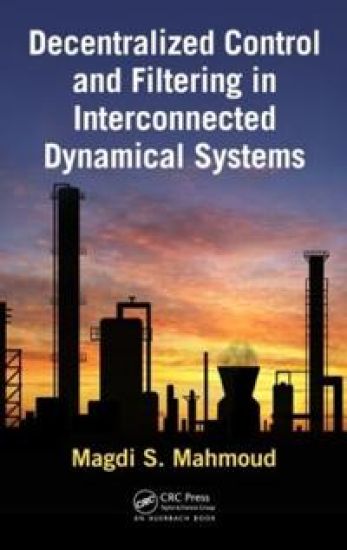
Decentralized Control and Filtering in Interconnected Dynamical Systems
Based on the many approaches available for dealing with large-scale systems (LSS), Decentralized Control and Filtering in Interconnected Dynamical Systems supplies a rigorous framework for studying the analysis, stability, and control problems of LSS. Providing an overall assessment of LSS theories, it addresses model order reduction, parametric uncertainties, time delays, and control estimator gain perturbations. Taking readers on a guided tour through LSS, the book examines recent trends and approaches and reviews past methods and results from a contemporary perspective. It traces the progress of research along three eras: Fundamental era in which the basic conceptual frameworks, major ideas, and operational methodologies are laid down Contemporary era in which several of the workable methods and techniques are established and applied to many application areas Advanced era in which different high-level schemes and configurations are being developed to meet accelerated technological advancementsFocusing on robust, reliable, and/or resilient decentralized design methods based on linear matrix inequalities framework, the author offers suggestions for improvements to current approaches. He addresses the dominating sources of difficulties due to dimensionality, information structure constraints, uncertainties, and time delays. Drawing attention to key issues, the text is supported by proofs, efficient computational methods, end-of-chapter problems, and approximately 1,300 equations.
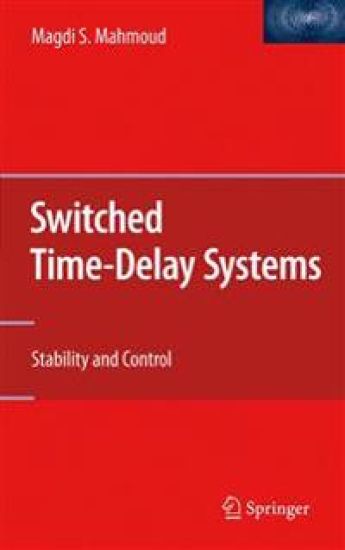
Switched Time-Delay Systems

Switched Time-Delay Systems

Magdi S. Mahmoud

Springer-Verlag New York Inc.
2010
sidottu
In many practical applications we deal with a wide class of dynamical systems that are comprised of a family of continuous-time or discrete-time subsystems and a rule orchestrating the switching between the subsystems. This class of systems is frequently called switched system. Switched linear systems provide a framework that bridges the linear systems and the complex and/or uncertain systems. The mo- vation for investigating this class of systems is twofold: ?rst, it has an inherent multi-modal behavior in the sense that several dynamical subsystems are required to describe their behavior, which might depend on various environmental factors. Second, the methods of intelligent control systems are based on the idea of swit- ing between different controllers. Looked at in this light, switched systems provide an integral framework to deal with complex system behaviors such as chaos and multiple limit cycles and gain more insights into powerful tools such as intelligent control, adaptive control, and robust control. Switched systems have been inves- gated for a long time in the control and systems literature and have increasingly attracted more attention for the past three decades. The number of journal articles, books, and conference papers have grown exponentially and a number of fundam- tal concepts and powerful tools have been developed. It has been pointed out that switched systems have been studied from various viewpoints.
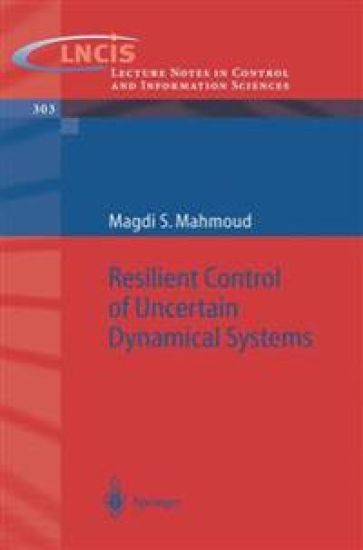
Resilient Control of Uncertain Dynamical Systems

Resilient Control of Uncertain Dynamical Systems

Magdi S. Mahmoud

Springer-Verlag Berlin and Heidelberg GmbH Co. K
2004
nidottu
This monograph provides a complete description of resilient control theory. It unifies the methods for developing resilient controllers and filters for a class of uncertain dynamical systems and reports recent advances in design methodologies. The book presents an introductory and comprehensive treatment of resilient controller design methods placing great emphasis on the derivation of necessary and sufficient design conditions and on the use of linear matrix inequalities as a convenient computational tool. The book can be used as a graduate-level textbook in control engineering or applied mathematics as well as a reference for practicing engineers, researchers and students.
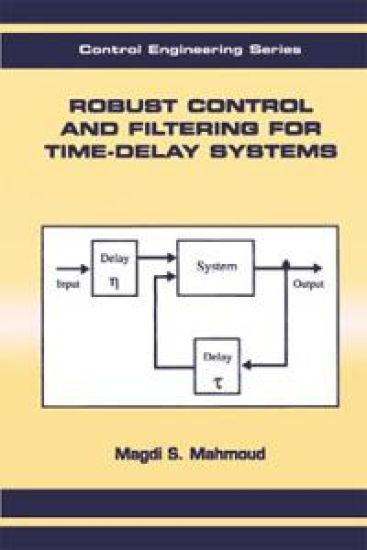
Robust Control and Filtering for Time-Delay Systems
A discussion of robust control and filtering for time-delay systems. It provides information on approaches to stability, stabilization, control design, and filtering aspects of electronic and computer systems - explicating the developments in time-delay systems and uncertain time-delay systems. There are appendices detailing important facets of matrix theory, standard lemmas and mathematical results, and applications of industry-tested software.
Control of Partially-Known Dynamical Systems

Control of Partially-Known Dynamical Systems

Ahmad A. Bahnasawi; Magdi S. Mahmoud

Springer-Verlag Berlin and Heidelberg GmbH Co. K
1989
nidottu
The main objective of this monograph is to develop efficient techniques for tackling the control problems of partially-known dynamical systems. This broad class of systems has a fundamental feature: Knowledge of the dynamic characteristics of the control plant is not complete. In one category, the missing knowledge is due to the unmodeled high-frequency parasitics (adaptive systems). In another category, some of the model parameters are unknown-but-bounded (uncertain systems). The book concentrates on reduced-order adaptive control schemes and deterministic stabilizing control methodologies. Special emphasis has been placed on presenting new results, establishing efficient control laws and treating both small-scale and large-scale problems. Effects of external disturbances, state parameter errors and interconnection patterns have been investigated and dealt with in contructing various controller structures.