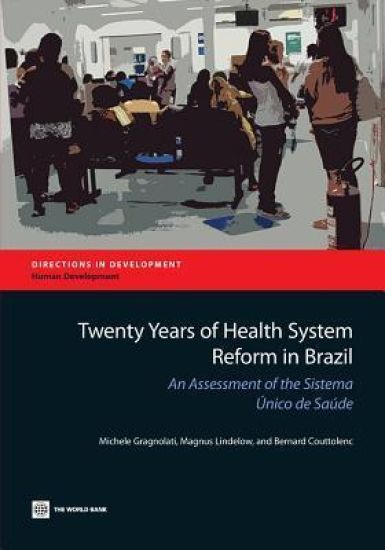
Twenty Years of Health System Reform in Brazil
Michele Gragnolati; Bernard Couttolenc; Magnus Lindelow
World Bank Publications
2013
nidottu
It has been over twenty years since the Brazilian Sistema Único de Saúde (Unified Health System or SUS) was formally established by the 1988 Constitution. The impetus for the SUS came in part from rising costs and a crisis in the social security system that preceded the reforms, but also from a broad-based political movement calling for democratisation and improved social rights. Building on reforms that started in the 1980s, the SUS was based on three overarching principles: (i) universal access to health services, with health defined as a citizen's right and an obligation of the state; (ii) equality of access to health care; and (iii) integrality (comprehensiveness) and continuity of care; along with several other guiding ideas, including decentralisation, increased participation, and evidence-based prioritisation. The SUS reform established health a fundamental right and duty of the state, and started a process of fundamentally transforming Brazil's health system to achieve this goal. So, what has been achieved since the SUS was established? And what challenges remain in achieving the goals that were established in 1988? These questions are the focus of this report. Specifically, it seeks to assess whether the SUS reforms have managed to transform the health system as envisaged more than 20 years ago, and whether the reforms have led to improved outcomes in terms of access to services, financial protection, and health status. Any effort to assess the performance of a health system runs into a host of challenges concerning the definition of boundaries of the 'health system', the outcomes that the assessment should focus on, data sources and quality, and the role of policies and reforms in understanding how the performance of the health system has changed over time. Building on an extensive literature on health system assessment, this report is based on a simple framework that specifies a set of health system 'building blocks', which affect a number of intermediate outcomes such as access, quality and efficiency, which, in turn, contribute to final outcomes, including health status, financial protection, and satisfaction. Based on this framework, the report starts by looking at how key building blocks of Brazil's health system have changed over time and then moves on to review performance in terms of intermediate and final outcomes.