Kirjojen hintavertailu – 12 903 725 kirjaa ja 27 kauppaa

Kirjailija

Mahmoud Ezzamel

Kirjat ja teokset yhdessä paikassa: 5 kirjaa, julkaisuja vuosilta 2003–2026, suosituimpiin kuuluu The Economy of Ancient Egypt. Vertaile teosten hintoja ja tarkista saatavuus suomalaisista kirjakaupoista.

5 kirjaa

Kirjojen julkaisuvuodet: 2003–2026.

The Economy of Ancient Egypt

The Economy of Ancient Egypt

Mahmoud Ezzamel

TAYLOR FRANCIS LTD
2026
nidottu
Taking ancient records as the starting point for analysis, this book theorises the state, administration and economy of ancient Egypt. The Egyptian state is theorised as an administrative field of material and symbolic powers with emphasis upon the latter because it has received scant attention in Egyptology. Maat (truth, fairness, connective justice) is theorised as symbolic power discursively authored, disseminated and monitored by senior administrators who redefined its meaning to suit changes in the sociopolitical contexts. The book examines the classification schemes of the Egyptian population devised by the administrative field of power and how they were used to differentiate, hierarchise and fix specific individuals within clearly demarcated social and economic categories that aimed to fix the subjectivity of those assigned to each category. Ancient Egyptian had a significant state economic sector and a private sector. A multiplicity of sources of state economic resources are examined: taxation/ impost, war booty and tributes, and gifts exchanged between the Egyptian kings and foreign kings. A nuanced understanding of Polanyi’s work on redistribution is used to theorise the cycle of levying, collecting, storing and redistributing tax revenues. Exchanges of gifts between Egyptian kings and kings from Asia Minor are theorised as occurring on a stage of institutional drama, war booty as an ‘economy of force’ and tribute as an economy of restitution. Private exchange is theorised by developing the concept of ‘sociable markets’ and drawing on Maat in its various meanings as truth, fairness and connective justice. This book will be of interest to readers in the fields of economic history, ancient Egypt and ancient history more broadly.
The Economy of Ancient Egypt

The Economy of Ancient Egypt

Mahmoud Ezzamel

TAYLOR FRANCIS LTD
2024
sidottu
Taking ancient records as the starting point for analysis, this book theorises the state, administration and economy of ancient Egypt. The Egyptian state is theorised as an administrative field of material and symbolic powers with emphasis upon the latter because it has received scant attention in Egyptology. Maat (truth, fairness, connective justice) is theorised as symbolic power discursively authored, disseminated and monitored by senior administrators who redefined its meaning to suit changes in the sociopolitical contexts. The book examines the classification schemes of the Egyptian population devised by the administrative field of power and how they were used to differentiate, hierarchise and fix specific individuals within clearly demarcated social and economic categories that aimed to fix the subjectivity of those assigned to each category. Ancient Egyptian had a significant state economic sector and a private sector. A multiplicity of sources of state economic resources are examined: taxation/ impost, war booty and tributes, and gifts exchanged between the Egyptian kings and foreign kings. A nuanced understanding of Polanyi’s work on redistribution is used to theorise the cycle of levying, collecting, storing and redistributing tax revenues. Exchanges of gifts between Egyptian kings and kings from Asia Minor are theorised as occurring on a stage of institutional drama, war booty as an ‘economy of force’ and tribute as an economy of restitution. Private exchange is theorised by developing the concept of ‘sociable markets’ and drawing on Maat in its various meanings as truth, fairness and connective justice. This book will be of interest to readers in the fields of economic history, ancient Egypt and ancient history more broadly.
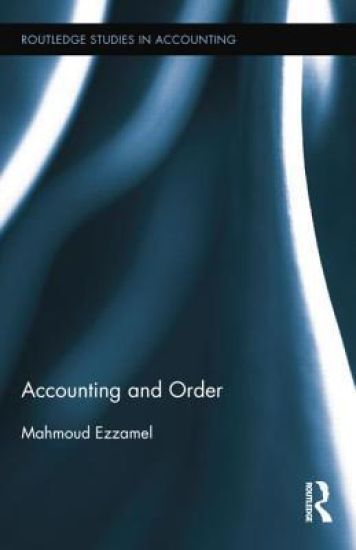
Accounting and Order

Accounting and Order

Mahmoud Ezzamel

Routledge
2014
nidottu
This book draws on ancient Egyptian inscriptions in order to theorize the relationship between accounting and order. It focuses especially on the performative power of accounting in producing and sustaining order in society. It explores how accounting intervened in various domains of the ancient Egyptian world: the cosmos; life on earth (offerings to the gods; taxation; transportation; redistribution for palace dependants; mining activities; work organization; baking and brewing; private estates and the household; and private transactions in semi-barter exchange); and the cult of the dead. The book emphasizes several possibilities through which accounting can be theorized over and above strands of theorizing that have already been explored in detail previously. These additional possibilities theorize accounting as a performative ritual; myth; a sign system; a signifier; a time ordering device; a spatial ordering device; violence; and as an archive and a cultural memory. Each of these themes are summarized with further suggestions as to how theorizing might be pursued in future research in the final chapter of the book. This book is of particular relevance to all accounting students and researchers concerned with theorize accounting and also with the relevance of history to the project of contemporary theorizing of accounting.
Accounting and Order

Accounting and Order

Mahmoud Ezzamel

Routledge
2012
sidottu
This book draws on ancient Egyptian inscriptions in order to theorize the relationship between accounting and order. It focuses especially on the performative power of accounting in producing and sustaining order in society. It explores how accounting intervened in various domains of the ancient Egyptian world: the cosmos; life on earth (offerings to the gods; taxation; transportation; redistribution for palace dependants; mining activities; work organization; baking and brewing; private estates and the household; and private transactions in semi-barter exchange); and the cult of the dead. The book emphasizes several possibilities through which accounting can be theorized over and above strands of theorizing that have already been explored in detail previously. These additional possibilities theorize accounting as a performative ritual; myth; a sign system; a signifier; a time ordering device; a spatial ordering device; violence; and as an archive and a cultural memory. Each of these themes are summarized with further suggestions as to how theorizing might be pursued in future research in the final chapter of the book. This book is of particular relevance to all accounting students and researchers concerned with theorize accounting and also with the relevance of history to the project of contemporary theorizing of accounting.
The Challenge of Management Accounting Change

The Challenge of Management Accounting Change

John Burns; Mahmoud Ezzamel; Robert W. Scapens

CIMA Publishing
2003
nidottu
The implementation of management accounting change constitutes much more than the selection of what may be perceived as being 'optimal' accounting systems and techniques, followed by a 'technical' process of implementation. Selecting and implementing the 'right' accounting systems and techniques and the technical aspects of implementation are important, but change implementation and change management also involves important behavioural and cultural issues that must be understood and addressed. The main focus of "The Challenge of Management Accounting Change" is on understanding the processes involved in the implementation of management accounting change and the complexities of, and difficulties involved in, changing management accounting systems, techniques and roles in the UK. This book outlines a framework for interpreting and understanding management accounting change as an on-going process and a range of case studies are used to illustrate both successful and unsuccessful implementations, drawing out the various lessons that can be learned and suggesting some pointers for those embarking on a programme of management accounting change. It describes the finding of a research project investigating management accounting change in the UK. It focuses on the difficulties involved in changing management accounting systems. It is written by experts in the field of management accounting.