Kirjojen hintavertailu – 12 859 828 kirjaa ja 27 kauppaa

Kirjailija

Mantz Yorke

Kirjat ja teokset yhdessä paikassa: 7 kirjaa, julkaisuja vuosilta 1999–2015, suosituimpiin kuuluu Grading Student Achievement in Higher Education. Vertaile teosten hintoja ja tarkista saatavuus suomalaisista kirjakaupoista.

7 kirjaa

Kirjojen julkaisuvuodet: 1999–2015.

Grading Student Achievement in Higher Education
A lot hangs on the summative grades that students are given. A good degree opens doors which otherwise might remain closed. Yet, as higher education is now a mass rather than an elite system, what is expected of its graduates is different from the expectations of previous generations. Students are expected not only to be able to demonstrate high standards of academic achievement, but also a variety of capabilities that have at different times been given labels such as ‘generic skills’ and ‘transferable skills’. These abilities are difficult to grade for a variety of reasons and some graduates may be losing out because their particular strengths are given insufficient acknowledgement in current summative assessment practices. Using the UK honours degree classifications as a case study, this book appraises the way in which summative assessment in higher education is approached and shows that the foundations of current practices (in the UK and elsewhere) are of questionable robustness. It argues that there is a need to widen the assessment frame if the breadth of valued student achievements is to be recognised adequately.

Grading Student Achievement in Higher Education
A lot hangs on the summative grades that students are given. A good degree opens doors which otherwise might remain closed. Yet, as higher education is now a mass rather than an elite system, what is expected of its graduates is different from the expectations of previous generations. Students are expected not only to be able to demonstrate high standards of academic achievement, but also a variety of capabilities that have at different times been given labels such as ‘generic skills’ and ‘transferable skills’. These abilities are difficult to grade for a variety of reasons and some graduates may be losing out because their particular strengths are given insufficient acknowledgement in current summative assessment practices. Using the UK honours degree classifications as a case study, this book appraises the way in which summative assessment in higher education is approached and shows that the foundations of current practices (in the UK and elsewhere) are of questionable robustness. It argues that there is a need to widen the assessment frame if the breadth of valued student achievements is to be recognised adequately.
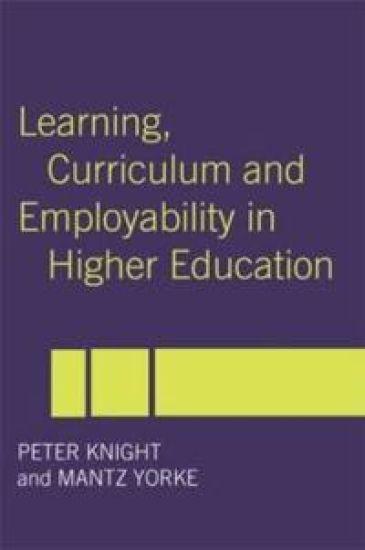
Learning, Curriculum and Employability in Higher Education
How can universities ensure that they are preparing their students for today's competitive job market? This book tackles the highly topical subject of graduate underemployment with insight and clarity. The authors argue the case for more sophisticated research into employability with passion and vision, discussing how employability-friendly curricula can be developed, even in subjects which have less obvious vocational relevance. The rapid growth of higher education over the past fifty years has seen expectations increase, and governments seeking to widen participation. There is now an urgent need for the Government and higher education institutions to address the issue of graduate employability. The authors of this timely book encourage a pro-active stance, offering a ground-breaking model that can be easily implemented in institutions to make low-cost, high-gain improvements to students' employability. Topics covered include:* The challenge of employability* The study and careers of English graduates* The enhancement of practice* Assessing employability* The Skills Plus project. Based on a set of over 200 in-depth interviews with recent graduates, this book forms a unique account of the meanings of employability in the workplace.
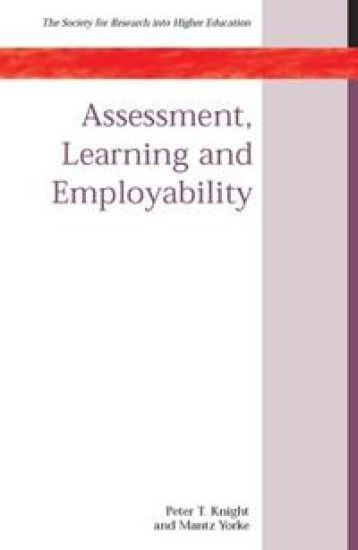
Assessment, Learning And Employability

Assessment, Learning And Employability

Peter Knight; Mantz Yorke

Open University Press
2003
nidottu
What is assessed gets attention: what is not assessed does not. When higher education is expected to promote complex achievements in subject disciplines and in terms of 'employability', problems arise: how are such achievements to be assessed? In the first part of the book, it is argued that existing grading practices cannot cope with the expectations laid upon them, while the potential of formative assessment for the support of learning is not fully realised. The authors argue that improving the effectiveness of assessment depends on a well-grounded appreciation of what assessment is, and what may and may not be expected of it. The second part covers summative judgements for high-stakes purposes. Using established measurement theory, a view is developed of the conditions under which affordable, useful, valid and reliable summative judgements can be made. One conclusion is that many complex achievements resist high-stakes assessment, which directs attention to low-stakes, essentially formative, alternatives. Assessment for learning and employability demands more than module-level changes to assessment methods. The final part discusses how institutions need to respond in policy terms to the challenges that have been posed. The book concludes with a discussion of how institutions can respond in policy terms to the challenges that have been posed. Assessment, Learning and Employability has wide and practical relevance - to teachers, module and programme leaders, higher education managers and quality enhancement specialists.
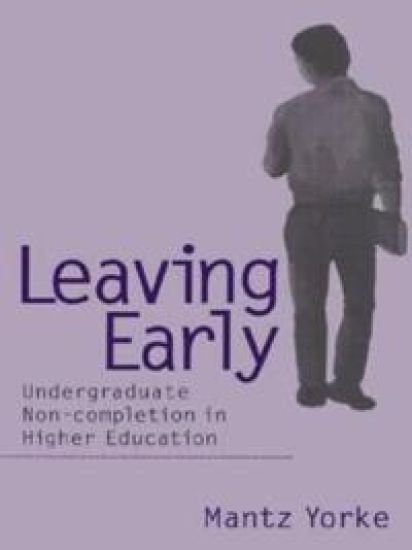
Leaving Early

Leaving Early

Mantz Yorke

Routledge Falmer
1999
sidottu
Presents the findings of new research into the problem of students dropping-out from their courses, and provides information that will help institutions understand and address the problem. The book clarifies definitions of non-completion, looks at what influences students to leave early, assesses the implications for the institution's performance and the costs to the public purse. The analysis is illustrated by examples of student experience, and highlights courses of action that may help to reduce the problem.
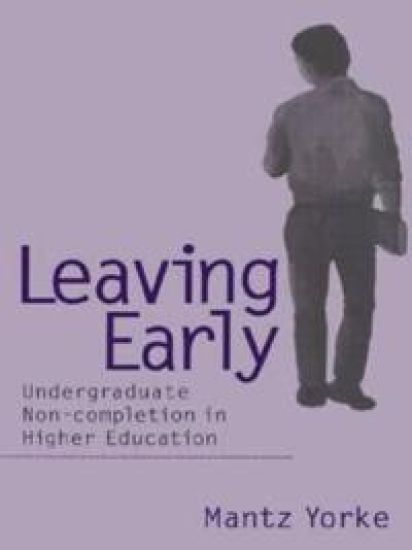
Leaving Early

Leaving Early

Mantz Yorke

Routledge Falmer
1999
nidottu
Presents the findings of new research into the problem of students dropping-out from their courses, and provides information that will help institutions understand and address the problem. The book clarifies definitions of non-completion, looks at what influences students to leave early, assesses the implications for the institution's performance and the costs to the public purse. The analysis is illustrated by examples of student experience, and highlights courses of action that may help to reduce the problem.