

Kirjailija
Marc Bloch
Kirjat ja teokset yhdessä paikassa: 33 kirjaa, julkaisuja vuosilta 1964–2026, suosituimpiin kuuluu The Selected Works of Marc Bloch. Vertaile teosten hintoja ja tarkista saatavuus suomalaisista kirjakaupoista.
33 kirjaa
Kirjojen julkaisuvuodet: 1964–2026.

Marc Bloch said that his goal in writing Feudal Society was to go beyond the technical study a medievalist would typically write and ‘dismantle a social structure.’ In this outstanding and monumental work, which has introduced generations of students and historians to the feudal period, Bloch treats feudalism as living, breathing force in Western Europe from the ninth to the thirteenth century. At its heart lies a magisterial account of relations of lord and vassal, and the origins of the nature of the fief, brought to life through compelling accounts of the nobility, knighthood and chivalry, family relations, political and legal institutions, and the church. For Bloch history was a process of constant movement and evolution and he describes throughout the slow process by which feudal societies turned into what would become nation states. A tour de force of historical writing, Feudal Society is essential reading for anyone interested in both Western Europe’s past and present. With a new foreword by Geoffrey Koziol

L' trange D faite. T moignage crit en 1940 est un t moignage sur la bataille de France crit en 1940 par Marc Bloch, officier et historien, qui a particip aux deux guerres mondiales. Dans ce livre, il ne raconte pas ses souvenirs personnels, mais il s'efforce, en t moin objectif, de comprendre les raisons de la d faite fran aise lors de la bataille de France pendant la Seconde Guerre mondiale. R dig sur le moment, L' trange D faite a marqu les esprits d s sa parution par la pertinence des constats qui y sont faits. Malgr le manque d'informations sa disposition et le d savantage de l'analyse chaud, Marc Bloch fait une analyse des causes de la d faite de 1940 qui n'a pas t profond ment remise en cause ce jour et a ouvert la question de savoir dans quelle mesure les lites ont pr f r la victoire d'Hitler face la mont e du communisme. Le texte L' trange D faite peut se voir comme la d position d'un t moin face au tribunal de l'Histoire. Il comporte trois parties in gales. En guise d'introduction, Marc Bloch pr sente sa position personnelle et son action au cours de la campagne de 1940 dans une Pr sentation du t moin. La d position de ce t moin constitue l'essentiel de l'ouvrage, La d position d'un vaincu. Il y analyse les carences de l'arm e fran aise durant l'avant-guerre et la guerre. Il conclut par un Examen de conscience d'un Fran ais, o il fait le lien entre les carences observ es et celles qu'il identifie dans la soci t fran aise de l'Entre-deux-guerres.
Land and Work in Mediaeval Europe was first published in English in 1967. Throughout the work, the idea that Marc Bloch was not only a historian but a great teacher is exemplified, as is his ability to ask interesting and original questions through his writing. Topics covered include medieval Germany, technical problems in the medieval economy and society, and the medieval class structure.

First published in English in 1973, The Royal Touch explores the supernatural character that was long attributed to royal power. Throughout history, both France and England claimed to hold kings with healing powers who, by their touch, could cure people from all strands of society from illness and disease. Indeed, the idea of royalty as something miraculous and sacred was common to the whole of Western Europe. Using the work of both professional scholars and of doctors, this work stands as a contribution to the political history of Europe.

First published in English in 1971, The Ile-de-France presents the reader with a study of the countryside around Paris through the eyes of Marc Bloch, a man with his own view of history. It looks at the area’s origins, extent, geographical features, archaeology, and past local histories. The book extends beyond the region of Paris itself and offers the reader a masterful demonstration of the methodology of such enquiries and their purpose within the wider context of historical research. The work is particularly valuable in that it covers a wide variety of subjects and makes extensive use of archives and original documents.
Marc Bloch said that his goal in writing Feudal Society was to go beyond the technical study a medievalist would typically write and ‘dismantle a social structure.’ In this outstanding and monumental work, which has introduced generations of students and historians to the feudal period, Bloch treats feudalism as living, breathing force in Western Europe from the ninth to the thirteenth century. At its heart lies a magisterial account of relations of lord and vassal, and the origins of the nature of the fief, brought to life through compelling accounts of the nobility, knighthood and chivalry, family relations, political and legal institutions, and the church. For Bloch history was a process of constant movement and evolution and he describes throughout the slow process by which feudal societies turned into what would become nation states. A tour de force of historical writing, Feudal Society is essential reading for anyone interested in both Western Europe’s past and present. With a new foreword by Geoffrey Koziol

Marc Bloch wrote Strange Defeat during the three months following the fall of France, after he returned home from military service. In the midst of his anguish, he nevertheless "brought to his study of the crisis all the critical faculty and all the penetrating analysis of a first-rate historian" (Christian Science Monitor). Bloch takes a close look at the military failures he witnessed, examining why France was unable to respond to attack quickly and effectively. He gives a personal account of the battle of France, followed by a biting analysis of the generation between the wars. His harsh conclusion is that the immediate cause of the disaster was the utter incompetence of the High Command, but his analysis ranges broadly, appraising all the factors, social as well as military, which since 1870 had undermined French national solidarity.
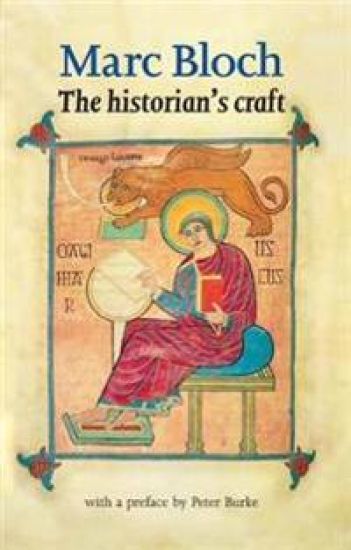
This work, by the co-founder of the "Annales School" deals with the uses and methods of history. It is useful for students of history, teachers of historiography and all those interested in the writings of the Annales school.
Describes social, political, and economic conditions that contributed to the development of and characterized European feudal society. Bibliogs
Describes social, political, and economic conditions that contributed to the development of and characterized European feudal society. Bibliogs
The Historian's Craft: Reflections on the Nature and Uses of History and the Techniques and Methods of Those Who Write It.
Marc Bloch
VINTAGE
1964
pokkari
In this classic work, distinguished French economic historian, Marc Bloch, discusses the techniques of historical observation, analysis, and criticism, and the reestablishment of historical causation in assessing events. What is the value of history? What is the use of history? How do scholars attempt to unpack it and make connections in a responsible manner? While the topics of historiography and historical methodology have become increasingly popular, Bloch remains an authority. He argues that history is a whole; no period and no topic can be understood except in relation to other periods and topics. And what is unique about Bloch is that he puts his theories into practice; for example, calling upon both his experience serving in WWI as well as his many years spent in peaceful study and reflection. He also argues that written records are not enough; a historian must draw upon maps, place-names, ancient tools, aerial surveys, folklore, and everything that is available. This is a work that argues constantly for a wider, more human history. For a history that describes how and why people live and work together. There is a living, breathing connection between the past and the present and it is the historian's responsibility to do it justice.