Kirjojen hintavertailu – 12 903 735 kirjaa ja 27 kauppaa

Kirjailija

Marcel Duchamp

Kirjat ja teokset yhdessä paikassa: 6 kirjaa, julkaisuja vuosilta 1989–2023, suosituimpiin kuuluu Given - Reutersward Fahlstroem Duchamp. Vertaile teosten hintoja ja tarkista saatavuus suomalaisista kirjakaupoista.

6 kirjaa

Kirjojen julkaisuvuodet: 1989–2023.

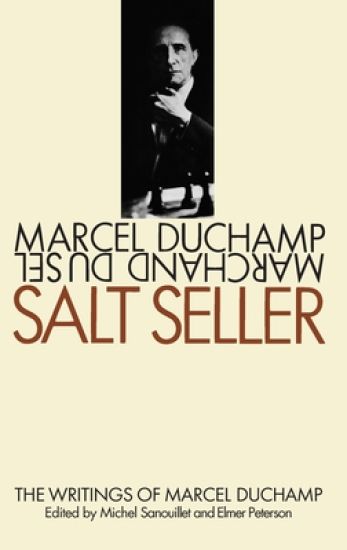
Salt Seller

Salt Seller

Marcel Duchamp; Michel Sanouillet; Elmer Peterson

OXFORD UNIVERSITY PRESS INC
2023
sidottu
Nude Descending a Staircase is one of the best known works of art in tihs century. It caused a sensation at the historic Armory Show of 1913, being damned by one critic as "an explosion in a shingle factory." Yet the criticism in no way perturbed it imperturable creator, Marcel Duchamp. Duchamp's "readymades" (the urinal singed by R. Mutt and entitled Fountain, the snow shovel entitled In Advance of the Broken Arm, and other objects bought and exhibits as works of art) are by now familiar objecs of critical derision and delight. And Duchamp's influence has been pervasive throughout modern art, fosterin Neo-Dada, Op Art, Pop Art, and Conceptual Art. Marcel Duchamp's major work, The Bride Stripped Bare by her Bachelors, Even (also known as The Large Glass) was left in a state of "definitive incompletion" in 1923. The notes for this extradordinarywork form the largest part of SALT SELLER. Duchamp collected many of them for his Green Box in 1934, when their publication was immediately hailed by Andre Breton as a major intellectual event. The notes themselves will help the curious but mystified spectator of The Large Glass in no simple or straighforward way. They do, however, demonstrate wht an extraordinarily original process the making of The Bride Stripped Barde by Her Bachelors, Even was. Duchamp's wit is nowhere in greater evidence than in the section "Rrose Selavy & Co." Duchamp was photographed in women's apparel by Man Ray and created a "readymade" female alter-ego Rrose Selavy ("Eros c'est la vie" or "arroser la vie" - drink it up; celebrate life). Rrose printed a calling card and her company advertised -- "For practical wear, a Rrose Selavy creation: The oblong cress, designed exclusively for ladies afflicted with hiccups." The company also had a service department which made "...home deliveries: domestic mosquitoes (half stock.)" The surrealists had proclaimed in the twenties that words were no longer playing around but had started making clove. This description seems to fit the sayings of Rrose Selavy who fashioned some of the most joyour and ingenious couplings and uncouplings in modern literautre.' In the section "Marcel Duchamp, Criticavit", the more serious side of Duchamp is represented by two informative interviews and two important statements on art, "The Creative Act" and "Apropos of Readymades." His more experimental writings are grouped under the title "Texticles." Taken together these varied writings constitute a major document of modern art. Whether the reader sits back and enjoys the charms of Duchamp or studies and attempts to decipher his inner-most secrets, the reader will find SALT SELLAR a compendium of delight.

Given - Reutersward Fahlstroem Duchamp

Given - Reutersward Fahlstroem Duchamp

Marcel Duchamp; Carl Frederik Reutersward; OEyvind Fahlstroem

SNOECK VERLAGSGESELLSCHAFT MBH
2022
sidottu
yvind Fahlstr m and Carl Fredrik Reutersw rd - his work is prominently represented in the collection of the Sprengel Museum Hannover through a generous donation by the artist - belonged to a circle within the Swedish art scene of the 1950s and 60s that was united in its veneration of Marcel Duchamp and an enthusiasm for his work, yet also in its fierce rejection of Abstract Expressionism. The exhibition, and especially the book GEGEBEN SIND, brings together the works of these three very different artists, revealing numerous connecting lines between their works, and gradually, in their concepts and games, in their wordplay and irony, one realizes what these artists have in common. Among Reutersw rd's best-known works is the sculpture Non Violence , the revolver with the knotted barrel placed in front of the New York headquarters of the UN, which has become a symbol, as it were, of the that institution's seemingly almost impossible task of preserving peace. The sculpture, which has been installed at sixteen other locations around the world, was Carl Frederik Reutersw rd's response to the assassination of John Lennon.
Marcel Duchamp (Bilingual edition)

Marcel Duchamp (Bilingual edition)

Marcel Duchamp; Sarah Archino; Kornelia von Berswordt-Wallrabe; Patricia Bethlen; Deborah Bürgel; Paul B. Franklin; Gerhard Graulich; Sarah Kolb

Hatje Cantz
2020
nidottu
Marcel Duchamp: one of his themes was the boundary between works of art and everyday objects, and with it, he set the art world in an uproar. Surely one of his most brilliant strokes of genius was the Fountain, a urinal he put on display. There are, of course, many more works that bear his signature, and the Duchamp Collection in Schwerin has ninety-two of them. Founded in 2009, the research centre has succeeded in establishing an interdisciplinary, globally connected network of researchers in Schwerin. Under the title Marcel Duchamp: Inventing the Presence, individual as well as groups of artworks from the Schwerin collection are examined from philosophical, art historical, and literary perspectives in volume five of the series Poiesis.
Duchamp: Museum in a box

Duchamp: Museum in a box

Marcel Duchamp; Rrose Sélavy

Verlag der Buchhandlung Walther Konig
2016
sidottu

Halvin toimitettuna 169,10 €

With his Boîte-en-valise, or Museum in a Box, Duchamp embarked on one of his more ambitious projects: a portable museum of miniature replicas and facsimiles created with the help of elaborate reproduction techniques as pochoir (a type of hand stencilling) and comprising his most important works. Conceived in the mid-1930s and consisting of eighty-one items, it was first released in 1941 and continued to be assembled in various editions until after his death, with the final seven different series totalling about 300 items. This publication is a facsimile of the series D, 1961 edition. Created with the full approval of the Duchamp Estate, it contains a reproduction of The Large Glass on Plexiglas, colour reproductions of his pictures, reproductions of his drawings and a selection of his humorous texts, a glass vial of Parisian air, a urinal, a small sugar dispenser, ‘canned chance’ and other miscellanea, all housed in a green cardboard box.
3 New York Dadas And The Blind Man

3 New York Dadas And The Blind Man

Marcel Duchamp; Henri-Pierre Roche; Beatrice Wood

Atlas Press
2013
sidottu
Three New York Dadas and The Blind Man relates the story of the triangular relationship between Marcel Duchamp, Henri-Pierre Roch and Beatrice Wood, told in the words of two of its protagonists; and also reprints in facsimile the Dadaist magazine they produced together in New York in 1917: The Blind Man. The principal text is the first English translation of Roch 's novel Victor, an account of his friendship with Duchamp (nicknamed Victor by his close friends in those days). Although unfinished, Roch 's text offers a unique account of New York Dada, all of whose principal characters and events make an appearance: Francis Picabia, Arthur Cravan, the Arensbergs and their soir es, the Blind Man's Ball and the scandal of Duchamp's "Fountain" at the Independents exhibition, a pivotal moment in modern art. The novel offers interesting insights into the sexual politics of the period, when a woman could be arrested or blackmailed for spending the night with a man to whom she was not married. Roch , a lifelong friend of Duchamp, appears to have been something of a devotee of triangular relationships, and went on to write a more famous novel on the topic (also autobiographical), Jules et Jim--later made into a film by Fran ois Truffaut. Beatrice Wood's account of these events is taken from her memoirs; she went on to become a celebrated ceramicist, dying in 1998 aged 105. The introduction and commentary is by Dawn Ades, the well-known scholar of Dada and Surrealism.
The Writings Of Marcel Duchamp

The Writings Of Marcel Duchamp

Elmer Peterson; Marcel Duchamp; Michel Sanouillet

Da Capo Press Inc
1989
pokkari

Halvin toimitettuna 31,50 €

In the twenties, Surrealists proclaimed that words had stopped playing around and had begun to make love. Nowhere is this more apparent than in the writings of Marcel Duchamp, who fashioned some of the more joyous and ingenious couplings and uncouplings in modern art. This collection beings together two essential interviews and two statements about his art that underscore the serious side of Duchamp. But most of the book is made up of his experimental writings, which he called "Texticles," the long and extraordinary notes he wrote for The Bride Stripped Bare By Her Bachelors, Eben (also known as The Large Glass ), and the outrageous puns and alter-ego he constructed for his female self, Rrose Sélavy ("Eros, c'est la vie" or arouser la vie", drink it up" celebrate life"). Wacky, perverse, deliberately frustrating, these entertaining notes are basic for understanding one of the twentieth century's most provocative artists, a figure whose influence on the contemporary scene has never been stronger.