Kirjojen hintavertailu – 12 903 725 kirjaa ja 27 kauppaa

Kirjailija

Marco Breda

Kirjat ja teokset yhdessä paikassa: 5 kirjaa, julkaisuja vuosilta 2018–2025, suosituimpiin kuuluu The Topological Weighted Centroid: A New Vision of Geographic Profiling. Vertaile teosten hintoja ja tarkista saatavuus suomalaisista kirjakaupoista.

5 kirjaa

Kirjojen julkaisuvuodet: 2018–2025.

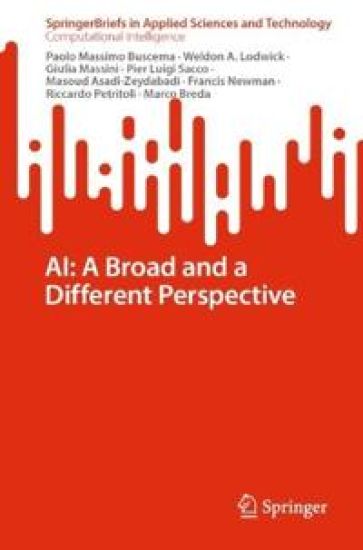
AI: A Broad and a Different Perspective

AI: A Broad and a Different Perspective

Paolo Massimo Buscema; Weldon A. Lodwick; Giulia Massini; Pier Luigi Sacco; Masoud Asadi-Zeydabadi; Francis Newman; Riccardo Petritoli; Marco Breda

Springer International Publishing AG
2025
nidottu
One of the primary objectives of this book is to highlight the profound difference between two types of AI that pursue distinct goals: emulative AI, which seeks to build machines whose output is similar to, or even superior to, that of the human brain, and investigative AI, whose purpose is to make invisible information within data visible by uncovering the laws through which individual behaviors self-organize into collective behaviors. The former is better known, as it serves as a useful tool for automating human labor and generating market profits; the latter is less widely recognized but is more scientifically oriented towards saving lives (in the medical field), explaining otherwise inexplicable phenomena (in the geophysical field), and enhancing our understanding of the material and abstract world. Both are valuable yet distinct: the emulative approach generates immediate profits and creates illusions of human-like power, while the investigative approach enhances fundamental scientific research and will yield its greatest benefits over time. The investigative approach presented in this volume seeks to rebuild the bridge between humanity and nature.

The Topological Weighted Centroid: A New Vision of Geographic Profiling

The Topological Weighted Centroid: A New Vision of Geographic Profiling

Massimo Buscema; Masoud Asadi-Zeydabadi; Giulia Massini; Weldon A. Lodwick; Marco Breda; Riccardo Petritoli; Francis Newman; Francesca Della Torre

Springer International Publishing AG
2024
nidottu
This book introduces the Topological Weighed Centroid approach and describes some applications in the study of the dynamics of various spatial phenomena with a special emphasis on the spatial analysis of the relationship, influence, and dynamics of geographical phenomena. Offering a comprehensive introduction to the theory and illustrative examples from various kinds of geographical data, this book also takes an in-depth look at more complex case studies, such as the applications of the topological weighed centroid approach in the study of epidemic patterns, cultural processes, criminality, and environmental phenomena.
The Topological Weighted Centroid: A New Vision of Geographic Profiling

The Topological Weighted Centroid: A New Vision of Geographic Profiling

Massimo Buscema; Masoud Asadi-Zeydabadi; Giulia Massini; Weldon A. Lodwick; Marco Breda; Riccardo Petritoli; Francis Newman; Francesca Della Torre

Springer International Publishing AG
2023
sidottu
This book introduces the Topological Weighed Centroid approach and describes some applications in the study of the dynamics of various spatial phenomena with a special emphasis on the spatial analysis of the relationship, influence, and dynamics of geographical phenomena. Offering a comprehensive introduction to the theory and illustrative examples from various kinds of geographical data, this book also takes an in-depth look at more complex case studies, such as the applications of the topological weighed centroid approach in the study of epidemic patterns, cultural processes, criminality, and environmental phenomena.
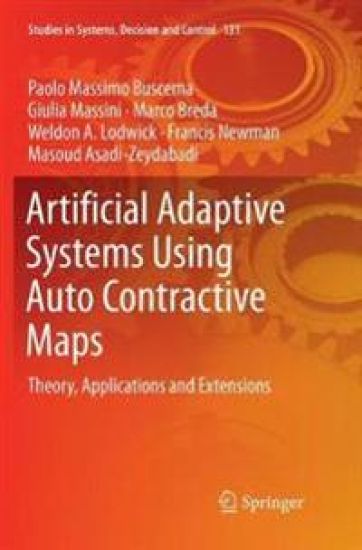
Artificial Adaptive Systems Using Auto Contractive Maps

Artificial Adaptive Systems Using Auto Contractive Maps

Paolo Massimo Buscema; Giulia Massini; Marco Breda; Weldon A. Lodwick; Francis Newman; Masoud Asadi-Zeydabadi

Springer Nature Switzerland AG
2018
nidottu
This book offers an introduction to artificial adaptive systems and a general model of the relationships between the data and algorithms used to analyze them. It subsequently describes artificial neural networks as a subclass of artificial adaptive systems, and reports on the backpropagation algorithm, while also identifying an important connection between supervised and unsupervised artificial neural networks. The book’s primary focus is on the auto contractive map, an unsupervised artificial neural network employing a fixed point method versus traditional energy minimization. This is a powerful tool for understanding, associating and transforming data, as demonstrated in the numerous examples presented here. A supervised version of the auto contracting map is also introduced as an outstanding method for recognizing digits and defects. In closing, the book walks the readers through the theory and examples of how the auto contracting map can be used in conjunction with another artificial neural network, the “spin-net,” as a dynamic form of auto-associative memory.
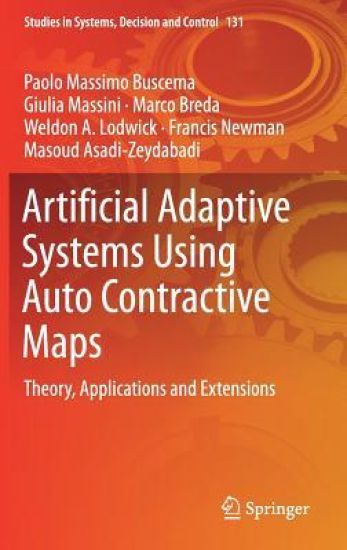
Artificial Adaptive Systems Using Auto Contractive Maps

Artificial Adaptive Systems Using Auto Contractive Maps

Paolo Massimo Buscema; Giulia Massini; Marco Breda; Weldon A. Lodwick; Francis Newman; Masoud Asadi-Zeydabadi

Springer International Publishing AG
2018
sidottu
This book offers an introduction to artificial adaptive systems and a general model of the relationships between the data and algorithms used to analyze them. It subsequently describes artificial neural networks as a subclass of artificial adaptive systems, and reports on the backpropagation algorithm, while also identifying an important connection between supervised and unsupervised artificial neural networks. The book’s primary focus is on the auto contractive map, an unsupervised artificial neural network employing a fixed point method versus traditional energy minimization. This is a powerful tool for understanding, associating and transforming data, as demonstrated in the numerous examples presented here. A supervised version of the auto contracting map is also introduced as an outstanding method for recognizing digits and defects. In closing, the book walks the readers through the theory and examples of how the auto contracting map can be used in conjunction with another artificial neural network, the “spin-net,” as a dynamic form of auto-associative memory.