Kirjojen hintavertailu – 12 903 735 kirjaa ja 27 kauppaa

Kirjailija

Marcus G. Raskin

Kirjat ja teokset yhdessä paikassa: 9 kirjaa, julkaisuja vuosilta 1987–2025, suosituimpiin kuuluu The State and Democracy. Vertaile teosten hintoja ja tarkista saatavuus suomalaisista kirjakaupoista.

9 kirjaa

Kirjojen julkaisuvuodet: 1987–2025.

The State and Democracy

The State and Democracy

Marc V. Levine; Carol MacLennan; John J. Kushma; Charles Noble; Jeff Faux; Marcus G. Raskin

TAYLOR FRANCIS LTD
2025
sidottu
Corporate domination of public policy during the Reagan years resulted not only in increasing inequality and deteriorating living standards for millions of Americans, but in a diminution in the capacity of government to solve basic problems that are not amenable to market-oriented solutions. The authors of The State and Democracy (originally published in 1988) propose a new public philosophy for America: one which comprises communitarian values; governments at all levels which actively pursue the public interest; a participatory political culture; and a democratic, accountable process of public choice. Because of the authors’ extensive experience both inside and outside government, they offer a fresh, interdisciplinary perspective based not only on extensive research and study, but also on first-hand experience.
The Common Good

The Common Good

Marcus G. Raskin

Routledge
2021
nidottu
First published in 1986. In this thought-provoking book the widely acclaimed thinker and activist, Marcus Raskin, moves beyond the limits and failures of socialism and capitalism to an original theory of social reconstruction for a humane society. Presenting concrete alternatives for education, health, economics and national security he develops a new conception of democracy and the rule of law in relation to our common good. A political and philosophic tool designed for those who search for alternatives in their lives and in the world, The Common Good shows how to organize for social reconstruction, the type of leadership now required, and the importance of restoring progress as a political purpose. Defining politics as broader than the mere manifestation of power, Raskin’s vision helps the left and liberals find their way towards a new public philosophy and program.
The Common Good

The Common Good

Marcus G. Raskin

Routledge
2019
sidottu
First published in 1986. In this thought-provoking book the widely acclaimed thinker and activist, Marcus Raskin, moves beyond the limits and failures of socialism and capitalism to an original theory of social reconstruction for a humane society. Presenting concrete alternatives for education, health, economics and national security he develops a new conception of democracy and the rule of law in relation to our common good. A political and philosophic tool designed for those who search for alternatives in their lives and in the world, The Common Good shows how to organize for social reconstruction, the type of leadership now required, and the importance of restoring progress as a political purpose. Defining politics as broader than the mere manifestation of power, Raskin’s vision helps the left and liberals find their way towards a new public philosophy and program.
Warfare Welfare

Warfare Welfare

Marcus G. Raskin

Potomac Books Inc
2012
sidottu
This edited volume reveals how a permanent war economy has made the United States unable to spread democracy abroad and has worsened domestic problems. The editors draw from classical readings in political theory, from primary documents (including key court decisions), and from social science research to analyze such issues as the effect of militarization and combativeness on the everyday lives of Americans. The editors also address the dire connection among banking losses, the housing recession, the welfare/national security state, and the challenge of rebuilding America's infrastructure. Raskin and Squires ultimately conclude that only by making war an unattractive option and dismantling the warfare system can meaningful progress be made on the current foreign and domestic challenges facing the United States. They also offer steps to replace the warfare system, outlining the ideological and material transformations necessary for peace. Students of political science, sociology, history, and law will find this a thought-provoking, forward-thinking contribution concerning America's future at home and abroad.
Warfare Welfare

Warfare Welfare

Marcus G. Raskin

Potomac Books Inc
2012
pokkari
This edited volume reveals how a permanent war economy has made the United States unable to spread democracy abroad and has worsened domestic problems. The editors draw from classical readings in political theory, from primary documents (including key court decisions), and from social science research to analyze such issues as the effect of militarization and combativeness on the everyday lives of Americans. The editors also address the dire connection among banking losses, the housing recession, the welfare/national security state, and the challenge of rebuilding America's infrastructure. Raskin and Squires ultimately conclude that only by making war an unattractive option and dismantling the warfare system can meaningful progress be made on the current foreign and domestic challenges facing the United States. They also offer steps to replace the warfare system, outlining the ideological and material transformations necessary for peace. Students of political science, sociology, history, and law will find this a thought-provoking, forward-thinking contribution concerning America's future at home and abroad.
The Four Freedoms Under Siege

The Four Freedoms Under Siege

Marcus G. Raskin; Robert Spero; Barbara Ehrenreich

Potomac Books Inc
2009
pokkari
FDR’s Four Freedoms-Freedom of Speech, Freedom to Worship, Freedom from Want, and Freedom from Fear-were presented to the American people in his 1941 State of the Union address, and they became the inspiration for a second bill of rights, extending the New Deal and guaranteeing work, housing, medical care, and education. Although the bill never was adopted in a legal sense in this country, its principles pervaded the political landscape for an entire generation, including the War on Poverty and the Great Society reforms of the 1960s. The ideas expressed in the Four Freedoms speech inspired the Universal Declaration of Human Rights. But since the late 1970s and early 1980s, these freedoms have been under assault, from administrations of both parties, economic pressures, and finally, the alleged requirements of national security. After 9/11, this process accelerated even more rapidly. The authors address the hard questions of individual freedom versus national security that are on the minds of Americans of all political stripes. They bring together the pivotal events, leaders, policies, and fateful decisions-often pathbreaking, more often ending in folly-that have subverted our constitutional government from its founding. “You reach the inescapable conclusion,” the authors write, “that the United States is a warrior nation, has been addicted to war from the start, and is able to sustain its warfare habit only by mugging American taxpayers, and believing in its mission as God’s chosen.” The Four Freedoms Under Siege features a foreword by Barbara Ehrenreich, a journalist, activist, and the author of Nickel and Dimed: On (Not) Getting By in America.
Liberalism

Liberalism

Marcus G. Raskin

Rowman Littlefield Publishers
2003
sidottu
Contrary to those who believe that liberalism has descended into the dustbins of history, renowned political activist and social critic Marcus G. Raskin argues that there is no escape from liberalism. Against the empty-headed and mean-spirited conservative onslaught of recent times, Raskin asserts and ably demonstrates how the liberal purpose is tied to human liberation and inclusivity for all people. For liberalism to succeed in a new century, it must reckon with its past mistakes—especially its reluctance to be bold. It must also embrace the inextricably interwoven character of morality and politics. To this end, Raskin seeks no less than a new intellectual and spiritual covenant in the university, the political economy, and foreign policy. He shows how this is possible through a radical rethinking of America's role in the world including war avoidance and economic restructuring. He probes the tensions and limits as well as the promise of community, family, and technology. His text helps us recognize the potential of a new multiculturalism within American society and the important role that knowledge workers and specialists will play as change agents in a changed world. Liberalism: The Genius of American Ideals traces Raskin's remarkable journey of the last fifty years through social and political action as well as thought. It is a book for people 'in motion' who realize the importance of humane ideas in relation to action, aware not only that peace should be given a chance but that our best instincts must also be engaged through the reconstruction of our institutions. In the face of a new, distinctly uncompassionate brand of conservatism that has shuttered the doors to the very real world of struggle, alienation, and pain, Liberalism is intended to hold a candle in the window of this dark time.
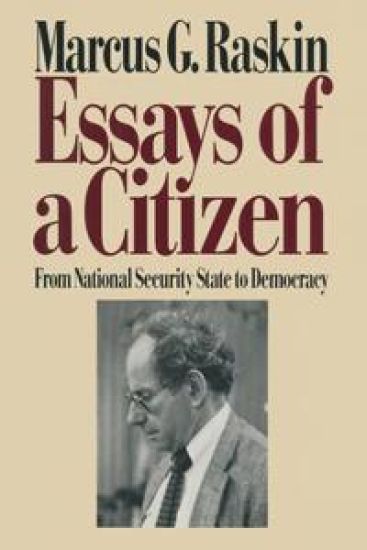
Essays of a Citizen: From National Security State to Democracy
First Published in 1992. This volume includes Raskin's political essays on true democracy in running a nation's security affairs. He explores the arrogance of power, offers a commitment to constructive critique of government policy and alternative proposals to resolve problems of a nation trying to live up to the principles of the Declaration of Independence.