Kirjojen hintavertailu – 12 903 735 kirjaa ja 27 kauppaa

Kirjailija

Marek Rutkowski

Kirjat ja teokset yhdessä paikassa: 5 kirjaa, julkaisuja vuosilta 2001–2010, suosituimpiin kuuluu Paris-Princeton Lectures on Mathematical Finance 2003. Vertaile teosten hintoja ja tarkista saatavuus suomalaisista kirjakaupoista.

5 kirjaa

Kirjojen julkaisuvuodet: 2001–2010.

Paris-Princeton Lectures on Mathematical Finance 2003

Paris-Princeton Lectures on Mathematical Finance 2003

Tomasz R. Bielecki; Tomas Björk; Monique Jeanblanc; Marek Rutkowski; Jose A. Scheinkman; Wei Xiong

Springer-Verlag Berlin and Heidelberg GmbH Co. K
2004
nidottu
The Paris-Princeton Lectures in Financial Mathematics, of which this is the second volume, will, on an annual basis, publish cutting-edge research in self-contained, expository articles from outstanding - established or upcoming! - specialists. The aim is to produce a series of articles that can serve as an introductory reference for research in the field. It arises as a result of frequent exchanges between the finance and financial mathematics groups in Paris and Princeton. This volume presents the following articles: "Hedging of Defaultable Claims" by T. Bielecki, M. Jeanblanc, and M. Rutkowski; "On the Geometry of Interest Rate Models" by T. Björk; "Heterogeneous Beliefs, Speculation and Trading in Financial Markets" by J. A. Scheinkman, and W. Xiong.
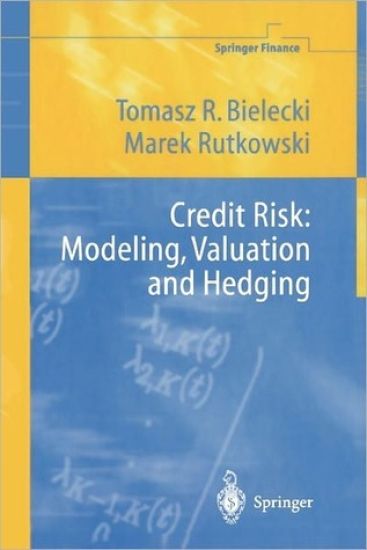
Credit Risk: Modeling, Valuation and Hedging

Credit Risk: Modeling, Valuation and Hedging

Tomasz R. Bielecki; Marek Rutkowski

Springer-Verlag Berlin and Heidelberg GmbH Co. K
2010
nidottu
Mathematical finance and financial engineering have been rapidly expanding fields of science over the past three decades. The main reason behind this phenomenon has been the success of sophisticated quantitative methodolo­ gies in helping professionals manage financial risks. It is expected that the newly developed credit derivatives industry will also benefit from the use of advanced mathematics. This industry has grown around the need to handle credit risk, which is one of the fundamental factors of financial risk. In recent years, we have witnessed a tremendous acceleration in research efforts aimed at better comprehending, modeling and hedging this kind of risk. Although in the first chapter we provide a brief overview of issues related to credit risk, our goal was to introduce the basic concepts and related no­ tation, rather than to describe the financial and economical aspects of this important sector of financial market. The interested reader may consult, for instance, Francis et al. (1999) or Nelken (1999) for a much more exhaustive description of the credit derivatives industry.
Martingale Methods in Financial Modelling

Martingale Methods in Financial Modelling

Marek Musiela; Marek Rutkowski

Springer-Verlag Berlin and Heidelberg GmbH Co. K
2010
nidottu
In the 2nd edition some sections of Part I are omitted for better readability, and a brand new chapter is devoted to volatility risk. As a consequence, hedging of plain-vanilla options and valuation of exotic options are no longer limited to the Black-Scholes framework with constant volatility. In the 3rd printing of the 2nd edition, the second Chapter on discrete-time markets has been extensively revised. Proofs of several results are simplified and completely new sections on optimal stopping problems and Dynkin games are added. Applications to the valuation and hedging of American-style and game options are presented in some detail. The theme of stochastic volatility also reappears systematically in the second part of the book, which has been revised fundamentally, presenting much more detailed analyses of the various interest-rate models available: the authors' perspective throughout is that the choice of a model should be basedon the reality of how a particular sector of the financial market functions, never neglecting to examine liquid primary and derivative assets and identifying the sources of trading risk associated. This long-awaited new edition of an outstandingly successful, well-established book, concentrating on the most pertinent and widely accepted modelling approaches, provides the reader with a text focused on practical rather than theoretical aspects of financial modelling.
Martingale Methods in Financial Modelling

Martingale Methods in Financial Modelling

Marek Musiela; Marek Rutkowski

Springer-Verlag Berlin and Heidelberg GmbH Co. K
2004
sidottu
In the 2nd edition some sections of Part I are omitted for better readability, and a brand new chapter is devoted to volatility risk. As a consequence, hedging of plain-vanilla options and valuation of exotic options are no longer limited to the Black-Scholes framework with constant volatility. In the 3rd printing of the 2nd edition, the second Chapter on discrete-time markets has been extensively revised. Proofs of several results are simplified and completely new sections on optimal stopping problems and Dynkin games are added. Applications to the valuation and hedging of American-style and game options are presented in some detail. The theme of stochastic volatility also reappears systematically in the second part of the book, which has been revised fundamentally, presenting much more detailed analyses of the various interest-rate models available: the authors' perspective throughout is that the choice of a model should be basedon the reality of how a particular sector of the financial market functions, never neglecting to examine liquid primary and derivative assets and identifying the sources of trading risk associated. This long-awaited new edition of an outstandingly successful, well-established book, concentrating on the most pertinent and widely accepted modelling approaches, provides the reader with a text focused on practical rather than theoretical aspects of financial modelling.
Credit Risk: Modeling, Valuation and Hedging

Credit Risk: Modeling, Valuation and Hedging

Tomasz R. Bielecki; Marek Rutkowski

Springer-Verlag Berlin and Heidelberg GmbH Co. K
2001
sidottu
Mathematical finance and financial engineering have been rapidly expanding fields of science over the past three decades. The main reason behind this phenomenon has been the success of sophisticated quantitative methodolo­ gies in helping professionals manage financial risks. It is expected that the newly developed credit derivatives industry will also benefit from the use of advanced mathematics. This industry has grown around the need to handle credit risk, which is one of the fundamental factors of financial risk. In recent years, we have witnessed a tremendous acceleration in research efforts aimed at better comprehending, modeling and hedging this kind of risk. Although in the first chapter we provide a brief overview of issues related to credit risk, our goal was to introduce the basic concepts and related no­ tation, rather than to describe the financial and economical aspects of this important sector of financial market. The interested reader may consult, for instance, Francis et al. (1999) or Nelken (1999) for a much more exhaustive description of the credit derivatives industry.