Kirjojen hintavertailu – 12 876 531 kirjaa ja 26 kauppaa

Kirjailija

Margaret S. Archer

Kirjat ja teokset yhdessä paikassa: 18 kirjaa, julkaisuja vuosilta 1995–2025, suosituimpiin kuuluu Teoría social realista. Vertaile teosten hintoja ja tarkista saatavuus suomalaisista kirjakaupoista.

18 kirjaa

Kirjojen julkaisuvuodet: 1995–2025.

Morphogenesis Answers Its Critics

Morphogenesis Answers Its Critics

Margaret S. Archer

Cambridge University Press
2025
pokkari
In this final book by renowned sociologist Margaret S. Archer, her groundbreaking morphogenetic approach is defended, refined and extended through a series of engagements with her critics. Archer, a pioneer of critical realism, addresses key debates surrounding her work on structure, agency, and social change. Each chapter responds to critiques from a different scholar, using these exchanges as springboards to further develop her powerful explanatory framework. Through these lively dialogues, Archer elaborates her tools for analysing social and cultural dynamics. This book offers readers a unique window into Archer's thought as she clarifies, sharpens and expands her theoretical contributions in response to constructive criticism. It will be an essential read for scholars and students across the social sciences, and for anyone seeking to understand the forces that shape our social world and how we can reshape it.

Morphogenesis Answers Its Critics

Morphogenesis Answers Its Critics

Margaret S. Archer

Cambridge University Press
2024
sidottu
In this final book by renowned sociologist Margaret S. Archer, her groundbreaking morphogenetic approach is defended, refined and extended through a series of engagements with her critics. Archer, a pioneer of critical realism, addresses key debates surrounding her work on structure, agency, and social change. Each chapter responds to critiques from a different scholar, using these exchanges as springboards to further develop her powerful explanatory framework. Through these lively dialogues, Archer elaborates her tools for analysing social and cultural dynamics. This book offers readers a unique window into Archer's thought as she clarifies, sharpens and expands her theoretical contributions in response to constructive criticism. It will be an essential read for scholars and students across the social sciences, and for anyone seeking to understand the forces that shape our social world and how we can reshape it.
Moral Agency within Social Structures and Culture

Moral Agency within Social Structures and Culture

Margaret S. Archer; Lisa Sowle Cahill

Georgetown University Press
2020
sidottu
Christian ethics has addressed moral agency and culture from the start, and Christian social ethics increasingly acknowledges the power of social structures. However, neither has made sufficient use of the discipline that specializes in understanding structures and culture: sociology. In Moral Agency within Social Structures and Culture, editor and contributor Daniel K. Finn proposes a field-changing critical realist sociology that puts Christian ethics into conversation with modern discourses on human agency and social transformation. Catholic social teaching mischaracterizes social evil as being little more than the sum of individual choices, remedied through individual conversion. Liberation theology points to the power of social structures but without specifying how structures affect moral agency. Critical realist sociology provides a solution to both shortcomings. This collection shows how sociological insights can deepen and extend Catholic social thought by enabling ethicists to analyze more precisely how structures and culture impact human decisions. The book demonstrates how this sociological framework has applications for the study of the ecological crisis, economic life, and virtue ethics. Moral Agency within Social Structures and Culture is a valuable tool for Christian ethicists who seek systemic change in accord with the Gospel.
Moral Agency within Social Structures and Culture

Moral Agency within Social Structures and Culture

Margaret S. Archer; Lisa Sowle Cahill

Georgetown University Press
2020
pokkari
Christian ethics has addressed moral agency and culture from the start, and Christian social ethics increasingly acknowledges the power of social structures. However, neither has made sufficient use of the discipline that specializes in understanding structures and culture: sociology. In Moral Agency within Social Structures and Culture, editor and contributor Daniel K. Finn proposes a field-changing critical realist sociology that puts Christian ethics into conversation with modern discourses on human agency and social transformation. Catholic social teaching mischaracterizes social evil as being little more than the sum of individual choices, remedied through individual conversion. Liberation theology points to the power of social structures but without specifying how structures affect moral agency. Critical realist sociology provides a solution to both shortcomings. This collection shows how sociological insights can deepen and extend Catholic social thought by enabling ethicists to analyze more precisely how structures and culture impact human decisions. The book demonstrates how this sociological framework has applications for the study of the ecological crisis, economic life, and virtue ethics. Moral Agency within Social Structures and Culture is a valuable tool for Christian ethicists who seek systemic change in accord with the Gospel.
The Relational Subject

The Relational Subject

Pierpaolo Donati; Margaret S. Archer

Cambridge University Press
2015
sidottu
Many social theorists now call themselves 'relational sociologists', but mean entirely different things by it. The majority endorse a 'flat ontology', dealing exclusively with dyadic relations. Consequently, they cannot explain the context in which relationships occur or their consequences, except as resultants of endless 'transactions'. This book adopts a different approach which regards 'the relation' itself as an emergent property, with internal causal effects upon its participants and external ones on others. The authors argue that most 'relationists' seem unaware that analytical philosophers, such as Searle, Gilbert and Tuomela, have spent years trying to conceptualize the 'We' as dependent upon shared intentionality. Donati and Archer change the focus away from 'We thinking' and argue that 'We-ness' derives from subjects' reflexive orientations towards the emergent relational 'goods' and 'evils' they themselves generate. Their approach could be called 'relational realism', though they suggest that realists, too, have failed to explore the 'relational subject'.
The Reflexive Imperative in Late Modernity

The Reflexive Imperative in Late Modernity

Margaret S. Archer

Cambridge University Press
2012
pokkari

Halvin toimitettuna 44,30 €

This book completes Margaret Archer's trilogy investigating the role of reflexivity in mediating between structure and agency. What do young people want from life? Using analysis of family experiences and life histories, her argument respects the properties and powers of both structures and agents and presents the 'internal conversation' as the site of their interplay. In unpacking what 'social conditioning' means, Archer demonstrates the usefulness of 'relational realism'. She advances a new theory of relational socialisation, appropriate to the 'mixed messages' conveyed in families that are rarely normatively consensual and thus cannot provide clear guidelines for action. Life-histories are analysed to explain the making and breaking of the various modes of reflexivity. Different modalities have been dominant from early societies to the present and the author argues that modernity is slowly ceding place to a 'morphogenetic society' as meta-reflexivity now begins to predominate, at least amongst educated young people.
The Reflexive Imperative in Late Modernity

The Reflexive Imperative in Late Modernity

Margaret S. Archer

Cambridge University Press
2012
sidottu
This book completes Margaret Archer's trilogy investigating the role of reflexivity in mediating between structure and agency. What do young people want from life? Using analysis of family experiences and life histories, her argument respects the properties and powers of both structures and agents and presents the 'internal conversation' as the site of their interplay. In unpacking what 'social conditioning' means, Archer demonstrates the usefulness of 'relational realism'. She advances a new theory of relational socialisation, appropriate to the 'mixed messages' conveyed in families that are rarely normatively consensual and thus cannot provide clear guidelines for action. Life-histories are analysed to explain the making and breaking of the various modes of reflexivity. Different modalities have been dominant from early societies to the present and the author argues that modernity is slowly ceding place to a 'morphogenetic society' as meta-reflexivity now begins to predominate, at least amongst educated young people.
Making our Way through the World

Making our Way through the World

Margaret S. Archer

Cambridge University Press
2007
sidottu
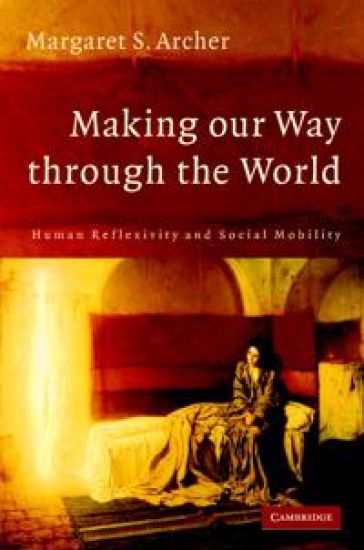
How do we reflect upon ourselves and our concerns in relation to society, and vice versa? Human reflexivity works through 'internal conversations' using language, but also emotions, sensations and images. Most people acknowledge this 'inner-dialogue' and can report upon it. However, little research has been conducted on 'internal conversations' and how they mediate between our ultimate concerns and the social contexts we confront. In this book, Margaret Archer argues that reflexivity is progressively replacing routine action in late modernity, shaping how ordinary people make their way through the world. Using interviewees' life and work histories, she shows how 'internal conversations' guide the occupations people seek, keep or quit; their stances towards structural constraints and enablements; and their resulting patterns of social mobility.
Making our Way through the World

Making our Way through the World

Margaret S. Archer

Cambridge University Press
2007
pokkari
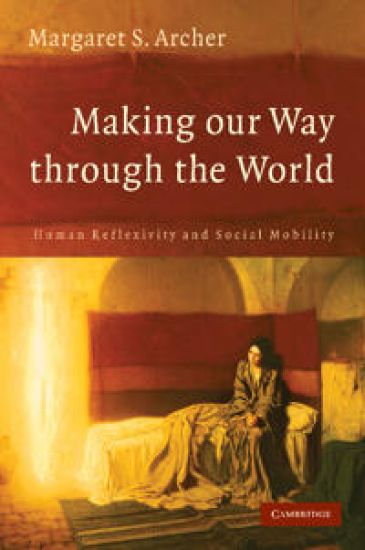
How do we reflect upon ourselves and our concerns in relation to society, and vice versa? Human reflexivity works through 'internal conversations' using language, but also emotions, sensations and images. Most people acknowledge this 'inner-dialogue' and can report upon it. However, little research has been conducted on 'internal conversations' and how they mediate between our ultimate concerns and the social contexts we confront. In this book, Margaret Archer argues that reflexivity is progressively replacing routine action in late modernity, shaping how ordinary people make their way through the world. Using interviewees' life and work histories, she shows how 'internal conversations' guide the occupations people seek, keep or quit; their stances towards structural constraints and enablements; and their resulting patterns of social mobility.
Transcendence

Transcendence

Margaret S. Archer; Andrew Collier; Douglas V. Porpora

Routledge
2004
nidottu
Atheism as a belief does not have to present intellectual credentials within academia. Yet to hold beliefs means giving reasons for doing so, ones which may be found wanting. Instead, atheism is the automatic default setting within the academic world. Conversely, religious belief confronts a double standard. Religious believers are not permitted to make truth claims but are instead forced to present their beliefs as part of one language game amongst many. Religious truth claims are expected to satisfy empiricist criteria of evidence but when they fail, as they must, religious belief becomes subject to the hermeneutics of suspicion. This book explores religious experience as a justifiable reason for religious belief. It uniquely demonstrates that the three pillars of critical realism - ontological intransitivity, epistemic relativity and judgemental rationality - can be applied to religion as to any other beliefs or theories. The three authors are critical realists by philosophical position. They seek to establish a level playing field between religion and secular ideas, which has not existed in the academic world for some generations, in order for reasoned debate to be conducted.
Transcendence

Transcendence

Margaret S. Archer; Andrew Collier; Douglas V. Porpora

Routledge
2004
sidottu
Atheism as a belief does not have to present intellectual credentials within academia. Yet to hold beliefs means giving reasons for doing so, ones which may be found wanting. Instead, atheism is the automatic default setting within the academic world. Conversely, religious belief confronts a double standard. Religious believers are not permitted to make truth claims but are instead forced to present their beliefs as part of one language game amongst many. Religious truth claims are expected to satisfy empiricist criteria of evidence but when they fail, as they must, religious belief becomes subject to the hermeneutics of suspicion. This book explores religious experience as a justifiable reason for religious belief. It uniquely demonstrates that the three pillars of critical realism - ontological intransitivity, epistemic relativity and judgemental rationality - can be applied to religion as to any other beliefs or theories. The three authors are critical realists by philosophical position. They seek to establish a level playing field between religion and secular ideas, which has not existed in the academic world for some generations, in order for reasoned debate to be conducted.
Structure, Agency and the Internal Conversation

Structure, Agency and the Internal Conversation

Margaret S. Archer

Cambridge University Press
2003
pokkari
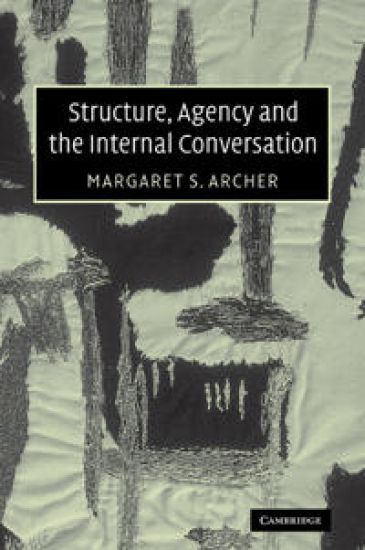
The central problem of social theory is ‘structure and agency’. How do the objective features of society influence human agents? Determinism is not the answer, nor is conditioning as currently conceptualised. It accentuates the way structure and culture shape the social context in which individuals operate, but it neglects our personal capacity to define what we care about most and to establish a modus vivendi expressive of our concerns. Through inner dialogue, ‘the internal conversation’, individuals reflect upon their social situation in the light of current concerns and projects. On the basis of a series of unique, in-depth interviews, Archer identifies three distinctive forms of internal conversation. These govern agents’ responses to social conditioning, their individual patterns of social mobility and whether or not they contribute to social stability or change. Thus the internal conversation is seen as being the missing link between society and the individual, structure and agency.
Being Human

Being Human

Margaret S. Archer

Cambridge University Press
2000
sidottu
Humanity and the very notion of the human subject are under threat from postmodernist thinking which has declared not only the 'Death of God' but also the 'Death of Man'. This book is a revindication of the concept of humanity, rejecting contemporary social theory that seeks to diminish human properties and powers. Archer argues that being human depends on an interaction with the real world in which practice takes primacy over language in the emergence of human self-consciousness, thought, emotionality and personal identity - all of which are prior to, and more basic than, our acquisition of a social identity. This original and provocative new book from leading social theorist Margaret S. Archer builds on the themes explored in her previous books Culture and Agency (CUP 1988) and Realist Social Theory (CUP 1995). It will be required reading for academics and students of social theory, cultural theory, political theory, philosophy and theology.
Culture and Agency

Culture and Agency

Margaret S. Archer

Cambridge University Press
1996
pokkari
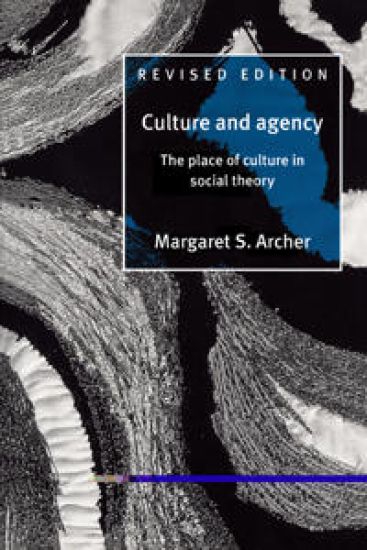
Margaret Archer’s Culture and Agency was first published in 1988, and proved a seminal contribution to social theory and the case for the role of culture in sociological thought. Described in Sociological Review as ‘a timely and sophisticated treatment’, the book showed that the ‘problems’ of culture and agency, on the one hand, and structure and agency, on the other, could be solved using the same analytical framework. In this revised edition of Culture and Agency, Margaret Archer contextualises her argument in 1990s cultural sociology and links it explicitly to her latest book, Realist Social Theory: The Morphogenetic Approach (Cambridge University Press, 1995).
Realist Social Theory

Realist Social Theory

Margaret S. Archer

Cambridge University Press
1995
pokkari

Halvin toimitettuna 61,60 €

Building on her seminal contribution to social theory in Culture and Agency, Margaret Archer develops here her morphogenetic approach, applying it to the problem of structure and agency. Since structure and agency constitute different levels of stratified social reality, each possesses distinctive emergent properties which are real and causally efficacious but irreducible to one another. The problem, therefore, is shown to be how to link the two rather than conflate them, as has been common theoretical practice. Realist Social Theory: The Morphogenetic Approach not only rejects methodological individualism and holism, but argues that the debate between them has been replaced by a new one, between elisionary theorising and emergentist theories based on a realist ontology of the social world. The morphogenetic approach is the sociological complement of transcendental realism, and together they provide a basis for non-conflationary theorizing which is also of direct utility to the practising social analyst.
Realist Social Theory

Realist Social Theory

Margaret S. Archer

Cambridge University Press
1995
sidottu

Halvin toimitettuna 136,50 €

Building on her seminal contribution to social theory in Culture and Agency, Margaret Archer develops here her morphogenetic approach, applying it to the problem of structure and agency. Since structure and agency constitute different levels of stratified social reality, each possesses distinctive emergent properties which are real and causally efficacious but irreducible to one another. The problem, therefore, is shown to be how to link the two rather than conflate them, as has been common theoretical practice. Realist Social Theory: The Morphogenetic Approach not only rejects methodological individualism and holism, but argues that the debate between them has been replaced by a new one, between elisionary theorising and emergentist theories based on a realist ontology of the social world. The morphogenetic approach is the sociological complement of transcendental realism, and together they provide a basis for non-conflationary theorizing which is also of direct utility to the practising social analyst.