Kirjojen hintavertailu – 12 859 819 kirjaa ja 27 kauppaa
Kirjailija
Margaret Sanger
Kirjat ja teokset yhdessä paikassa: 69 kirjaa, julkaisuja vuosilta 1999–2026, suosituimpiin kuuluu Margaret Sanger. Vertaile teosten hintoja ja tarkista saatavuus suomalaisista kirjakaupoista.
Dieses klassische Buch wurde urspr nglich vor Jahrzehnten unter dem Titel ""Margaret Sanger An autobiography"". Es wurde jetzt von Writat f r seine franz sischsprachigen Leser in die franz sische Sprache bersetzt. Bei Writat liegt uns die Bewahrung des literarischen Erbes der Vergangenheit am Herzen. Wir haben dieses Buch ins Franz sische bersetzt, damit heutige und zuk nftige Generationen es lesen und bewahren k nnen.
Dieses klassische Buch wurde urspr nglich vor Jahrzehnten ver ffentlicht als "Magnetation Methods of Birth Control" . Es wurde jetzt von Writat f r seine deutschsprachigen Leser ins Deutsche bersetzt. Bei Writat liegt uns die Bewahrung des literarischen Erbes der Vergangenheit sehr am Herzen. Wir haben dieses Buch ins Deutsche bersetzt, damit es heutige und zuk nftige Generationen lesen und bewahren k nnen.
The Pivot of Civilization, a classical book, has been considered essential throughout the human history, and so that this work is never forgotten we at Alpha Editions have made efforts in its preservation by republishing this book in a modern format for present and future generations. This whole book has been reformatted, retyped and designed. These books are not made of scanned copies of their original work and hence the text is clear and readable.
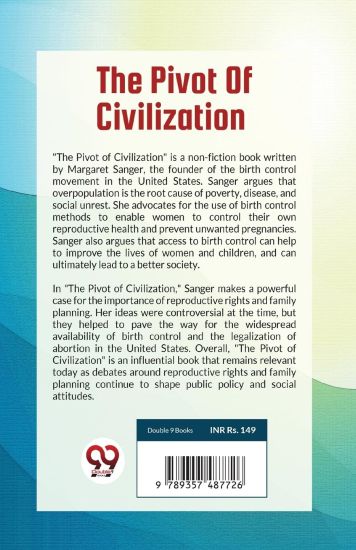
"The Pivot of Civilization" is a non-fiction book written by Margaret Sanger, the founder of the birth control movement in the United States. Sanger argues that overpopulation is the root cause of poverty, disease, and social unrest. She advocates for the use of birth control methods to enable women to control their own reproductive health and prevent unwanted pregnancies. Sanger also argues that access to birth control can help to improve the lives of women and children, and can ultimately lead to a better society. In "The Pivot of Civilization," Sanger makes a powerful case for the importance of reproductive rights and family planning. Her ideas were controversial at the time, but they helped to pave the way for the widespread availability of birth control and the legalization of abortion in the United States. Overall, "The Pivot of Civilization" is an influential book that remains relevant today as debates around reproductive rights and family planning continue to shape public policy and social attitudes.
Margaret Sanger: an autobiography has been regarded as significant work throughout human history, and in order to ensure that this work is never lost, we have taken steps to ensure its preservation by republishing this book in a contemporary format for both current and future generations. This entire book has been retyped, redesigned, and reformatted. Since these books are not made from scanned copies, the text is readable and clear.
Arguably her most important and influential book, this controversial work, first published in 1922 by pioneering birth-control advocate Margaret Sanger, attempted to broaden the still-radical idea of birth control beyond its socialist and feminist roots. Moving away from a single-minded focus on women's reproductive rights to the larger issue of the general health and economic prosperity of the whole human race, Sanger argued that birth control was pivotal to a rational approach toward dealing with the threat of overpopulation and its ruinous consequences in poverty and disease. Through this book Sanger hoped to persuade the medical establishment to assume control over contraceptive distribution, and thereby to lessen the religious, legal, and moral opposition that continued to restrict access to contraceptive information. However important this book is to the history of women's rights, it remains a very problematic work from our more scientifically informed perspective today. In arguing for population control Sanger made frequent reference to the then fashionable "science" of eugenics. She also adopted its rhetoric, using such callous phrases as "the feeble-minded" and the "unfit" and advocating birth control as a means of limiting the breeding of "defectives, delinquents and dependents." Although she incorporated views and terminology commonly held in respectable medical and scientific circles of the day, Sanger's writings on eugenics, and this book in particular, have become fodder for her critics both on the left and the right, who seek to diminish her achievements and obscure what is ultimately a powerful feminist message: when women gain greater control over their fertility, they will improve the human race. This unusual and historically significant book is complemented by a thoughtful and informative introduction by Peter C. Engelman, assistant editor of The Margaret Sanger Papers Project, who provides much insight by placing this work in the context of the age and Sanger's life.
The book, "" Family Limitation "", has been considered important throughout the human history, and so that this work is never forgotten we have made efforts in its preservation by republishing this book in a modern format for present and future generations. This whole book has been reformatted, retyped and designed. These books are not made of scanned copies and hence the text is clear and readable.
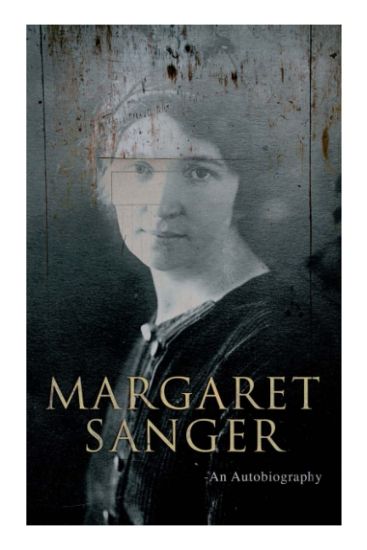
Margaret Sanger - An Autobiography is a memoir written by famous American birth control activist with a goal to promote her main cause - the fight for birth control. Sanger speaks of her experiences in New York and all around the world seeing the state of the poor and practicing nursing. She disapproved abortion and preferred to help women gain control of their lives with birth control and she tried to develop a professional medical procedure for distributing it. Sanger dedicated herself to the cause of birth control and she spent her life desperately trying to educate women.
This book has been considered by academicians and scholars of great significance and value to literature. This forms a part of the knowledge base for future generations. So that the book is never forgotten we have represented this book in a print format as the same form as it was originally first published. Hence any marks or annotations seen are left intentionally to preserve its true nature.
This book has been considered by academicians and scholars of great significance and value to literature. This forms a part of the knowledge base for future generations. So that the book is never forgotten we have represented this book in a print format as the same form as it was originally first published. Hence any marks or annotations seen are left intentionally to preserve its true nature.
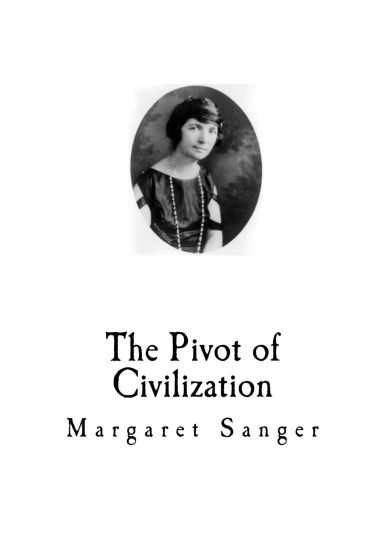
The Pivot of Civilization talks about how birth control is viewed and will affect civilization and approach individual and social problems. The book also discusses different issues that affect mothers and children in this day and age. The text covers topics such as issues that have arisen due to birth control; the difficult state mothers are still in; child labor; negative effects of philanthropy and organized charity; the relation of Marxian Socialism to birth control; the problems with eugenics; and the orthodox Catholic view on contraception. The book is recommended for those who wish to understand and learn more about birth control, including how it affects the civilization, mothers, and children. Those who are interested in knowing how civilization views birth control and affects mothers and children will also find the book helpful.
The Pivot of Civilization by Margaret Sanger. Birth Control, Mrs. Sanger claims, and claims rightly, to be a question of fundamental importance at the present time. I do not know how far one is justified in calling it the pivot or the corner-stone of a progressive civilization. These terms involve a criticism of metaphors that may take us far away from the question in hand. Birth Control is no new thing in human experience, and it has been practised in societies of the most various types and fortunes. But there can be little doubt that at the present time it is a test issue between two widely different interpretations of the word civilization, and of what is good in life and conduct. The way in which men and women range themselves in this controversy is more simply and directly indicative of their general intellectual quality than any other single indication. I do not wish to imply by this that the people who oppose are more or less intellectual than the people who advocate Birth Control, but only that they have fundamentally contrasted general ideas, -that, mentally, they are DIFFERENT. Very simple, very complex, very dull and very brilliant persons may be found in either camp, but all those in either camp have certain attitudes in common which they share with one another, and do not share with those in the other camp
Birth Control, Mrs. Sanger claims, and claims rightly, to be a question of fundamental importance at the present time. I do not know how far one is justified in calling it the pivot or the corner-stone of a progressive civilization. These terms involve a criticism of metaphors that may take us far away from the question in hand. Birth Control is no new thing in human experience, and it has been practised in societies of the most various types and fortunes. But there can be little doubt that at the present time it is a test issue between two widely different interpretations of the word civilization, and of what is good in life and conduct. The way in which men and women range themselves in this controversy is more simply and directly indicative of their general intellectual quality than any other single indication. I do not wish to imply by this that the people who oppose are more or less intellectual than the people who advocate Birth Control, but only that they have fundamentally contrasted general ideas, -that, mentally, they are DIFFERENT. Very simple, very complex, very dull and very brilliant persons may be found in either camp, but all those in either camp have certain attitudes in common which they share with one another, and do not share with those in the other camp
Originally published in 1914 as a pamphlet, Family Limitation is a basic instructional manual of basic family planning techniques. While working as a nurse in the New York slums, Margaret Sanger witnessed the plight of poor women suffering from frequent pregnancies and self-induced abortions. Believing that these women had the right to control their reproductive health, Sanger published this pamphlet that simply explained how to prevent pregnancy. Distribution through the mails was blocked by enforcement of the Comstock Law, which banned mailing of materials judged to be obscene. However, several hundred thousand copies were distributed through the first family-planning and birth control clinic Sanger established in Brooklyn in 1916 and by networks of active women at rallies and political meetings.
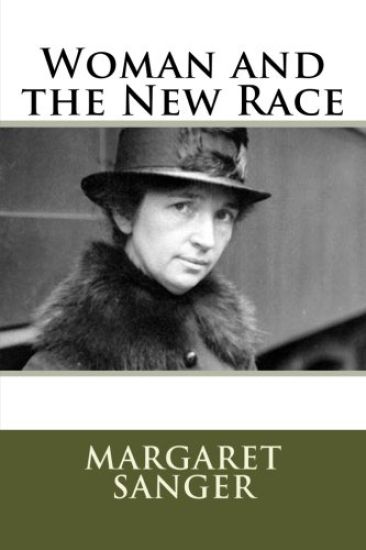
Margaret Sanger wrote this book in 1920 at the high water mark of the first wave of feminism. Women in the United States could now vote, own property, acquire higher education, and many other rights won through hard struggle. Sanger saw a woman's right to control her own body (specifically her reproductive system) as the next big goal. It took more than forty years before a new wave of feminism, along with advances in medical technology, made this attainable. Of course, this is still the fault-line which runs through the topic of women and religion. The themes which Sanger raises in this book still arouse vehement debate, and pertain to contemporary issues which would have seemed unimaginable to Sanger, such as human cloning and stem-cell research. Some of the language in this book may mystify or confuse contemporary readers. When she speaks of a 'New Race' she means the improvement of the human species in general. She occasionally uses arguments similar to the Eugenics movement (which was later embraced by the Nazis). This has been used as ammunition by some opposed to women's reproductive rights, and several misleading quotes either taken out of context or completely fabricated have been attributed to her in an attempt to demonize her. This is a disservice and dishonors Sangers' legacy. Sanger later denounced the Eugenics movement. Her books were among the first burned by the Nazis. She also personally helped several Jewish women and men escape Nazi Germany. Sanger was about as far from a reactionary as could be imagined--note her opposition to militarism, her ardent feminism and activism on behalf of working-class women, her support for labor and the rights of immigrants, all of which she makes clear in this book. Sanger's opposition to abortion has to be considered in the light of the reality of pre-Roe v. Wade 'back-alley' abortion, which often had fatal or harmful side-effects. She states that she would not be opposed to abortion if it could be performed safely. Sangers' transcendent (and very spiritual) vision of women and humanity in general free from the shackles of sexual repression and endless child-bearing is impressive, and overwhelms the shortcomings of this book.
Margaret Sanger wrote this book in 1920 at the high water mark of the first wave of feminism. Women in the United States could now vote, own property, acquire higher education, and many other rights won through hard struggle. Sanger saw a woman's right to control her own body (specifically her reproductive system) as the next big goal. It took more than forty years before a new wave of feminism, along with advances in medical technology, made this attainable. Of course, this is still the fault-line which runs through the topic of women and religion. The themes which Sanger raises in this book still arouse vehement debate, and pertain to contemporary issues which would have seemed unimaginable to Sanger, such as human cloning and stem-cell research. Some of the language in this book may mystify or confuse contemporary readers. When she speaks of a 'New Race' she means the improvement of the human species in general. She occasionally uses arguments similar to the Eugenics movement (which was later embraced by the Nazis). This has been used as ammunition by some opposed to women's reproductive rights, and several misleading quotes either taken out of context or completely fabricated have been attributed to her in an attempt to demonize her. This is a disservice and dishonors Sangers' legacy. Sanger later denounced the Eugenics movement. Her books were among the first burned by the Nazis. She also personally helped several Jewish women and men escape Nazi Germany. Sanger was about as far from a reactionary as could be imagined--note her opposition to militarism, her ardent feminism and activism on behalf of working-class women, her support for labor and the rights of immigrants, all of which she makes clear in this book. She opened clinics in Harlem to bring health services to the African American community, and worked closely with such African American activists as W. E. B. DuBois and Adam Clayton Powell. In 1966, the year Sanger died, the Rev. Martin Luther King, Jr. said: There is a striking kinship between our movement and Margaret Sanger's early efforts. . . . Our sure beginning in the struggle for equality by nonviolent direct action may not have been so resolute without the tradition established by Margaret Sanger and people like her. Sanger's opposition to abortion has to be considered in the light of the reality of pre-Roe v. Wade 'back-alley' abortion, which often had fatal or harmful side-effects. She states that she would not be opposed to abortion if it could be performed safely.
Originally published in 1920 (that being the edition I read), Sanger's radical exhortation in favor of contraception is a passionate polemic. She presents birth control as a solution to all the world's problems and she predicts its ultimate, inexorable triumph. It struck me to see, even this early in her career, her arguments that the "feeble minded" and immigrant poor in particular have too many children, preventing the development of "a greater race." (This is presumably the human race; or maybe a new "race" of Americans; but the eugenic overtone is unmistakable.) Such a rationale ends up interlaced with her feminism, pacifism, pragmatism, and so on. Voluntary motherhood is for Sanger the key to women's emancipation, to the point that she dismisses women's suffrage and labor movements as mere "palliatives." She musters all kinds of experts, statistics, and examples to make her case; yet claims straight-faced that greater scarcity of human beings will lead to greater respect for human life, thus making wars untenable. Quite the document of its time.