Kirjojen hintavertailu – 12 903 735 kirjaa ja 27 kauppaa

Kirjailija

Maria Nieves Zedeno

Kirjat ja teokset yhdessä paikassa: 3 kirjaa, julkaisuja vuosilta 1994–2017, suosituimpiin kuuluu Sourcing Prehistoric Ceramics at Chodistaas Pueblo, Arizona. Vertaile teosten hintoja ja tarkista saatavuus suomalaisista kirjakaupoista.

Nimi esiintyy myös muodoissa: María Nieves Zedeño

3 kirjaa

Kirjojen julkaisuvuodet: 1994–2017.

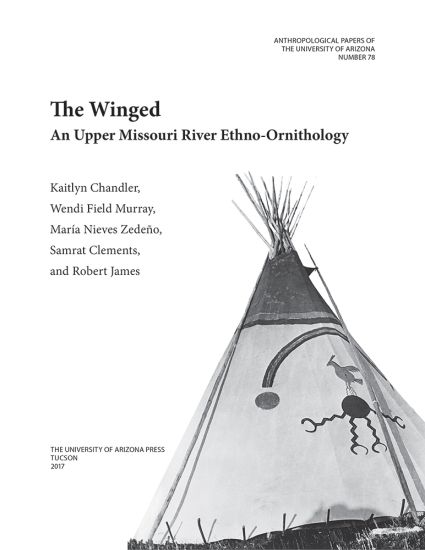
The Winged

The Winged

Kaitlyn Moore Chandler; Wendi Field Murray; María Nieves Zedeño; Samrat Miller Clements; Robert James

University of Arizona Press
2017
nidottu
The Missouri River Basin is home to thousands of bird species that migrate across the Great Plains of North America each year, marking the seasonal cycle and filling the air with their song. In time immemorial, Native inhabitants of this vast region established alliances with birds that helped them to connect with the gods, to learn the workings of nature, and to live well. This book integrates published and archival sources covering archaeology, ethnohistory, historical ethnography, folklore, and interviews with elders from the Blackfoot, Assiniboine, Mandan, Hidatsa, Arikara, and Crow communities to explore how relationships between people and birds are situated in contemporary practice, and what has fostered its cultural persistence. Native principles of ecological and cosmological knowledge are brought into focus to highlight specific beliefs, practices, and concerns associated with individual bird species, bird parts, bird objects, the natural and cultural landscapes that birds and people cohabit, and the future of this ancient alliance. Detailed descriptions critical to ethnohistorians and ethnobiologists are accompanied by thirty-four color images. A unique contribution, The Winged expands our understanding of sets of interrelated dependencies or entanglements between bird and human agents, and it steps beyond traditional scientific and anthropological distinctions between humans and animals to reveal the intricate and eminently social character of these interactions.
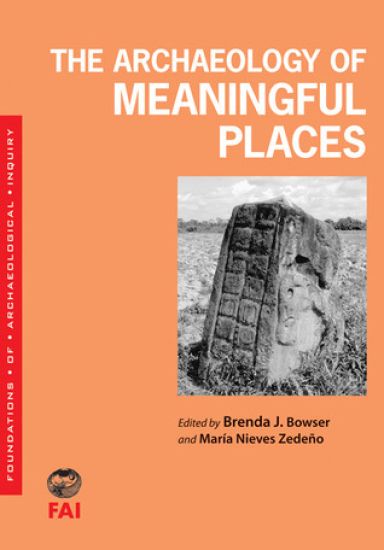
The Archaeology of Meaningful Places

The Archaeology of Meaningful Places

Maria Nieves Zedeno

University of Utah Press,U.S.
2009
nidottu
In the broadest sense this book is concerned with describing and explaining how particular places contain the key elements necessary for understanding the social worlds constructed, maintained, and modified by those who once inhabited them. This is achieved through the investigation of biographical, topographic, geopolitical, ideological, cosmological, and mnemonic facets of place, beginning with processes of place making and continuing with the development of networks among and between places and broader landscapes. Diverse spatial and temporal contexts in two culture areas--Mesoamerica and the Greater Southwest--serve as backdrops for nine chapters in which fourteen contributors show how place is an ideal starting point to begin unravelling the human past. Several authors further address the enduring significance of places of the past for contemporary peoples. Among the many strengths of this volume is the careful way in which powerful concepts, diverse lines of thought and empirical models are integrated to reveal the multiple facets of meaningful places, and to illustrate ways in which places may be approached archaeologically, theoretically, and culturally. Ultimately, the book's contributor’s champion the notion that place is a valid and useful analytical unit for describing, reconstructing, interpreting, and explaining the form, structure, and temporality of the meanings humans ascribe to their environment.
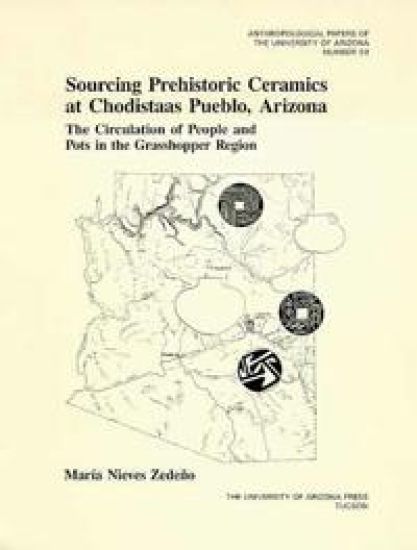
Sourcing Prehistoric Ceramics at Chodistaas Pueblo, Arizona

Sourcing Prehistoric Ceramics at Chodistaas Pueblo, Arizona

Maria Nieves Zedeno

University of Arizona Press
1994
nidottu
For decades archaeologists have used pottery to reconstruct the lifeways of ancient populations. It has become increasingly evident, however, that to make inferences about prehistoric economic, social, and political activities through the patterning of ceramic variation, it is necessary to determine the location where the vessels were made. Through detailed analysis of manufacturing technology and design styles as well as the use of modern analytical techniques such as neutron activation analysis, Zedeno here demonstrates a broadly applicable methodology for identifying local and nonlocal ceramics.