Kirjojen hintavertailu – 12 859 829 kirjaa ja 27 kauppaa

Kirjailija

Mariano Giaquinta

Kirjat ja teokset yhdessä paikassa: 21 kirjaa, julkaisuja vuosilta 1983–2018, suosituimpiin kuuluu Calculus of Variations II. Vertaile teosten hintoja ja tarkista saatavuus suomalaisista kirjakaupoista.

21 kirjaa

Kirjojen julkaisuvuodet: 1983–2018.

The Early Period of the Calculus of Variations

The Early Period of the Calculus of Variations

Paolo Freguglia; Mariano Giaquinta

Birkhauser Verlag AG
2018
nidottu
This monograph explores the early development of the calculus of variations in continental Europe during the Eighteenth Century by illustrating the mathematics of its founders. Closely following the original papers and correspondences of Euler, Lagrange, the Bernoullis, and others, the reader is immersed in the challenge of theory building. We see what the founders were doing, the difficulties they faced, the mistakes they made, and their triumphs. The authors guide the reader through these works with instructive commentaries and complements to the original proofs, as well as offering a modern perspective where useful. The authors begin in 1697 with Johann Bernoulli’s work on the brachystochrone problem and the events leading up to it, marking the dawn of the calculus of variations. From there, they cover key advances in the theory up to the development of Lagrange’s d-calculus, including: • The isoperimetrical problems• Shortest lines and geodesics• Euler’s Methodus Inveniendi and the two AdditamentaFinally, the authors give the readers a sense of how vast the calculus of variations has become in centuries hence, providing some idea of what lies outside the scope of the book as well as the current state of affairs in the field. This book will be of interest to anyone studying the calculus of variations who wants a deeper intuition for the techniques and ideas that are used, as well as historians of science and mathematics interested in the development and evolution of modern calculus and analysis.
An Introduction to the Regularity Theory for Elliptic Systems, Harmonic Maps and Minimal Graphs
This volume deals with the regularity theory for elliptic systems. We may find the origin of such a theory in two of the problems posed by David Hilbert in his celebrated lecture delivered during the International Congress of Mathematicians in 1900 in Paris: 19th problem: Are the solutions to regular problems in the Calculus of Variations always necessarily analytic? 20th problem: does any variational problem have a solution, provided that certain assumptions regarding the given boundary conditions are satisfied, and provided that the notion of a solution is suitably extended? During the last century these two problems have generated a great deal of work, usually referred to as regularity theory, which makes this topic quite relevant in many fields and still very active for research. However, the purpose of this volume, addressed mainly to students, is much more limited. We aim to illustrate only some of the basic ideas and techniques introduced in this context, confining ourselves toimportant but simple situations and refraining from completeness. In fact some relevant topics are omitted. Topics include: harmonic functions, direct methods, Hilbert space methods and Sobolev spaces, energy estimates, Schauder and L^p-theory both with and without potential theory, including the Calderon-Zygmund theorem, Harnack's and De Giorgi-Moser-Nash theorems in the scalar case and partial regularity theorems in the vector valued case; energy minimizing harmonic maps and minimal graphs in codimension 1 and greater than 1. In this second deeply revised edition we also included the regularity of 2-dimensional weakly harmonic maps, the partial regularity of stationary harmonic maps, and their connections with the case p=1 of the L^p theory, including the celebrated results of Wente and of Coifman-Lions-Meyer-Semmes.
Mathematical Analysis

Mathematical Analysis

Mariano Giaquinta; Giuseppe Modica

Springer-Verlag New York Inc.
2012
nidottu
For more than two thousand years some familiarity with mathematics has been regarded as an indispensable part of the intellectual equipment of every cultured person. Today the traditional place of mathematics in education is in grave danger. Unfortunately, professional representatives of mathematics share in the reponsibiIity. The teaching of mathematics has sometimes degen­ erated into empty drill in problem solving, which may develop formal ability but does not lead to real understanding or to greater intellectual indepen­ dence. Mathematical research has shown a tendency toward overspecialization and over-emphasis on abstraction. Applications and connections with other fields have been neglected . . . But . . . understanding of mathematics cannot be transmitted by painless entertainment any more than education in music can be brought by the most brilliant journalism to those who never have lis­ tened intensively. Actual contact with the content of living mathematics is necessary. Nevertheless technicalities and detours should be avoided, and the presentation of mathematics should be just as free from emphasis on routine as from forbidding dogmatism which refuses to disclose motive or goal and which is an unfair obstacle to honest effort. (From the preface to the first edition of What is Mathematics? by Richard Courant and Herbert Robbins, 1941.
Mathematical Analysis

Mathematical Analysis

Mariano Giaquinta; Giuseppe Modica

Birkhauser Boston Inc
2011
sidottu
Mathematical Analysis: Foundations and Advanced Techniques for Functions of Several Variables builds upon the basic ideas and techniques of differential and integral calculus for functions of several variables, as outlined in an earlier introductory volume. The presentation is largely focused on the foundations of measure and integration theory. The book begins with a discussion of the geometry of Hilbert spaces, convex functions and domains, and differential forms, particularly k-forms. The exposition continues with an introduction to the calculus of variations with applications to geometric optics and mechanics. The authors conclude with the study of measure and integration theory – Borel, Radon, and Hausdorff measures and the derivation of measures. An appendix highlights important mathematicians and other scientists whose contributions have made a great impact on the development of theories in analysis. This work may be used as a supplementary text in the classroom or for self-study by advanced undergraduate and graduate students and as a valuable reference for researchers in mathematics, physics, and engineering. One of the key strengths of this presentation, along with the other four books on analysis published by the authors, is the motivation for understanding the subject through examples, observations, exercises, and illustrations.
Cartesian Currents in the Calculus of Variations II

Cartesian Currents in the Calculus of Variations II

Mariano Giaquinta; Guiseppe Modica; Jiri Soucek

Springer-Verlag Berlin and Heidelberg GmbH Co. K
2010
nidottu
Non-scalar variational problems appear in different fields. In geometry, for in­ stance, we encounter the basic problems of harmonic maps between Riemannian manifolds and of minimal immersions; related questions appear in physics, for example in the classical theory of a-models. Non linear elasticity is another example in continuum mechanics, while Oseen-Frank theory of liquid crystals and Ginzburg-Landau theory of superconductivity require to treat variational problems in order to model quite complicated phenomena. Typically one is interested in finding energy minimizing representatives in homology or homotopy classes of maps, minimizers with prescribed topological singularities, topological charges, stable deformations i. e. minimizers in classes of diffeomorphisms or extremal fields. In the last two or three decades there has been growing interest, knowledge, and understanding of the general theory for this kind of problems, often referred to as geometric variational problems. Due to the lack of a regularity theory in the non scalar case, in contrast to the scalar one - or in other words to the occurrence of singularities in vector valued minimizers, often related with concentration phenomena for the energy density - and because of the particular relevance of those singularities for the problem being considered the question of singling out a weak formulation, or completely understanding the significance of various weak formulations becames non trivial.
Calculus of Variations II

Calculus of Variations II

Mariano Giaquinta; Stefan Hildebrandt

Springer-Verlag Berlin and Heidelberg GmbH Co. K
2010
nidottu
This book describes the classical aspects of the variational calculus which are of interest to analysts, geometers and physicists alike. Volume 1 deals with the for­ mal apparatus of the variational calculus and with nonparametric field theory, whereas Volume 2 treats parametric variational problems as weIl as Hamilton­ Jacobi theory and the classical theory of partial differential equations of first order. In a subsequent treatise we shall describe developments arising from Hilbert's 19th and 20th problems, especially direct methods and regularity theory. Of the classical variational calculus we have particularly emphasized the often neglected theory of inner variations, i. e. of variations of the independent variables, which is a source of useful information such as monotonicity for­ mulas, conformality relations and conservation laws. The combined variation of dependent and independent variables leads to the general conservation laws of Emmy Noether, an important tool in exploitingsymmetries. Other parts of this volume deal with Legendre-Jacobi theory and with field theories. In particular we give a detailed presentation of one-dimensional field theory for non para­ metric and parametric integrals and its relations to Hamilton-Jacobi theory, geometrieal optics and point mechanics. Moreover we discuss various ways of exploiting the notion of convexity in the calculus of variations, and field theory is certainly the most subtle method to make use of convexity. We also stress the usefulness of the concept of a null Lagrangian which plays an important role in several instances.
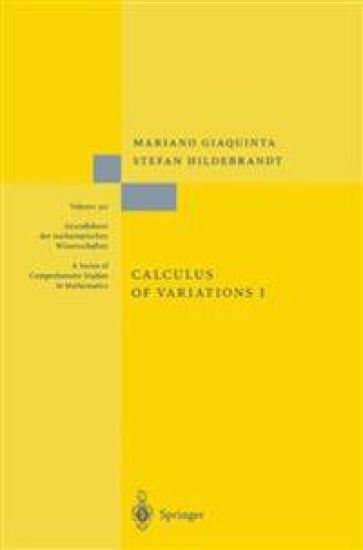
Calculus of Variations I

Calculus of Variations I

Mariano Giaquinta; Stefan Hildebrandt

Springer-Verlag Berlin and Heidelberg GmbH Co. K
2010
nidottu
This book describes the classical aspects of the variational calculus which are of interest to analysts, geometers and physicists alike. Volume 1 deals with the for­ mal apparatus of the variational calculus and with nonparametric field theory, whereas Volume 2 treats parametric variational problems as well as Hamilton­ Jacobi theory and the classical theory of partial differential equations of first ordel;. In a subsequent treatise we shall describe developments arising from Hilbert's 19th and 20th problems, especially direct methods and regularity theory. Of the classical variational calculus we have particularly emphasized the often neglected theory of inner variations, i. e. of variations of the independent variables, which is a source of useful information such as mono tonicity for­ mulas, conformality relations and conservation laws. The combined variation of dependent and independent variables leads to the general conservation laws of Emmy Noether, an important tool in exploiting symmetries. Other parts of this volume deal with Legendre-Jacobi theory and with field theories. In particular we give a detailed presentation of one-dimensional field theory for nonpara­ metric and parametric integrals and its relations to Hamilton-Jacobi theory, geometrical optics and point mechanics. Moreover we discuss various ways of exploiting the notion of convexity in the calculus of variations, and field theory is certainly the most subtle method to make use of convexity. We also stress the usefulness of the concept of a null Lagrangian which plays an important role in we give an exposition of Hamilton-Jacobi several instances.
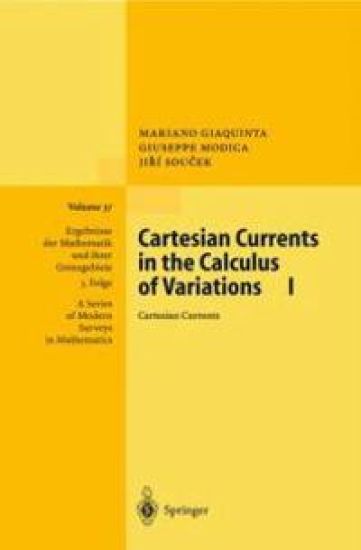
Cartesian Currents in the Calculus of Variations I

Cartesian Currents in the Calculus of Variations I

Mariano Giaquinta; Giuseppe Modica; Jiri Soucek

Springer-Verlag Berlin and Heidelberg GmbH Co. K
2010
nidottu
This monograph (in two volumes) deals with non scalar variational problems arising in geometry, as harmonic mappings between Riemannian manifolds and minimal graphs, and in physics, as stable equilibrium configuations in nonlinear elasticity or for liquid crystals. The presentation is selfcontained and accessible to non specialists. Topics are treated as far as possible in an elementary way, illustrating results with simple examples; in principle, chapters and even sections are readable independently of the general context, so that parts can be easily used for graduate courses. Open questions are often mentioned and the final section of each chapter discusses references to the literature and sometimes supplementary results. Finally, a detailed Table of Contents and an extensive Index are of help to consult this monograph
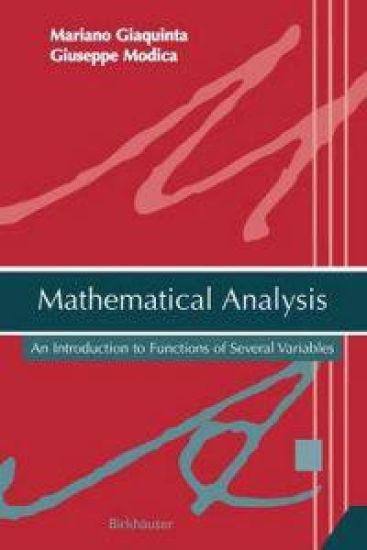
Mathematical Analysis

Mathematical Analysis

Mariano Giaquinta; Giuseppe Modica

Birkhauser Boston Inc
2009
nidottu
This self-contained work is an introductory presentation of basic ideas, structures, and results of differential and integral calculus for functions of several variables. The wide range of topics covered include: differential calculus of several variables, including differential calculus of Banach spaces, the relevant results of Lebesgue integration theory, differential forms on curves, a general introduction to holomorphic functions, including singularities and residues, surfaces and level sets, and systems and stability of ordinary differential equations. An appendix highlights important mathematicians and other scientists whose contributions have made a great impact on the development of theories in analysis. Mathematical Analysis: An Introduction to Functions of Several Variables motivates the study of the analysis of several variables with examples, observations, exercises, and illustrations. It may be used in the classroom setting or for self-study by advanced undergraduate and graduate students and as a valuable reference for researchers in mathematics, physics, and engineering. Other books recently published by the authors include: Mathematical Analysis: Functions of One Variable, Mathematical Analysis: Approximation and Discrete Processes, and Mathematical Analysis: Linear and Metric Structures and Continuity, all of which provide the reader with a strong foundation in modern-day analysis.
Mathematical Analysis

Mathematical Analysis

Mariano Giaquinta; Giuseppe Modica

Birkhauser Boston Inc
2009
sidottu
This self-contained work is an introductory presentation of basic ideas, structures, and results of differential and integral calculus for functions of several variables. The wide range of topics covered include: differential calculus of several variables, including differential calculus of Banach spaces, the relevant results of Lebesgue integration theory, differential forms on curves, a general introduction to holomorphic functions, including singularities and residues, surfaces and level sets, and systems and stability of ordinary differential equations. An appendix highlights important mathematicians and other scientists whose contributions have made a great impact on the development of theories in analysis. Mathematical Analysis: An Introduction to Functions of Several Variables motivates the study of the analysis of several variables with examples, observations, exercises, and illustrations. It may be used in the classroom setting or for self-study by advanced undergraduate and graduate students and as a valuable reference for researchers in mathematics, physics, and engineering. Other books recently published by the authors include: Mathematical Analysis: Functions of One Variable, Mathematical Analysis: Approximation and Discrete Processes, and Mathematical Analysis: Linear and Metric Structures and Continuity, all of which provide the reader with a strong foundation in modern-day analysis.
Mathematical Analysis

Mathematical Analysis

Mariano Giaquinta; Giuseppe Modica

Birkhauser Boston Inc
2007
nidottu
One of the fundamental ideas of mathematical analysis is the notion of a function; we use it to describe and study relationships among variable quantities in a system and transformations of a system. We have already discussed real functions of one real variable and a few examples of functions of several variables but there are many more examples of functions that the real world, physics, natural and social sciences, and mathematics have to offer: (a) not only do we associate numbers and points to points, but we as- ciate numbers or vectors to vectors, (b) in the calculus of variations and in mechanics one associates an - ergy or action to each curve y(t) connecting two points (a, y(a)) and (b,y(b)): b Lea ~(y) - / 9 F(t, y(t), y' (t))dt t. J a in terms of the so-called Lagrangian F(t, y, p), (c) in the theory of integral equations one maps a function into a new function b /1, d-r / o. J a by means of a kernel K(s, T), (d) in the theory of differential equations one considers transformations of a function x(t) into the new function t t f f( a where f(s, y) is given. 1 in M. Giaquinta, G. Modica, Mathematical Analysis. Functions of One Va- able, Birkh~user, Boston, 2003, which we shall refer to as [GM1] and in M. G- quinta, G. Modica, Mathematical Analysis. Approximation and Discrete Processes, Birkhs Boston, 2004, which we shall refer to as [GM2].
Mathematical Analysis

Mathematical Analysis

Mariano Giaquinta; Giuseppe Modica

Birkhauser Boston Inc
2007
sidottu
One of the fundamental ideas of mathematical analysis is the notion of a function; we use it to describe and study relationships among variable quantities in a system and transformations of a system. We have already discussed real functions of one real variable and a few examples of functions of several variables but there are many more examples of functions that the real world, physics, natural and social sciences, and mathematics have to offer: (a) not only do we associate numbers and points to points, but we as- ciate numbers or vectors to vectors, (b) in the calculus of variations and in mechanics one associates an - ergy or action to each curve y(t) connecting two points (a, y(a)) and (b,y(b)): b Lea ~(y) - / 9 F(t, y(t), y' (t))dt t. J a in terms of the so-called Lagrangian F(t, y, p), (c) in the theory of integral equations one maps a function into a new function b /1, d-r / o. J a by means of a kernel K(s, T), (d) in the theory of differential equations one considers transformations of a function x(t) into the new function t t f f( a where f(s, y) is given. 1 in M. Giaquinta, G. Modica, Mathematical Analysis. Functions of One Va- able, Birkh~user, Boston, 2003, which we shall refer to as [GM1] and in M. G- quinta, G. Modica, Mathematical Analysis. Approximation and Discrete Processes, Birkhs Boston, 2004, which we shall refer to as [GM2].
Mathematical Analysis

Mathematical Analysis

Mariano Giaquinta; Giuseppe Modica

Birkhauser Boston Inc
2004
nidottu
This volume! aims at introducing some basic ideas for studying approxima­ tion processes and, more generally, discrete processes. The study of discrete processes, which has grown together with the study of infinitesimal calcu­ lus, has become more and more relevant with the use of computers. The volume is suitably divided in two parts. In the first part we illustrate the numerical systems of reals, of integers as a subset of the reals, and of complex numbers. In this context we intro­ duce, in Chapter 2, the notion of sequence which invites also a rethinking of the notions of limit and continuity2 in terms of discrete processes; then, in Chapter 3, we discuss some elements of combinatorial calculus and the mathematical notion of infinity. In Chapter 4 we introduce complex num­ bers and illustrate some of their applications to elementary geometry; in Chapter 5 we prove the fundamental theorem of algebra and present some of the elementary properties of polynomials and rational functions, and of finite sums of harmonic motions. In the second part we deal with discrete processes, first with the process of infinite summation, in the numerical case, i.e., in the case of numerical series in Chapter 6, and in the case of power series in Chapter 7. The last chapter provides an introduction to discrete dynamical systems; it should be regarded as an invitation to further study.
Mathematical Analysis

Mathematical Analysis

Mariano Giaquinta; Giuseppe Modica

Birkhauser Boston Inc
2004
sidottu
This volume! aims at introducing some basic ideas for studying approxima­ tion processes and, more generally, discrete processes. The study of discrete processes, which has grown together with the study of infinitesimal calcu­ lus, has become more and more relevant with the use of computers. The volume is suitably divided in two parts. In the first part we illustrate the numerical systems of reals, of integers as a subset of the reals, and of complex numbers. In this context we intro­ duce, in Chapter 2, the notion of sequence which invites also a rethinking of the notions of limit and continuity2 in terms of discrete processes; then, in Chapter 3, we discuss some elements of combinatorial calculus and the mathematical notion of infinity. In Chapter 4 we introduce complex num­ bers and illustrate some of their applications to elementary geometry; in Chapter 5 we prove the fundamental theorem of algebra and present some of the elementary properties of polynomials and rational functions, and of finite sums of harmonic motions. In the second part we deal with discrete processes, first with the process of infinite summation, in the numerical case, i.e., in the case of numerical series in Chapter 6, and in the case of power series in Chapter 7. The last chapter provides an introduction to discrete dynamical systems; it should be regarded as an invitation to further study.
Mathematical Analysis

Mathematical Analysis

Mariano Giaquinta; Giuseppe Modica

Birkhauser Boston Inc
2003
sidottu
For more than two thousand years some familiarity with mathematics has been regarded as an indispensable part of the intellectual equipment of every cultured person. Today the traditional place of mathematics in education is in grave danger. Unfortunately, professional representatives of mathematics share in the reponsibiIity. The teaching of mathematics has sometimes degen­ erated into empty drill in problem solving, which may develop formal ability but does not lead to real understanding or to greater intellectual indepen­ dence. Mathematical research has shown a tendency toward overspecialization and over-emphasis on abstraction. Applications and connections with other fields have been neglected . . . But . . . understanding of mathematics cannot be transmitted by painless entertainment any more than education in music can be brought by the most brilliant journalism to those who never have lis­ tened intensively. Actual contact with the content of living mathematics is necessary. Nevertheless technicalities and detours should be avoided, and the presentation of mathematics should be just as free from emphasis on routine as from forbidding dogmatism which refuses to disclose motive or goal and which is an unfair obstacle to honest effort. (From the preface to the first edition of What is Mathematics? by Richard Courant and Herbert Robbins, 1941.
One-dimensional Variational Problems

One-dimensional Variational Problems

Giuseppe Buttazzo; Mariano Giaquinta; Stefan Hildebrandt

Clarendon Press
1999
sidottu
One-dimensional variational problems have been somewhat neglected in the literature on calculus of variations, as authors usually treat minimal problems for multiple integrals which lead to partial differential equations and are considerably more difficult to handle. One-dimensional problems are connected with ordinary differential equations, and hence need many fewer technical prerequisites, but they exhibit the same kind of phenomena and surprises as variational problems for multiple integrals. This book provides an modern introduction to this subject, placing special emphasis on direct methods. It combines the efforts of a distinguished team of authors who are all renowned mathematicians and expositors. Since there are fewer technical details graduate students who want an overview of the modern approach to variational problems will be able to concentrate on the underlying theory and hence gain a good grounding in the subject. Except for results from the theory of measure and integration and from the theory of convex functions, the text develops all mathematical tools needed, including the basic results on one-dimensional Sobolev spaces, absolutely continuous functions, and functions of bounded variation.
Cartesian Currents in the Calculus of Variations II

Cartesian Currents in the Calculus of Variations II

Mariano Giaquinta; Guiseppe Modica; Jiri Soucek

Springer-Verlag Berlin and Heidelberg GmbH Co. K
1998
sidottu
Non-scalar variational problems appear in different fields. In geometry, for in­ stance, we encounter the basic problems of harmonic maps between Riemannian manifolds and of minimal immersions; related questions appear in physics, for example in the classical theory of a-models. Non linear elasticity is another example in continuum mechanics, while Oseen-Frank theory of liquid crystals and Ginzburg-Landau theory of superconductivity require to treat variational problems in order to model quite complicated phenomena. Typically one is interested in finding energy minimizing representatives in homology or homotopy classes of maps, minimizers with prescribed topological singularities, topological charges, stable deformations i. e. minimizers in classes of diffeomorphisms or extremal fields. In the last two or three decades there has been growing interest, knowledge, and understanding of the general theory for this kind of problems, often referred to as geometric variational problems. Due to the lack of a regularity theory in the non scalar case, in contrast to the scalar one - or in other words to the occurrence of singularities in vector valued minimizers, often related with concentration phenomena for the energy density - and because of the particular relevance of those singularities for the problem being considered the question of singling out a weak formulation, or completely understanding the significance of various weak formulations becames non trivial.
Cartesian Currents in the Calculus of Variations I

Cartesian Currents in the Calculus of Variations I

Mariano Giaquinta; Giuseppe Modica; Jiri Soucek

Springer-Verlag Berlin and Heidelberg GmbH Co. K
1998
sidottu
This monograph (in two volumes) deals with non scalar variational problems arising in geometry, as harmonic mappings between Riemannian manifolds and minimal graphs, and in physics, as stable equilibrium configuations in nonlinear elasticity or for liquid crystals. The presentation is selfcontained and accessible to non specialists. Topics are treated as far as possible in an elementary way, illustrating results with simple examples; in principle, chapters and even sections are readable independently of the general context, so that parts can be easily used for graduate courses. Open questions are often mentioned and the final section of each chapter discusses references to the literature and sometimes supplementary results. Finally, a detailed Table of Contents and an extensive Index are of help to consult this monograph
Calculus of Variations II

Calculus of Variations II

Mariano Giaquinta; Stefan Hildebrandt

Springer-Verlag Berlin and Heidelberg GmbH Co. K
1996
sidottu
This book describes the classical aspects of the variational calculus which are of interest to analysts, geometers and physicists alike. Volume 1 deals with the for­ mal apparatus of the variational calculus and with nonparametric field theory, whereas Volume 2 treats parametric variational problems as weIl as Hamilton­ Jacobi theory and the classical theory of partial differential equations of first order. In a subsequent treatise we shall describe developments arising from Hilbert's 19th and 20th problems, especially direct methods and regularity theory. Of the classical variational calculus we have particularly emphasized the often neglected theory of inner variations, i. e. of variations of the independent variables, which is a source of useful information such as monotonicity for­ mulas, conformality relations and conservation laws. The combined variation of dependent and independent variables leads to the general conservation laws of Emmy Noether, an important tool in exploitingsymmetries. Other parts of this volume deal with Legendre-Jacobi theory and with field theories. In particular we give a detailed presentation of one-dimensional field theory for non para­ metric and parametric integrals and its relations to Hamilton-Jacobi theory, geometrieal optics and point mechanics. Moreover we discuss various ways of exploiting the notion of convexity in the calculus of variations, and field theory is certainly the most subtle method to make use of convexity. We also stress the usefulness of the concept of a null Lagrangian which plays an important role in several instances.
Calculus of Variations I

Calculus of Variations I

Mariano Giaquinta; Stefan Hildebrandt

Springer-Verlag Berlin and Heidelberg GmbH Co. K
1995
sidottu
This book describes the classical aspects of the variational calculus which are of interest to analysts, geometers and physicists alike. Volume 1 deals with the for­ mal apparatus of the variational calculus and with nonparametric field theory, whereas Volume 2 treats parametric variational problems as well as Hamilton­ Jacobi theory and the classical theory of partial differential equations of first ordel;. In a subsequent treatise we shall describe developments arising from Hilbert's 19th and 20th problems, especially direct methods and regularity theory. Of the classical variational calculus we have particularly emphasized the often neglected theory of inner variations, i. e. of variations of the independent variables, which is a source of useful information such as mono tonicity for­ mulas, conformality relations and conservation laws. The combined variation of dependent and independent variables leads to the general conservation laws of Emmy Noether, an important tool in exploiting symmetries. Other parts of this volume deal with Legendre-Jacobi theory and with field theories. In particular we give a detailed presentation of one-dimensional field theory for nonpara­ metric and parametric integrals and its relations to Hamilton-Jacobi theory, geometrical optics and point mechanics. Moreover we discuss various ways of exploiting the notion of convexity in the calculus of variations, and field theory is certainly the most subtle method to make use of convexity. We also stress the usefulness of the concept of a null Lagrangian which plays an important role in we give an exposition of Hamilton-Jacobi several instances.