Kirjojen hintavertailu – 12 859 819 kirjaa ja 27 kauppaa

Kirjailija

Marie T. Henehan

Kirjat ja teokset yhdessä paikassa: 4 kirjaa, julkaisuja vuosilta 1999–2010, suosituimpiin kuuluu The Scientific Study of Peace and War. Vertaile teosten hintoja ja tarkista saatavuus suomalaisista kirjakaupoista.

4 kirjaa

Kirjojen julkaisuvuodet: 1999–2010.

Territory, War, and Peace

Territory, War, and Peace

John A. Vasquez; Marie T. Henehan

Routledge
2010
sidottu
This book presents a collection of new and updated essays on what has come to be known as the territorial explanation of war. The book argues that a key both to peace and to war lies in understanding the role territory plays as a source of conflict and inter-group violence. Of all the issues that spark conflict, territorial disputes have the highest probability of escalating to war. War, however, is hardly inevitable; much depends on how territorial issues are handled. More importantly, settling territorial disputes and establishing mutually recognized boundaries can produce long periods of peace between neighbors, even if other salient issues arise. While territory is not the only cause of war and wars arise from other issues, territory is one of the main causes of war, and learning how to manage it, can, in principle, eliminate an entire class of wars. This book will be of great interest to all students of war and conflict studies, causes of war and peace, international security and strategic studies. John A. Vasquez is Thomas B. Mackie Scholar in International Relations at the University of Illinois, Urbana-Champaign. He is author of The Steps to War (2008) (with Paul Senese) and The War Puzzle Revisited (2009). He has been president of the Peace Science Society (International) and the International Studies Association. Marie T. Henehan is Director of Internships and Lecturer, Department of Political Science at the University of Illinois, Urbana-Champaign. She is author of Foreign Policy and Congress: An International Relations Perspective and co-editor of The Scientific Study of Peace and War.
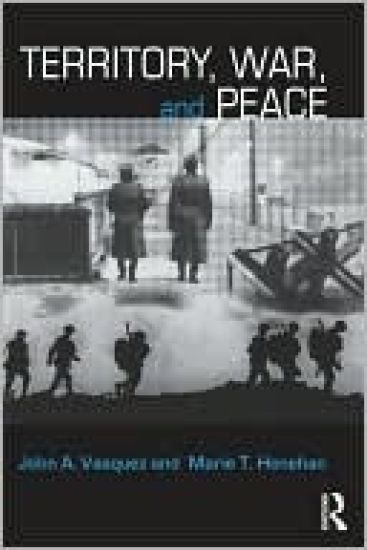
Territory, War, and Peace

Territory, War, and Peace

John A. Vasquez; Marie T. Henehan

Routledge
2010
nidottu
This book presents a collection of new and updated essays on what has come to be known as the territorial explanation of war. The book argues that a key both to peace and to war lies in understanding the role territory plays as a source of conflict and inter-group violence. Of all the issues that spark conflict, territorial disputes have the highest probability of escalating to war. War, however, is hardly inevitable; much depends on how territorial issues are handled. More importantly, settling territorial disputes and establishing mutually recognized boundaries can produce long periods of peace between neighbors, even if other salient issues arise. While territory is not the only cause of war and wars arise from other issues, territory is one of the main causes of war, and learning how to manage it, can, in principle, eliminate an entire class of wars. This book will be of great interest to all students of war and conflict studies, causes of war and peace, international security and strategic studies. John A. Vasquez is Thomas B. Mackie Scholar in International Relations at the University of Illinois, Urbana-Champaign. He is author of The Steps to War (2008) (with Paul Senese) and The War Puzzle Revisited (2009). He has been president of the Peace Science Society (International) and the International Studies Association. Marie T. Henehan is Director of Internships and Lecturer, Department of Political Science at the University of Illinois, Urbana-Champaign. She is author of Foreign Policy and Congress: An International Relations Perspective and co-editor of The Scientific Study of Peace and War.
Foreign Policy and Congress

Foreign Policy and Congress

Marie T. Henehan

The University of Michigan Press
2000
sidottu
In the traditional view of foreign policy making in the United States, the President is considered the primary authority and Congress is seen as playing a subsidiary role. Marie T. Henehan looks at the effects of events in the international system on both the content of foreign policy and what actions Congress takes on foreign policy. Henehan argues that the only way to understand the way congressional behavior varies over time is by looking at the rise and resolution of critical issues in foreign policy, which in turn have their origin in the international system. When a critical foreign policy issue arises, congressional activity and attempts to influence foreign policy increase. Once the debate is resolved and one side wins, a consensus emerges and Congress settles into a more passive role. Using a data set consisting of all roll call votes on foreign policy issues taken by the Senate from 1897 to 1984 to generate indicators of Congressional behavior, together with the rise and fall of critical issues in international relations, Henehan is able to develop a more nuanced understanding of Congress's role in foreign policy making over time. In recent years political scientists have begun to consider the impact of the international system on domestic policy. Part of the difficulty of some of this work, as well as work on Congress's role in foreign policy, is that it has been limited in terms of time and the number of events the analysis considered, depending on case studies. This book offers a systematic consideration of the effects of international events on domestic politics, crossing many different kinds of international activity, and provides a unique longitudinal view of Congressional action on foreign policy. This book will be of interest to scholars of international relations, American foreign policy making, and Congress. Marie T. Henehan is Assistant Professor of Political Science, Vanderbilt University.
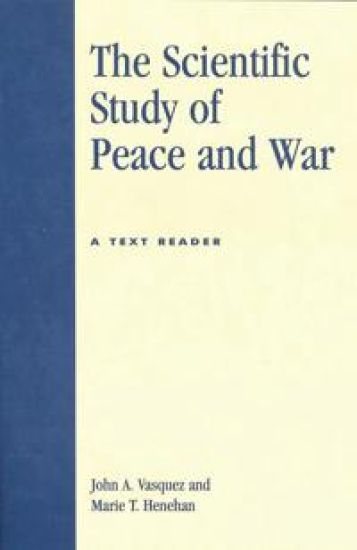
The Scientific Study of Peace and War

The Scientific Study of Peace and War

John A. Vasquez; Marie T. Henehan

Lexington Books
1999
pokkari
This widely used and acclaimed text reader brings together some of the best work on the onset of war, the expansion of war, the conditions of peace, and the termination and impact of war. Editorial commentary on the major findings and the statistical analysis used in each study teaches students how to read the article so that they can become literate in social science methods. A learning package in the appendix provides a programmed text to teach students how to interpret tables, read basic statistics, and conduct elementary data analysis. Correlates of War data on European countries is provided, and a methodological table of contents allows instructors to assign articles from the easiest (simple percentages) to the most advanced (time series and formal modeling).