
Kirjojen hintavertailu – 12 859 827 kirjaa ja 27 kauppaa

Kirjailija

Mario Schirmer

Kirjat ja teokset yhdessä paikassa: 2 kirjaa, julkaisuja vuosilta 2010–2014, suosituimpiin kuuluu Entropy, Water and Resources. Vertaile teosten hintoja ja tarkista saatavuus suomalaisista kirjakaupoista.

2 kirjaa

Kirjojen julkaisuvuodet: 2010–2014.

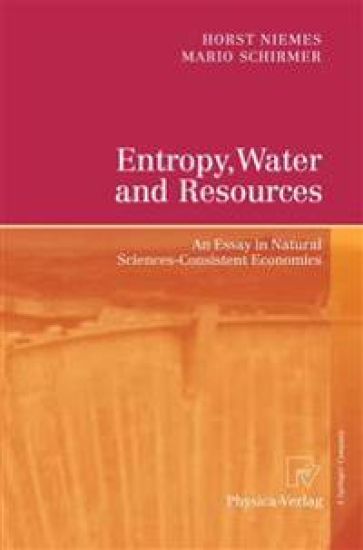
Entropy, Water and Resources

Entropy, Water and Resources

Horst Niemes; Mario Schirmer

Physica-Verlag GmbH Co
2014
nidottu
This book lies at the intersection of natural sciences, economics, and water en- neering and is in line with the long tradition of environmental economics at the University of Heidelberg. In the 1970s, the Neo-Austrian Capital Theory was developed using the fundamental laws of thermodynamics as a common language between the natural and social sciences. Niemes (1981) integrated the dynamic and irreversibility characteristics of the natural environment into the Neo-Austrian c- ital theory. Faber et al. (1983, 1987, 1995) then extended this interdisciplinary approach further to create a comprehensive, dynamic, environmental resource model. Over the last 3 decades, the theoretical foundations of environmental economics have been modi ed and there have been an impressive variety of applications. This book aims to reduce the gaps between economic theory, natural sciences, and engineering practice. One of the reasons these gaps exist is because economic assumptions are used to construct dynamic environmental and resource models, which are not consistent with the fundamental laws of the natural sciences. Another reason for the gap might be the distance between academic theory and real world situations. Based on an extended thermodynamic approach, the authors explain which economic assumptions are acceptable for constructing a dynamic model that is consistent with the natural sciences. In particular, the special role of water in the production and reproduction activities will be considered as an integral component.
Entropy, Water and Resources

Entropy, Water and Resources

Horst Niemes; Mario Schirmer

Physica-Verlag GmbH Co
2010
sidottu
This book lies at the intersection of natural sciences, economics, and water en- neering and is in line with the long tradition of environmental economics at the University of Heidelberg. In the 1970s, the Neo-Austrian Capital Theory was developed using the fundamental laws of thermodynamics as a common language between the natural and social sciences. Niemes (1981) integrated the dynamic and irreversibility characteristics of the natural environment into the Neo-Austrian c- ital theory. Faber et al. (1983, 1987, 1995) then extended this interdisciplinary approach further to create a comprehensive, dynamic, environmental resource model. Over the last 3 decades, the theoretical foundations of environmental economics have been modi ed and there have been an impressive variety of applications. This book aims to reduce the gaps between economic theory, natural sciences, and engineering practice. One of the reasons these gaps exist is because economic assumptions are used to construct dynamic environmental and resource models, which are not consistent with the fundamental laws of the natural sciences. Another reason for the gap might be the distance between academic theory and real world situations. Based on an extended thermodynamic approach, the authors explain which economic assumptions are acceptable for constructing a dynamic model that is consistent with the natural sciences. In particular, the special role of water in the production and reproduction activities will be considered as an integral component.