Kirjojen hintavertailu – 12 859 819 kirjaa ja 27 kauppaa

Kirjailija

Marisol De La Cadena

Kirjat ja teokset yhdessä paikassa: 5 kirjaa, julkaisuja vuosilta 2000–2022, suosituimpiin kuuluu Subaltern Studies 2.0 – Being against the Capitalocene. Vertaile teosten hintoja ja tarkista saatavuus suomalaisista kirjakaupoista.

5 kirjaa

Kirjojen julkaisuvuodet: 2000–2022.

Subaltern Studies 2.0 – Being against the Capitalocene

Subaltern Studies 2.0 – Being against the Capitalocene

Milinda Banerjee; Jelle J.p. Wouters; Gayatri Chakrav Spivak; Marisol De La Cadena; Thom Van Dooren

PRICKLY PARADIGM PRESS, LLC
2022
nidottu
On a second wave of anti-colonial revolutions. State and Capital reign over the Age of Sorrow. We face inequality, pandemics, ethnocide, climate crisis, and mass extinction. Our desire for security and power governs us as State. Our desire for possessions governs us as Capital. Our desires imprison and rule us beings as Unbeing. Yet, from Nagaland to New Zealand, Bhutan to Bolivia, a second wave of anti-colonial revolutions has begun. Arising from assemblies of humans and other-than-humans, these revolutions replace possessive individualism with non-exploitative interdependence. Naga elders, Bhutanese herders and other indigenous communities, feminists, poets, seers, yaks, cranes, vultures, and fungi haunt this pamphlet. The original Subaltern Studies narrated how Indian peasant communities destroyed the British empire. Subaltern Studies 2.0 prophesies the multi-being demos and liberates Being from Unbeing. Re-kin, Re-nomad, Re-animate, Re-wild! The Animist Revolution has come.
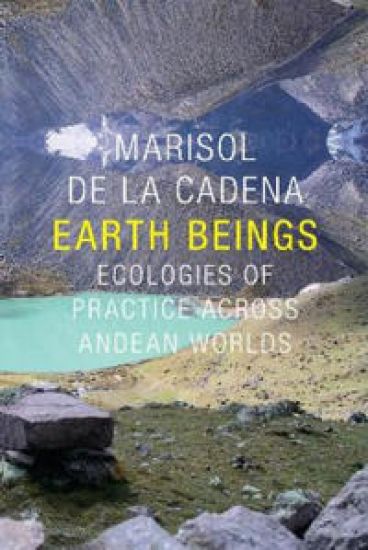
Earth Beings

Earth Beings

Marisol de la Cadena; Robert J. Foster; Daniel R. Reichman

Duke University Press
2015
pokkari

Halvin toimitettuna 33,40 €

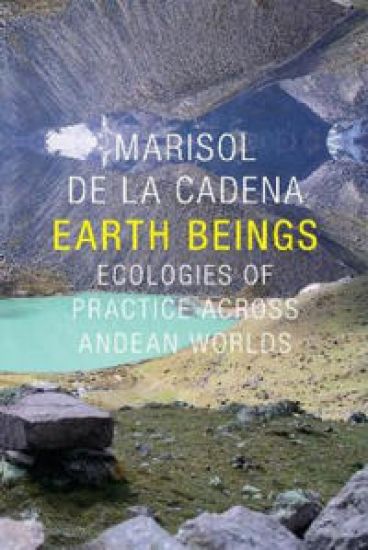
Earth Beings is the fruit of Marisol de la Cadena's decade-long conversations with Mariano and Nazario Turpo, father and son, runakuna or Quechua people. Concerned with the mutual entanglements of indigenous and nonindigenous worlds, and the partial connections between them, de la Cadena presents how the Turpos' indigenous ways of knowing and being include and exceed modern and nonmodern practices. Her discussion of indigenous political strategies-a realm that need not abide by binary logics-reconfigures how to think about and question modern politics, while pushing her readers to think beyond "hybridity" and toward translation, communication that accepts incommensurability, and mutual difference as conditions for ethnography to work.
Earth Beings

Earth Beings

Marisol de la Cadena; Robert J. Foster; Daniel R. Reichman

Duke University Press
2015
sidottu
Earth Beings is the fruit of Marisol de la Cadena's decade-long conversations with Mariano and Nazario Turpo, father and son, runakuna or Quechua people. Concerned with the mutual entanglements of indigenous and nonindigenous worlds, and the partial connections between them, de la Cadena presents how the Turpos' indigenous ways of knowing and being include and exceed modern and nonmodern practices. Her discussion of indigenous political strategies-a realm that need not abide by binary logics-reconfigures how to think about and question modern politics, while pushing her readers to think beyond "hybridity" and toward translation, communication that accepts incommensurability, and mutual difference as conditions for ethnography to work.
Indigenous Mestizos

Indigenous Mestizos

Marisol de la Cadena

Duke University Press
2000
pokkari
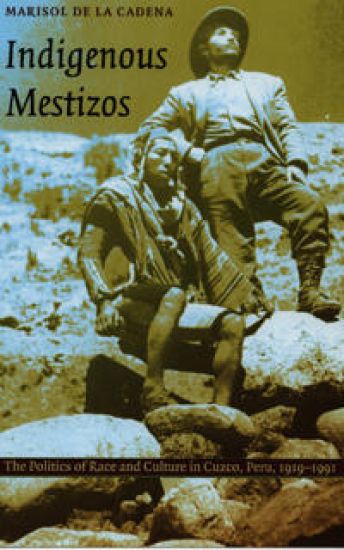
In the early twentieth century, Peruvian intellectuals, unlike their European counterparts, rejected biological categories of race as a basis for discrimination. But this did not eliminate social hierarchies; instead, it redefined racial categories as cultural differences, such as differences in education or manners. In Indigenous Mestizos Marisol de la Cadena traces the history of the notion of race from this turn-of-the-century definition to a hegemony of racism in Peru. De la Cadena’s ethnographically and historically rich study examines how indigenous citizens of the city of Cuzco have been conceived by others as well as how they have viewed themselves and places these conceptions within the struggle for political identity and representation. Demonstrating that the terms Indian and mestizo are complex, ambivalent, and influenced by social, legal, and political changes, she provides close readings of everyday concepts such as marketplace identity, religious ritual, grassroots dance, and popular culture, as well as of such common terms as respect, decency, and education. She shows how Indian has come to mean an indigenous person without economic and educational means-one who is illiterate, impoverished, and rural. Mestizo, on the other hand, has come to refer to an urban, usually literate, and economically successful person claiming indigenous heritage and participating in indigenous cultural practices. De la Cadena argues that this version of de-Indianization-which, rather than assimilation, is a complex political negotiation for a dignified identity-does not cancel the economic and political equalities of racism in Peru, although it has made room for some people to reclaim a decolonized Andean cultural heritage. This highly original synthesis of diverse theoretical arguments brought to bear on a series of case studies will be of interest to scholars of cultural anthropology, postcolonialism, race and ethnicity, gender studies, and history, in addition to Latin Americanists.
Indigenous Mestizos

Indigenous Mestizos

Marisol de la Cadena

Duke University Press
2000
sidottu
In the early twentieth century, Peruvian intellectuals, unlike their European counterparts, rejected biological categories of race as a basis for discrimination. But this did not eliminate social hierarchies; instead, it redefined racial categories as cultural differences, such as differences in education or manners. In Indigenous Mestizos Marisol de la Cadena traces the history of the notion of race from this turn-of-the-century definition to a hegemony of racism in Peru. De la Cadena’s ethnographically and historically rich study examines how indigenous citizens of the city of Cuzco have been conceived by others as well as how they have viewed themselves and places these conceptions within the struggle for political identity and representation. Demonstrating that the terms Indian and mestizo are complex, ambivalent, and influenced by social, legal, and political changes, she provides close readings of everyday concepts such as marketplace identity, religious ritual, grassroots dance, and popular culture, as well as of such common terms as respect, decency, and education. She shows how Indian has come to mean an indigenous person without economic and educational means-one who is illiterate, impoverished, and rural. Mestizo, on the other hand, has come to refer to an urban, usually literate, and economically successful person claiming indigenous heritage and participating in indigenous cultural practices. De la Cadena argues that this version of de-Indianization-which, rather than assimilation, is a complex political negotiation for a dignified identity-does not cancel the economic and political equalities of racism in Peru, although it has made room for some people to reclaim a decolonized Andean cultural heritage. This highly original synthesis of diverse theoretical arguments brought to bear on a series of case studies will be of interest to scholars of cultural anthropology, postcolonialism, race and ethnicity, gender studies, and history, in addition to Latin Americanists.