Kirjojen hintavertailu – 12 859 829 kirjaa ja 27 kauppaa
Kirjailija
Marjorie Grene
Kirjat ja teokset yhdessä paikassa: 8 kirjaa, julkaisuja vuosilta 1974–2004, suosituimpiin kuuluu The Understanding of Nature. Vertaile teosten hintoja ja tarkista saatavuus suomalaisista kirjakaupoista.
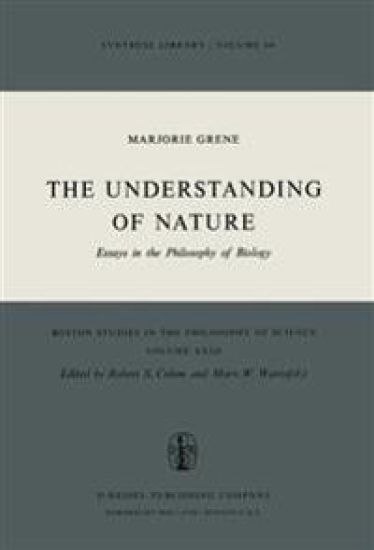
Is life different from the non-living? If so, how? And how, in that case, does biology as the study of living things differ from other sciences? These questions are traced through an exploration of episodes in the history of biology and philosophy. The book begins with Aristotle, then moves on to Descartes, comparing his position with that of Harvey. In the eighteenth century the authors consider Buffon and Kant. In the nineteenth century the authors examine the Cuvier-Geoffroy debate, pre-Darwinian geology and natural theology, Darwin and the transition from Darwin to the revival of Mendelism. Two chapters deal with the evolutionary synthesis and such questions as the species problem, the reducibility or otherwise of biology to physics and chemistry, and the problem of biological explanation in terms of function and teleology. The final chapters reflect on the implications of the philosophy of biology for philosophy of science in general.
Is life different from the non-living? If so, how? And how, in that case, does biology as the study of living things differ from other sciences? These questions are traced through an exploration of episodes in the history of biology and philosophy. The book begins with Aristotle, then moves on to Descartes, comparing his position with that of Harvey. In the eighteenth century the authors consider Buffon and Kant. In the nineteenth century the authors examine the Cuvier-Geoffroy debate, pre-Darwinian geology and natural theology, Darwin and the transition from Darwin to the revival of Mendelism. Two chapters deal with the evolutionary synthesis and such questions as the species problem, the reducibility or otherwise of biology to physics and chemistry, and the problem of biological explanation in terms of function and teleology. The final chapters reflect on the implications of the philosophy of biology for philosophy of science in general.
Gadfly, heretic, persuasive expositor, and illuminating teacher, Marjorie Grene has been writing about philosophical issues and influencing philosophical debate since the 1930s. In this unrepentant and provocative essay, Grene brings together some of the themes in philosophy, biology, and other disciplines which have influenced her other work, together with recollections of her contacts with some of the thinkers and ideas which have most impressed her.
In this engrossing double volume, the work and thought of Nicolas Malebranche is examined through the eyes of Simon Foucher and Dortous de Mairan. Part 1 consists of Richard A. Watson’s translation of the first published critique, by Simon Foucher, of Malebranche’s main philosophical work, Of the Search for the Truth. In the second part, Marjorie Grene presents a meticulous translation of the long correspondence between Malebranche and Jean-Jacques Dortous de Mairan that ended shortly before Malebranche’s death. Both Watson and Grene provide insightful introductions to their translations. The influence of the works of Malebranche has been extensive, as has the influence of the lesser works of his first critic, Simon Foucher. Although Foucher was a minor philosopher of the seventeenth century, he provided arguments that led to a crucial turning point in modern philosophy. Listened to with care and treated with respect by Leibniz, Foucher’s arguments were utilized by Bayle, Berkeley, and Hume toward the destruction not only of Cartesian metaphysics but of substance philosophy as well. In this translation of Foucher’s work, it is now possible for readers of Malebranche’s Of the Search for the Truth to evaluate the immediate response of a young philosopher about town to one of the most important philosophical works of his day. The correspondence between Jean-Jacques Dortous de Mairan, an obscure provincial, and Nicolas Malebranche has usually been viewed as a small addendum to the works of Malebranche. Marjorie Grene, however, in her translation of this correspondence, considers it not only a contribution to the Malebranchian corpus but also an example of a reaction to Spinoza. Born at Béziers in the south of France in 1678, Mairan went to Paris in 1698, where he studied mathematics with Malebranche. Their correspondence began four years later when Mairan returned to Béziers to accept a position with the local bishop. In his letters to Malebranche, Mairan reveals himself to be one of no more than a handful of known readers of Spinoza who, in the early eighteenth century, admitted fascination with Spinoza’s presentation of his thoroughly unorthodox God and his equally unorthodox nature.
AThink of the word "evolution": the name Darwin and the term "natural selection" come to mind. But any powerful general theory of evolution must account for social evolution, both human and nonhuman, and contemporary Darwinism has not persuasively made such an accounting. In Interactions: The Biological Context of Social Systems, Niles Eldredge and Marjorie Grene argue effectively and coherently against the reductionist tendencies in modern Darwinism, which they call ultra-Darwinism, also known as genic reduction. This book explores the biological underpinnings of social systems from invertebrates to mammals, particularly humans. These social systems, the authors argue, represent fusions between the economic and reproductive interests of organisms. Their theory moves away from the more prominent emphasis on reproductive biology at the core of sociobiology to reinstate the importance of economics in social organizations of all types.
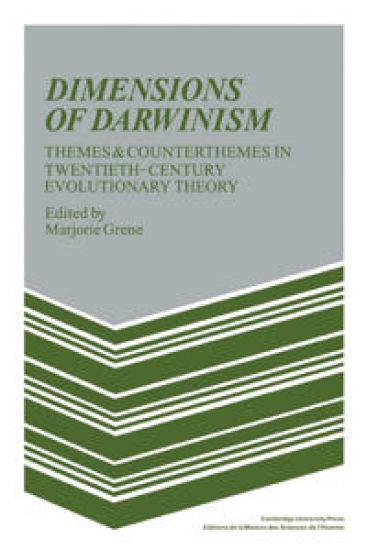
Originally published in paperback in 1986, the essays in this book discuss questions about the growth and conceptual structure of the modern evolutionary synthesis, or 'neo-Darwinism'. Written by biologists, historians and philosophers, the collection provides a penetrating analysis of the development, meaning and problems of twentieth-century evolutionary theory. Part I includes discussion of the role of eugenics in shaping the biological interests of R. A. Fisher; the abandonment of Lamarckism; the influence of systematics and the concepts of adaptation and random drift in the development of Sewall Wright's theory; and explanation of how the synthesis 'hardened' in the decades following its original presentation. Part II examines the history of mimetic theory as a case study in evolutionary thought, while Part III introduces the reader to some aspects of the German tradition. Finally, Part IV addresses the debates that existed around the time of publication.
No student or colleague of Marjorie Grene will miss her incisive presence in these papers on the study and nature of living nature, and we believe the new reader will quickly join the stimulating discussion and critique which Professor Grene steadily provokes. For years she has worked with equally sure knowledge in the classical domain of philosophy and in modern epistemological inquiry, equally philosopher of science and metaphysician. Moreover, she has the deeply sensible notion that she should be a critically intelligent learner as much as an imaginatively original thinker, and as a result she has brought insightful expository readings of other philosophers and scientists to her own work. We were most fortunate that Marjorie Grene was willing to spend a full semester of a recent leave here in Boston, and we have on other occasions sought her participation in our colloquia and elsewhere. Now we have the pleasure of including among the Boston Studies in the Philosophy of Science this generous selection from Grene's philosophical inquiries into the understanding of the natural world, and of the men and women in it. Boston University Center for the R. S. COHEN Philosophy and History of Science M. W. W ARTOFSKY April 1974 PREFACE This collection spans - spottily - years from 1946 ('On Some Distinctions between Men and Brutes') to 1974 ('On the Nature of Natural Necessity').
No student or colleague of Marjorie Grene will miss her incisive presence in these papers on the study and nature of living nature, and we believe the new reader will quickly join the stimulating discussion and critique which Professor Grene steadily provokes. For years she has worked with equally sure knowledge in the classical domain of philosophy and in modern epistemological inquiry, equally philosopher of science and metaphysician. Moreover, she has the deeply sensible notion that she should be a critically intelligent learner as much as an imaginatively original thinker, and as a result she has brought insightful expository readings of other philosophers and scientists to her own work. We were most fortunate that Marjorie Grene was willing to spend a full semester of a recent leave here in Boston, and we have on other occasions sought her participation in our colloquia and elsewhere. Now we have the pleasure of including among the Boston Studies in the Philosophy of Science this generous selection from Grene's philosophical inquiries into the understanding of the natural world, and of the men and women in it. Boston University Center for the R. S. COHEN Philosophy and History of Science M. W. W ARTOFSKY April 1974 PREFACE This collection spans - spottily - years from 1946 ('On Some Distinctions between Men and Brutes') to 1974 ('On the Nature of Natural Necessity').