Kirjojen hintavertailu – 12 903 725 kirjaa ja 27 kauppaa
Kirjailija
Mark Bovens
Kirjat ja teokset yhdessä paikassa: 11 kirjaa, julkaisuja vuosilta 1998–2025, suosituimpiin kuuluu Justice in Climate Policy. Vertaile teosten hintoja ja tarkista saatavuus suomalaisista kirjakaupoista.
This open access book is looking into ways to achieve just climate policy within a country. The authors of this monograph share a unique, timely and original vision: continuous support for climate policy is more likely to emerge when citizens find that the distribution of the bill for climate costs is fair. But what is a fair distribution of climate costs? This is an important question because financial costs of mitigation (reducing greenhouse gases), adaptation (adapting to climate change) and damage (compensating or compensating after weather extremes) increase significantly in the coming decades. Drawing on philosophy and ethics, the authors propose ten principles for achieving just distributions of domestic climate costs. Examples of such principles are individual responsibility, the polluter pays, greatest utility and capacity to pay. Yet what a fair distribution is, depends on, for example, political preferences and the policy issue at hand. Empirical research on designing climate policies, however, shows that distributive principles are not part of the political, policy, and public discussions. The authors therefore argue that explicit attention to principles of just distribution at the start of a policy process contributes to support for climate policy. This book provides tools to professionals and students to achieve justice in climate policy.
This Open Access book shows policymakers which initiatives work when responding to the increasing diversity in cities, towns and neighborhood's. In recent times, policymakers have grappled with ways of responding to this increase, which has resulted in a plethora of policy initiatives, some more effective than others. Bringing together a large amount of research and evidence-based policy recommendations, this book offers both a sense of strategic direction as well as more specific, actionable advice. It brings together a remarkable mixture of policy areas that touch upon issues of diversity, immigration policy, education, and labour policy. It is of benefit and importance to all those making policies for a country with increasing immigration.
This Open Access book shows policymakers which initiatives work when responding to the increasing diversity in cities, towns and neighborhood's. In recent times, policymakers have grappled with ways of responding to this increase, which has resulted in a plethora of policy initiatives, some more effective than others. Bringing together a large amount of research and evidence-based policy recommendations, this book offers both a sense of strategic direction as well as more specific, actionable advice. It brings together a remarkable mixture of policy areas that touch upon issues of diversity, immigration policy, education, and labour policy. It is of benefit and importance to all those making policies for a country with increasing immigration.
This open access book sets out to explain the reasons for the gap between "knowing" and "doing" in view of self-reliance, which is more and more often expected of citizens. In today's society, people are expected to take responsibility for their own lives and be self-reliant. This is no easy feat. They must be on constant high alert in areas of life such as health, work and personal finances and, if things threaten to go awry, take appropriate action without further ado. What does this mean for public policy? Policymakers tend to assume that the government only needs to provide people with clear information and that, once properly informed, they will automatically do the right thing. However, it is becoming increasingly obvious that things do not work like that. Even though people know perfectly well what they ought to do, they often behave differently. Why is this? This book sets out to explain the reasons for the gap between 'knowing' and 'doing'. It focuses on the role of non-cognitive capacities, such as setting goals, taking action, persevering and coping with setbacks, and shows how these capacities are undermined by adverse circumstances. By taking the latest psychological insights fully into account, this book presents a more realist perspective on self-reliance, and shows government officials how to design rules and institutions that allow for the natural limitations in people's 'capacity to act'. This work was published by Saint Philip Street Press pursuant to a Creative Commons license permitting commercial use. All rights not granted by the work's license are retained by the author or authors.
This open access book sets out to explain the reasons for the gap between "knowing" and "doing" in view of self-reliance, which is more and more often expected of citizens. In today's society, people are expected to take responsibility for their own lives and be self-reliant. This is no easy feat. They must be on constant high alert in areas of life such as health, work and personal finances and, if things threaten to go awry, take appropriate action without further ado. What does this mean for public policy? Policymakers tend to assume that the government only needs to provide people with clear information and that, once properly informed, they will automatically do the right thing. However, it is becoming increasingly obvious that things do not work like that. Even though people know perfectly well what they ought to do, they often behave differently. Why is this? This book sets out to explain the reasons for the gap between 'knowing' and 'doing'. It focuses on the role of non-cognitive capacities, such as setting goals, taking action, persevering and coping with setbacks, and shows how these capacities are undermined by adverse circumstances. By taking the latest psychological insights fully into account, this book presents a more realist perspective on self-reliance, and shows government officials how to design rules and institutions that allow for the natural limitations in people's 'capacity to act'. This work was published by Saint Philip Street Press pursuant to a Creative Commons license permitting commercial use. All rights not granted by the work's license are retained by the author or authors.
This open access book sets out to explain the reasons for the gap between “knowing” and “doing” in view of self-reliance, which is more and more often expected of citizens. In today’s society, people are expected to take responsibility for their own lives and be self-reliant. This is no easy feat. They must be on constant high alert in areas of life such as health, work and personal finances and, if things threaten to go awry, take appropriate action without further ado. What does this mean for public policy? Policymakers tend to assume that the government only needs to provide people with clear information and that, once properly informed, they will automatically do the right thing. However, it is becoming increasingly obvious that things do not work like that. Even though people know perfectly well what they ought to do, they often behave differently. Why is this? This book sets out to explain the reasons for the gap between ‘knowing’ and ‘doing’. It focuses on the role of non-cognitive capacities, such as setting goals, taking action, persevering and coping with setbacks, and shows how these capacities are undermined by adverse circumstances. By taking the latest psychological insights fully into account, this book presents a more realist perspective on self-reliance, and shows government officials how to design rules and institutions that allow for the natural limitations in people’s ‘capacity to act’.
This open access book sets out to explain the reasons for the gap between “knowing” and “doing” in view of self-reliance, which is more and more often expected of citizens. In today’s society, people are expected to take responsibility for their own lives and be self-reliant. This is no easy feat. They must be on constant high alert in areas of life such as health, work and personal finances and, if things threaten to go awry, take appropriate action without further ado. What does this mean for public policy? Policymakers tend to assume that the government only needs to provide people with clear information and that, once properly informed, they will automatically do the right thing. However, it is becoming increasingly obvious that things do not work like that. Even though people know perfectly well what they ought to do, they often behave differently. Why is this? This book sets out to explain the reasons for the gap between ‘knowing’ and ‘doing’. It focuses on the role of non-cognitive capacities, such as setting goals, taking action, persevering and coping with setbacks, and shows how these capacities are undermined by adverse circumstances. By taking the latest psychological insights fully into account, this book presents a more realist perspective on self-reliance, and shows government officials how to design rules and institutions that allow for the natural limitations in people’s ‘capacity to act’.
Lay politics lies at the heart of democracy. Political offices are the only offices for which no formal qualifications are required. Contemporary political practices are diametrically opposed to this constitutional ideal. Most democracies in Western Europe are diploma democracies - ruled by those with the highest formal qualifications. Citizens with low or medium educational qualifications currently make up about 70 percent of the electorates, yet they have become virtually absent from almost all political arenas. University graduates have come to dominate all political institutions and venues, from political parties, parliaments and cabinets, to organised interests, deliberative settings, and Internet consultations. This rise of a political meritocracy is part of larger trend. In the information society, educational background, like class or religion, is an important source of social and political divides. Those who are well educated tend to be cosmopolitans, whereas the lesser educated citizens are more likely to be nationalists. This book documents the context, contours, and consequences of this rise of a political meritocracy. It explores the domination of higher educated citizens in political participation, civil society, and political office in Western Europe. It discusses the consequences of this rise of a political meritocracy, such as descriptive deficits, policy incongruences, biased standards, and cynicism and distrust. Also, it looks at ways to remedy, or at least mitigate, some of the negative effects of diploma democracy.
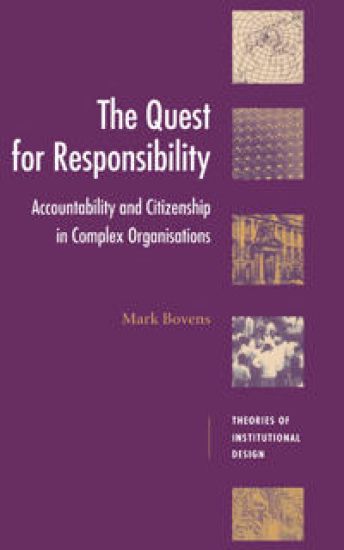
The search for responsibility in complex organisations often seems an impossible undertaking. Adopting a multidisciplinary approach combining law, social science, ethics and organisational design, Mark Bovens analyses the reasons for this, and offers possible solutions. He begins by examining the problem of ‘many hands’ - because so many people contribute in so many different ways, it is very difficult to determine who is accountable for organisational behaviour. Four possible solutions - corporate, hierarchical, collective and individual accountability - are analysed from normative, empirical and practical perspectives. Bovens argues that individual accountability is the most promising solution, but only if individuals have the chance to behave responsibly. The book then explores the implications of this approach. What does it mean to be a ‘responsible’ employee or official? When is it legitimate to disobey the orders of superiors? What institutional designs might be most appropriate?
The search for responsibility in complex organisations often seems an impossible undertaking. Adopting a multidisciplinary approach combining law, social science, ethics and organisational design, Mark Bovens analyses the reasons for this, and offers possible solutions. He begins by examining the problem of 'many hands' - because so many people contribute in so many different ways, it is very difficult to determine who is accountable for organisational behaviour. Four possible solutions - corporate, hierarchical, collective and individual accountability - are analysed from normative, empirical and practical perspectives. Bovens argues that individual accountability is the most promising solution, but only if individuals have the chance to behave responsibly. The book then explores the implications of this approach. What does it mean to be a 'responsible' employee or official? When is it legitimate to disobey the orders of superiors? What institutional designs might be most appropriate?