
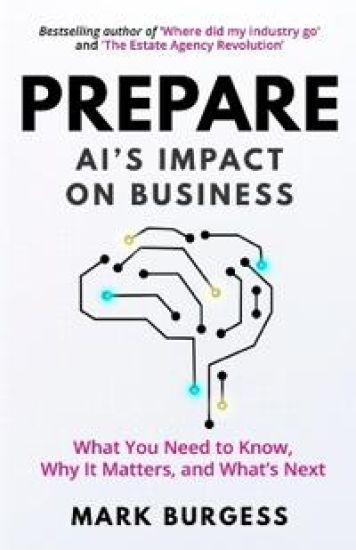
Kirjailija
Mark Burgess
Kirjat ja teokset yhdessä paikassa: 19 kirjaa, julkaisuja vuosilta 2002–2025, suosituimpiin kuuluu Prepare. Vertaile teosten hintoja ja tarkista saatavuus suomalaisista kirjakaupoista.
19 kirjaa
Kirjojen julkaisuvuodet: 2002–2025.

This 2002 book discusses the classical foundations of field theory, using the language of variational methods and covariance. It explores the limits of what can be achieved with purely classical notions, and shows how these have a deep and important connection with the second quantized field theory, which follows on from the Schwinger Action Principle. The book takes a pragmatic view of field theory, focusing on issues which are usually omitted from quantum field theory texts and cataloging results which are hard to find in the literature. Care is taken to explain how results arise and how to interpret them physically, for graduate students starting out in the field. An ideal supplementary text for courses on elementary field theory, group theory and dynamical systems, it is also a valuable reference for researchers working in these and related areas. It has been reissued as an Open Access publication on Cambridge Core.

This 2002 book discusses the classical foundations of field theory, using the language of variational methods and covariance. It explores the limits of what can be achieved with purely classical notions, and shows how these have a deep and important connection with the second quantized field theory, which follows on from the Schwinger Action Principle. The book takes a pragmatic view of field theory, focusing on issues which are usually omitted from quantum field theory texts and cataloging results which are hard to find in the literature. Care is taken to explain how results arise and how to interpret them physically, for graduate students starting out in the field. An ideal supplementary text for courses on elementary field theory, group theory and dynamical systems, it is also a valuable reference for researchers working in these and related areas. It has been reissued as an Open Access publication on Cambridge Core.
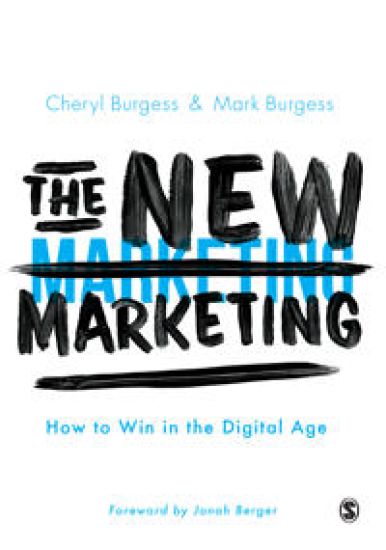
In our hyper-connected world that is changing at warp speed, marketers recognize the need to shift from traditional marketing methods to a new way that can help them better navigate the unpredictable environment. For traditionalists, this change has posed a challenge. Many have tried to incorporate new approaches into the old models they grew up with, only to be frustrated with the results. From the bestselling authors of The Social Employee, and LinkedIn Learning course authors, comes a powerful new textbook that cracks the marketing code in our hyper-focused digital age. The New Marketing, with contributions spanning CMO trailblazers to martech disruptors, behavioral economics luminaries at Yale to leading marketing thinkers at Kellogg and Wharton, is a GPS for navigating in a digital world and moves the craft of marketing through the forces of marketing transformation. We can’t predict the future. But our goal is to help make Masters/MBA students and marketing practitioners future-ready and successful.
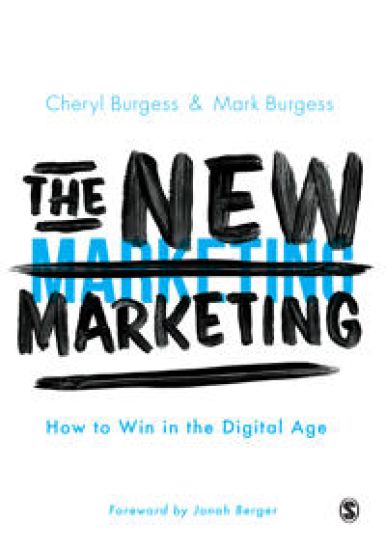
In our hyper-connected world that is changing at warp speed, marketers recognize the need to shift from traditional marketing methods to a new way that can help them better navigate the unpredictable environment. For traditionalists, this change has posed a challenge. Many have tried to incorporate new approaches into the old models they grew up with, only to be frustrated with the results. From the bestselling authors of The Social Employee, and LinkedIn Learning course authors, comes a powerful new textbook that cracks the marketing code in our hyper-focused digital age. The New Marketing, with contributions spanning CMO trailblazers to martech disruptors, behavioral economics luminaries at Yale to leading marketing thinkers at Kellogg and Wharton, is a GPS for navigating in a digital world and moves the craft of marketing through the forces of marketing transformation. We can’t predict the future. But our goal is to help make Masters/MBA students and marketing practitioners future-ready and successful.
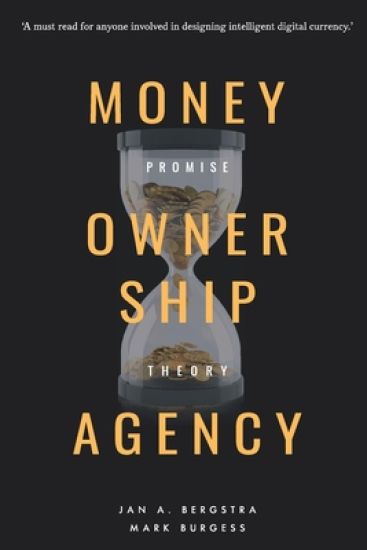
Money, Ownership. and Agency: As an Application of Promise Theory
Jan A. Bergstra; Mark Burgess
Independently Published
2019
nidottu
A survey of the elementary functions of money and its invariant representations, alongside the complementary topic of ownership. The book uses the language of Promise Theory to explain the semantics and lifecycle of money in a concise and semi-formal manner, with the goal of reaching a modern probabilistic view of money and economics as a network, independent of philosophical or political treatments as well as models that build on Game Theory. Relativistic notions like value' are distinguished carefully from invariant measures of amount to decouple frequently muddled concepts in the popular literature, and money is distinguished from its many inequivalent representations (i.e. proxy technologies). A key strength of this work lies in the way it exposes money as an interconnection network, which has evolved to communicate intentions and decisions between agents in a network, where prices form a language for information channels that we call markets. This book is aimed at economists, philosophers, and engineers. It introduces readers to the concepts in a practical manner, building on the concept of voluntary cooperation. The book draws on many examples from the real world, with a particular emphasis on semi-formal semantics.'A must read for anyone involved in designing intelligent digital currency.'--Mike Warner (Senior Strategist, San Francisco Federal Reserve)
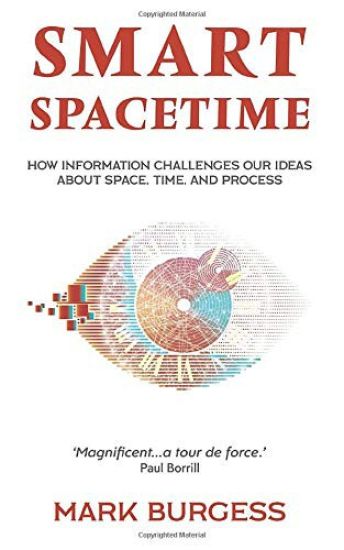
Smart Spacetime: How information challenges our ideas about space, time, and process
Mark Burgess
Independently Published
2019
nidottu

My first experience of an agency was back in the mid 1990s. Since then I have set up and built various successful businesses in the property, marketing, recruitment, publishing and digital sectors. Over all those years I have always remained connected to the estate agency industry in one way or another but the crazy thing is that although my journey over the last 25+ years has been one of discovery and development, the estate agency industry itself has remained largely unchanged. I can still relate with all of the issues and processes that take place on a day-to-day basis, as if feels like it was only yesterday that I worked in estate agency myself. The techniques and technology being used in the big wide world seem to have somehow passed traditional estate agency by and my Proptech company, Iceberg Digital, is on a mission to bring that tech, process and reasoning into estate agency and help traditional agents modernise their business. In this book Mark breaks down some of the key issues that currently exist in most estate agency businesses and explains how those issues can not only be solved but also what needs to be done in order to reinvent your processes and how they will open your eyes to a whole new dawn in estate agency - one where your current competitors simply can't compete.

Promise Theory: Case Study on the 2016 Brexit Vote
Mark Burgess; Jan Bergstra
Createspace Independent Publishing Platform
2017
nidottu
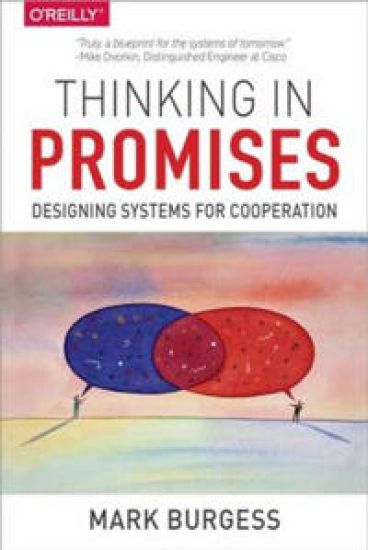
Imagine a set of simple principles that could help you to understand how parts combine to become a whole, and how each part sees the whole from its own perspective. If such principles were any good, it shouldn't matter whether we're talking about humans on a team, birds in a flock, computers in a datacenter, or cogs in a Swiss watch. A theory of cooperation ought to be pretty universal, so we could apply it both to technology and to the workplace. Such principles are the subject of Promise Theory, and the focus of this insightful book. The goal of Promise Theory is to reveal the behavior of a whole from the sum of its parts, taking the point of the parts rather than the whole. In other words, it is a bottom-up constructionist view of the world. Start Thinking in Promises and find out why this discipline works for documenting system behaviors from the bottom-up.
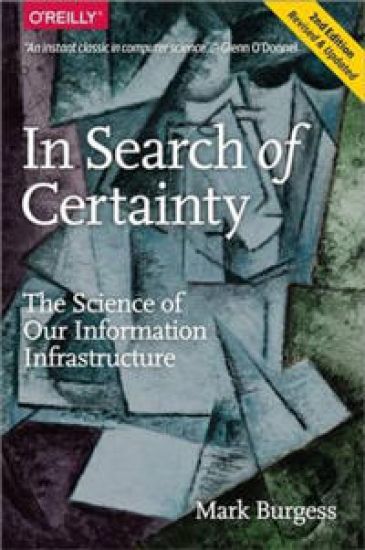
Quite soon, the world's information infrastructure is going to reach a level of scale and complexity that will force scientists and engineers to approach it in an entirely new way. The familiar notions of command and control are being thwarted by realities of a faster, denser world of communication where choice, variety, and indeterminism rule. The myth of the machine that does exactly what we tell it has come to an end. What makes us think we can rely on all this technology? What keeps it together today, and how might it work tomorrow? Will we know how to build the next generation-or will we be lulled into a stupor of dependence brought about by its conveniences? In this book, Mark Burgess focuses on the impact of computers and information on our modern infrastructure by taking you from the roots of science to the principles behind system operation and design. To shape the future of technology, we need to understand how it works-or else what we don't understand will end up shaping us. This book explores this subject in three parts: Part I, Stability: describes the fundamentals of predictability, and why we have to give up the idea of control in its classical meaning Part II, Certainty: describes the science of what we can know, when we don't control everything, and how we make the best of life with only imperfect information Part III, Promises: explains how the concepts of stability and certainty may be combined to approach information infrastructure as a new kind of virtual material, restoring a continuity to human-computer systems so that society can rely on them.

Promise Theory: Principles and Applications (Second edition)
Jan A. Bergstra; Mark Burgess
Independently Published
2014
nidottu
Promise Theory bridges the worlds of semantics and dynamics to describe scalable interactions between autonomous agents that form clusters and groups. It provides a broadly developed and semi-formal language, which builds on the mathematics of sets and graphs, and models intent and outcome in an impartial manner. The result is a theory that expresses a chemistry' of cooperative behaviours for a wide range of systems, emphasizing how each new scale of cooperation leads to new phenomena and new promises. This book is aimed at scientists, philosophers, and engineers. It introduces readers to the key concepts in a practical manner, building on the foundation of voluntary cooperation as a ground state for all interacting systems. The book draws on many examples from the real world, with a particular emphasis on human-computer systems. Promise Theory offers a methodology for generating certainty on top of uncertain foundations. This book presents the formal foundations of Promise Theory. It lays out the formalisms in a clear, concise, understandable way that makes them accessible to non-mathematicians. If you want to fully understand the conceptual mechanisms that underlie the distributed systems that make up today's "cloud services", you should start with this book.' -- Jeff Sussna, Author of Designing Delivery The authors] bring the rigor of theoretical physics to the science of cooperation. The application of this kind of rigor to the social sciences is a tremendous leap forward. The] pioneering work on developing an algebra of cooperation is an idea whose time has come. A promise is not a guarantee. That said: I promise you that examining this book will stimulate your thinking about cooperation and collaboration at scale. This book covers a lot of ground: promises, impositions, invitations, games, and the peculiar dynamics of authority and authorization. Those looking for a book that applies the lessons of distributed computing to the new and emerging science of cooperation will find what they are looking for here.' -- Daniel Mezick, Author of The Culture Game and Inviting Leadership
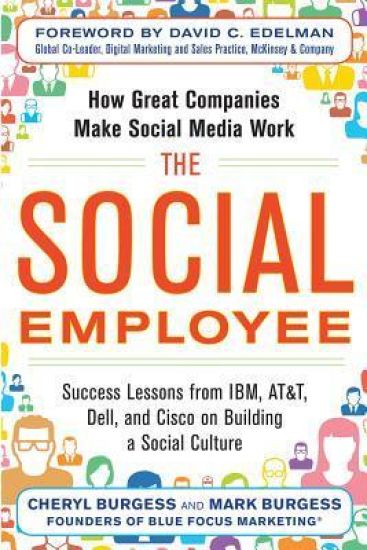
The Social Employee: How Great Companies Make Social Media Work
Cheryl Burgess; Mark Burgess
McGraw-Hill Professional
2013
nidottu
Build a successful SOCIAL BUSINESS by empowering the SOCIAL EMPLOYEEIncludes success stories from IBM, AT&T, Dell, Cisco, Southwest Airlines, Adobe, Domo, and Acxiom"Great brands have always started on the inside, but why are companies taking so long to leverage the great opportunities offered by internal social media? . . . The Social Employee lifts the lid on this potential and provides guidance for businesses everywhere." -- JEZ FRAMPTON, Global Chairman and CEO, Interbrand"Get a copy of this book for your whole team and get ready for a surge in measurable social media results!" -- MARI SMITH, author, The New Relationship Marketing, and coauthor, Facebook Marketing"Practical and insightful, The Social Employee is sure to improve your brand-building efforts." -- KEVIN LANE KELLER, E. B. Osborn Professor of Marketing, Tuck School of Business at Dartmouth College, and author, Strategic Brand Management"This book will change how you view the workplace and modern connectivity, and inform your view of how social employees are changing how we work and create value in today's networked economy." -- DAVID ARMANO, Managing Director, Edelman Digital Chicago, and contributor to Harvard Business Review"The Social Employee makes the compelling argument that most organizations are sadly missing a key opportunity to create a social brand, as well as to build a strong company culture." -- ANN HANDLEY, Chief Content Officer, MarketingProfs.com, and coauthor, Content Rules


Packed with expert advice, wit, and wisdom, this is the perfect resource for looking to secure their long-term financial independence. Do you dream of living life on your terms and having personal and financial freedom? Are you tired of living payday to payday? This book will reveal to you what thousands of people are discovering every day - you can realise your dreams and financial goals! The authors take a brilliant approach to surviving the economy. Through a marriage of traditional and contemporary marketing techniques, they eliminate the mystery of success in one of fastest growing industries in the world - the home-based business. Anyone who desires to become financially secure will want to read this expert guide that gives the insight and information you need to build and enjoy a successful home-based business of your own.

This 2002 book discusses the classical foundations of field theory, using the language of variational methods and covariance. It explores the limits of what can be achieved with purely classical notions, and shows how these have a deep and important connection with the second quantized field theory, which follows on from the Schwinger Action Principle. The book takes a pragmatic view of field theory, focusing on issues which are usually omitted from quantum field theory texts and cataloging results which are often hard to find in the literature. Care is taken to explain how results arise and how to interpret them physically, for graduate students starting out in the field. Many physical examples are provided, making the book an ideal supplementary text for courses on elementary field theory, group theory and dynamical systems. It will also be a valuable reference for researchers already working in these and related areas.
Foreword. Preface. Introduction. Science and its methods. Experiment and observation. Simple systems. Sets, states and logic. Diagrammatical representations. System variables. Change in systems. Information. Stability. Resource networks. Task management and services. System architectures. System normalization. System integrity. Policy and maintenance. Knowledge, learning and training. Policy transgressions and fault modelling. Decision and strategy. Conclusions. A Some Boolean formulae. B Statistical and scaling properties of time-series data. C Percolation conditions. Bibliography. Index.

A single, comprehensive resource that responds to the high demand for specialists who can provide advice to users and handle day-to-day administration, maintenance, and support of computer systems and networks Author approaches both network and system administration from the perspective of the principles that do not change on a day-to-day basis Shows how to discover customer needs and then use that information to identify, interpret, and evaluate system and network requirements New coverage includes Java services and Ipv6

This 2002 book discusses the classical foundations of field theory, using the language of variational methods and covariance. It explores the limits of what can be achieved with purely classical notions, and shows how these have a deep and important connection with the second quantized field theory, which follows on from the Schwinger Action Principle. The book takes a pragmatic view of field theory, focusing on issues which are usually omitted from quantum field theory texts and cataloging results which are often hard to find in the literature. Care is taken to explain how results arise and how to interpret them physically, for graduate students starting out in the field. Many physical examples are provided, making the book an ideal supplementary text for courses on elementary field theory, group theory and dynamical systems. It will also be a valuable reference for researchers already working in these and related areas.