Kirjojen hintavertailu – 12 903 725 kirjaa ja 27 kauppaa

Kirjailija

Mark C. Carnes

Kirjat ja teokset yhdessä paikassa: 15 kirjaa, julkaisuja vuosilta 1991–2022, suosituimpiin kuuluu American Nation + Study Guide for the American Nation: a History of the United States, Volume 1 (To 1877). Vertaile teosten hintoja ja tarkista saatavuus suomalaisista kirjakaupoista.

15 kirjaa

Kirjojen julkaisuvuodet: 1991–2022.

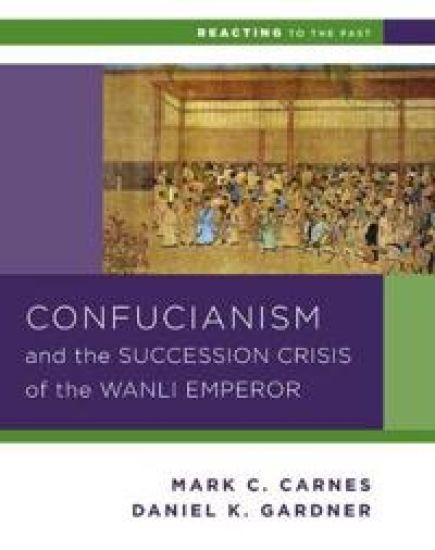
Confucianism and the Succession Crisis of the Wanli Emperor, 1587

Confucianism and the Succession Crisis of the Wanli Emperor, 1587

Daniel K. Gardner; Mark C. Carnes

THE UNIVERSITY OF NORTH CAROLINA PRESS
2022
pokkari
Confucianism and the Succession Crisis of the Wanli Emperor, 1587 is set in the Hanlin Academy in Ming dynasty China. Most students are members of the Grand Secretariat of the Hanlin Academy, the body of top-ranking graduates of the civil service examination who serve as advisers to the Wanli emperor. Some Grand Secretaries are Confucian "purists," who hold that tradition obliges the emperor to name his first-born son as successor; others, in support of the most senior of the Grand Secretaries, maintain that it is within the emperor's right to choose his successor; and still others, as they decide this matter among many issues confronting the empire, continue to scrutinize the teachings of Confucianism for guidance. The game unfolds amid the secrecy and intrigue within the walls of the Forbidden City as scholars struggle to apply Confucian precepts to a dynasty in peril.

Rousseau, Burke, and Revolution in France, 1791

Rousseau, Burke, and Revolution in France, 1791

Jennifer J. Popiel; Mark C. Carnes

THE UNIVERSITY OF NORTH CAROLINA PRESS
2022
pokkari
Rousseau, Burke, and Revolution in France, 1791 plunges students into the intellectual and political currents that surged through revolutionary Paris in the summer of 1791. As members of the National Assembly gather to craft a constitution for a new France, students wrestle with the threat of foreign invasion, political and religious power struggles, and questions of liberty and citizenship.
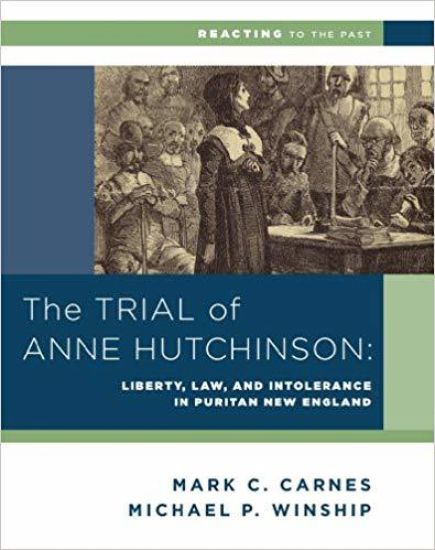
The Trial of Anne Hutchinson

The Trial of Anne Hutchinson

Michael Winship; Mark C. Carnes

THE UNIVERSITY OF NORTH CAROLINA PRESS
2022
pokkari
The Trial of Anne Hutchinson re-creates one of the most tumultuous and significant episodes in early American history: the struggle between the followers and allies of John Winthrop, governor of the Massachusetts Bay Colony, and those of Anne Hutchinson, a strong-willed and brilliant religious dissenter. The controversy pushed Massachusetts to the brink of collapse and spurred a significant exodus. The Puritans who founded Massachusetts were poised between the Middle Ages and the modern world, and in many ways, they helped to bring the modern world into being. The Trial of Anne Hutchinson plunges participants into a religious world that will be unfamiliar to many of them. Yet the Puritans' passionate struggles over how far they could tolerate a diversity of religious opinions in a colony committed to religious unity were part of a larger historical process that led to religious freedom and the modern concept of separation of church and state. Their vehement commitment to their liberties and fears about the many threats these faced were passed down to the American Revolution and beyond.
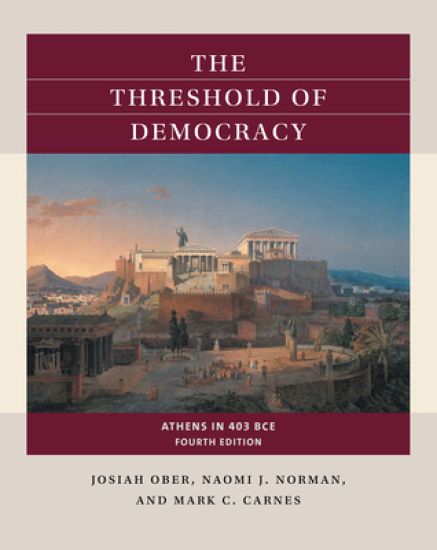
The Threshold of Democracy

The Threshold of Democracy

Josiah Ober; Naomi J. Norman; Mark C. Carnes

THE UNIVERSITY OF NORTH CAROLINA PRESS
2022
pokkari
The Threshold of Democracy re-creates the intellectual dynamics of one of the most formative periods in Western history. In the wake of Athenian military defeat and rebellion, advocates of democracy have reopened the Assembly, but stability remains elusive. As members of the Assembly, players must contend with divisive issues like citizenship, elections, remilitarization, and dissent. Foremost among the troublemakers: Socrates.
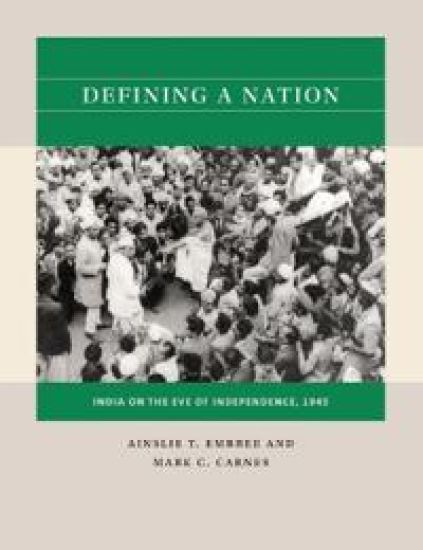
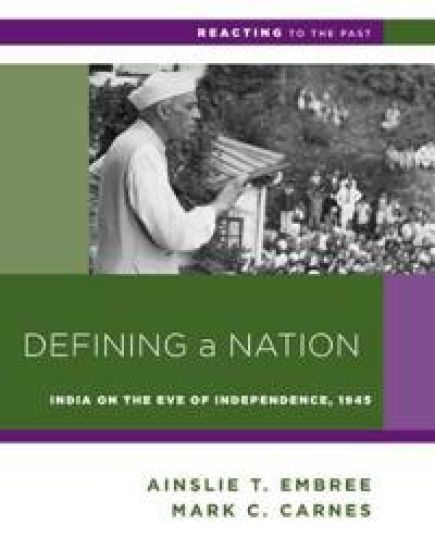
Defining a Nation

Defining a Nation

Ainslie T. Embree; Mark C. Carnes

THE UNIVERSITY OF NORTH CAROLINA PRESS
2022
pokkari
Defining a Nation is set at Simla, in the foothills of the Himalayas, where the British viceroy has invited leaders of various religious and political constituencies to work out the future of Britain's largest colony. Will the British transfer power to the Indian National Congress, which claims to speak for all Indians? Or will a separate Muslim state&8213;Pakistan&8213;be carved out of India to be ruled by Muslims, as the Muslim League proposes? And what will happen to the vulnerable minorities&8213;such as the Sikhs and untouchables&8213;or the hundreds of princely states? As British authority wanes, tensions among Hindus, Muslims, and Sikhs smolder and increasingly flare into violent riots that threaten to ignite all India. Towering above it all is the frail but formidable figure of Gandhi, whom some revere as an apostle of nonviolence and others regard as a conniving Hindu politician. Students struggle to reconcile religious identity with nation building&8213;perhaps the most intractable and important issue of the modern world. Texts include the literature of Hindu revival (Chatterjee, Tagore, and Tilak); the Koran and the literature of Islamic nationalism (Iqbal); and the writings of Ambedkar, Nehru, Jinnah, and Gandhi.
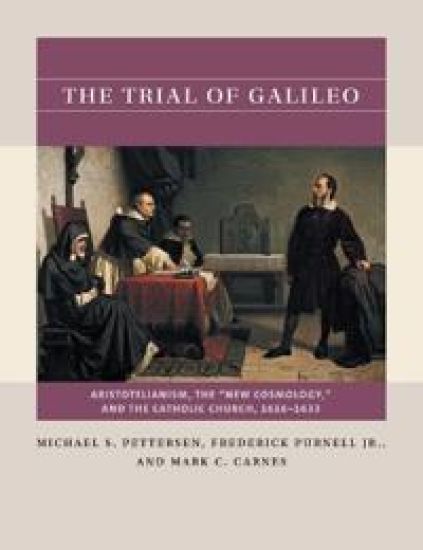
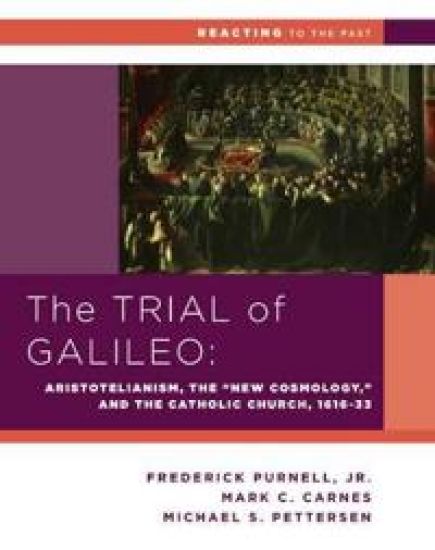
The Trial of Galileo

The Trial of Galileo

Michael S. Pettersen; Frederick Purnell Jr.; Mark C. Carnes

THE UNIVERSITY OF NORTH CAROLINA PRESS
2022
pokkari
In The Trial of Galileo the new science, as brilliantly propounded by Galileo Galilei, collides with the elegant cosmology of Aristotle, Aquinas, and medieval Scholasticism. The game is set in Rome in the early decades of the seventeenth century. Most of the debates occur within the Holy Office, the arm of the papacy that supervises the Roman Inquisition. At times action shifts to the palace of Prince Cesi, founder of the Society of the Lynx-Eyed, which promotes the new science, and to the lecture halls of the Jesuit Collegio Romano. Some students assume roles as faculty of the Collegio Romano and the secular University of Rome, the Sapienza. Others are cardinals who seek to defend the faith from resurgent Protestantism, the imperial ambitions of the Spanish monarch, the schemes of the Medici in Florence, and the crisis of faith throughout Christendom. Some embrace the "new cosmology," some denounce it, and still others are undecided. The issues range from the nature of faith and the meaning of the Bible to the scientific principles and methods as advanced by Copernicus, Kepler, Tycho Brahe, Giordano Bruno, and Galileo. Central texts include Aristotle's On the Heavens and Posterior Analytics; Galileo's Starry Messenger (1610), Letter to Grand Duchess Christina (1615) and Dialogue on the Two Chief World Systems (1632); the declarations of the Council of Trent; and the Bible.
Minds on Fire

Minds on Fire

Mark C. Carnes

Harvard University Press
2018
nidottu
A Choice Outstanding Academic Title of the YearIn Minds on Fire, Mark C. Carnes shows how role-immersion games channel students’ competitive (and sometimes mischievous) impulses into transformative learning experiences. His discussion is based on interviews with scores of students and faculty who have used a pedagogy called Reacting to the Past, which features month-long games set during the French Revolution, Galileo’s trial, the partition of India, and dozens of other epochal moments in disciplines ranging from art history to the sciences. These games have spread to over three hundred campuses around the world, where many of their benefits defy expectations.“[Minds on Fire is] Carnes’s beautifully written apologia for this fascinating and powerful approach to teaching and learning in higher education. If we are willing to open our minds and explore student-centered approaches like Reacting [to the Past], we might just find that the spark of student engagement we have been searching for in higher education’s mythical past can catch fire in the classrooms of the present.”—James M. Lang, Chronicle of Higher Education“This book is a highly engaging and inspirational study of a ‘new’ technique that just might change the way educators bring students to learning in the 21st century.”—D. D. Bouchard, Choice
Defining a Nation

Defining a Nation

Ainslie T. Embree; Mark C. Carnes

WW Norton Co
2014
nidottu
Defining a Nation is set at Simla, in the foothills of the Himalayas, where the British viceroy has invited leaders of various religious and political constituencies to work out the future of Britain’s largest colony. Will the British transfer power to the Indian National Congress, which claims to speak for all Indians? Or will a separate Muslim state—Pakistan—be carved out of India to be ruled by Muslims, as the Muslim League proposes? And what will happen to the vulnerable minorities—such as the Sikhs and untouchables—or the hundreds of princely states? As British authority wanes, tensions among Hindus, Muslims and Sikhs smolder and increasingly flare into violent riots that threaten to ignite all India. Towering above it all is the frail but formidable figure of Gandhi, whom some revere as an apostle of nonviolence and others regard as a conniving Hindu politician. Students struggle to reconcile religious identity with nation building—perhaps the most intractable and important issue of the modern world. Texts include the literature of Hindu revival (Chatterjee, Tagore, and Tilak); the Koran and the literature of Islamic nationalism (Iqbal); and the writings of Ambedkar, Nehru, Jinnah, and Gandhi.
The Trial of Galileo

The Trial of Galileo

Michael S. Petterson; Frederick Purnell; Mark C. Carnes

WW Norton Co
2014
nidottu
In The Trial of Galileo the new science, as brilliantly propounded by Galileo Galilei, collides with the elegant cosmology of Aristotle, Aquinas and medieval Scholasticism. The game is set in Rome in the early decades of the seventeenth century. Most of the debates occur within the Holy Office, the arm of the papacy that supervises the Roman Inquisition. At times action shifts to the palace of Prince Cesi, founder of the Society of the Lynx-Eyed, which promotes the new science, and to the lecture halls of the Jesuit Collegio Romano. Some students assume roles as faculty of the Collegio Romano and the secular University of Rome, the Sapienza. Others are Cardinals who seek to defend the faith from resurgent Protestantism, the imperial ambitions of the Spanish monarch, the schemes of the Medici in Florence, and the crisis of faith throughout Christendom. Some embrace the "new cosmology", some denounce it, and still others are undecided. The issues range from the nature of faith and the meaning of the Bible to the scientific principles and methods as advanced by Copernicus, Kepler, Tycho Brahe, Giordano Bruno, and Galileo. Central texts include Aristotle’s On the Heavens and Posterior Analytics; Galileo’s Starry Messenger (1610), Letter to Grand Duchess Christina (1615) and Dialogue on the Two Chief World Systems (1632); the declarations of the Council of Trent; and the Bible.
The Trial of Anne Hutchinson

The Trial of Anne Hutchinson

Michael P. Winship; Mark C. Carnes

WW Norton Co
2014
nidottu
The Trial of Anne Hutchinson re-creates one of the most tumultuous and significant episodes in early American history: the struggle between the followers and allies of John Winthrop, governor of the Massachusetts Bay Colony, and those of Anne Hutchinson, a strong-willed and brilliant religious dissenter. The controversy pushed Massachusetts to the brink of collapse and spurred a significant exodus. The Puritans who founded Massachusetts were poised between the Middle Ages and the modern world, and in many ways, they helped to bring the modern world into being. The Trial of Anne Hutchinson plunges participants into a religious world that will be unfamiliar to many of them. Yet the Puritans’ passionate struggles over how far they could tolerate a diversity of religious opinions in a colony committed to religious unity were part of a larger historical process that led to religious freedom and the modern concept of separation of church and state. Their vehement commitment to their liberties and fears about the many threats these faced were passed down to the American Revolution and beyond.
Confucianism and the Succession Crisis of the Wanli Emperor, 1587

Confucianism and the Succession Crisis of the Wanli Emperor, 1587

Daniel K. Gardner; Mark C. Carnes

WW Norton Co
2014
nidottu
The game is set in the Hanlin Academy in Ming dynasty China. Most students are members of the Grand Secretariat of the Hanlin Academy, the body of top-ranking graduates of the civil service examination who serve as advisers to the Wanli emperor. Some Grand Secretaries are Confucian "purists", who hold that tradition obliges the emperor to name his first-born son as successor; others, in support of the most senior of the Grand Secretaries, maintain that it is within the emperor’s right to choose his successor; and still others, as they decide this matter among many issues confronting the empire, continue to scrutinise the teachings of Confucianism for guidance. The game unfolds amidst the secrecy and intrigue within the walls of the Forbidden City, as scholars struggle to apply Confucian precepts to a dynasty in peril.

Historical Atlas of the United States
Designed for all libraries, this large-format, full-color atlas is an authoritative guide to the history of the United States. From the formation of the continent up through current events and information based on the most recent census, this work uses the geography of the United States to portray the history of the land and its people. The 300-plus maps tell the engaging story of America with detailed, clear information; accompanying text highlights key information presented in each map. An indispensable tool for students and educators alike, the Historical Atlas of the United States is destined to become a classic in the field.
Secret Ritual and Manhood in Victorian America

Secret Ritual and Manhood in Victorian America

Mark C. Carnes

Yale University Press
1991
pokkari
Freemasons, Odd Fellows, Knights of Pythias—why did millions of nineteenth-century American men belong to these and other secret orders? In this engrossing study, Mark C. Carnes argues that fraternal rituals created a fantasy world antithetical to prevailing religious practices, gender roles, and institutional structures, offering a male religious counterculture that opposed an increasingly liberal and feminized Protestantism. "[An] original and compelling study. . . . Making use of anthropology as well as social history, Carnes is probably the first outsider to take these rituals seriously. . . . Playing the role of a graceful, controlling . . . guide into these mysteries, Carnes slowly unveils his thesis, which itself has several layers of mystery."—David Leverentz, New England Quarterly "An imaginative fusion of social and intellectual history. . . . Carnes’s work shows the true depth of nineteenth-century male sexual anxiety and hostility toward women. In this compelling book, Carnes opens new approaches to the study of gender and helps us better understand the reorientation of American culture at the turn of the century." —Donald Yacovone, Journal of American History"This is an important monograph in the field of men’s history. . . . This is ambitious conceptualization—the book is a refreshingly bold statement. . . . I find most of its conclusions accurate."—Peter N. Stearns, Journal of Ritual Studies"The breadth and thoroughness of this book is impressive. Carnes draws on the literature of the time, religious history and theology, child rearing and developmental psychology, women's history and gender studies, and structural and cultural anthropology."—Rosamund Orde-Powlett, Literary Review