Kirjojen hintavertailu – 12 903 725 kirjaa ja 27 kauppaa

Kirjailija

Mark Considine

Kirjat ja teokset yhdessä paikassa: 12 kirjaa, julkaisuja vuosilta 2000–2022, suosituimpiin kuuluu The Careless State. Vertaile teosten hintoja ja tarkista saatavuus suomalaisista kirjakaupoista.

12 kirjaa

Kirjojen julkaisuvuodet: 2000–2022.

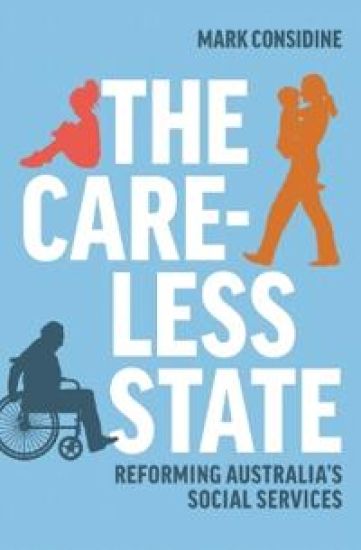
The Careless State

The Careless State

Mark Considine

MELBOURNE UNIVERSITY PRESS
2022
nidottu
The lives of all Australians are profoundly affected by the quality of social services available, but a long list of royal commissions and public inquiries have revealed them to be failing. In The Careless State Mark Considine shows that the preferred model of reform has failed to adapt and improve. In the 1980s Australian governments faced rapidly increasing demand for services in areas like employment assistance, aged care, childcare and vocational education and training; to respond to this challenge, governments led by Bob Hawke and Paul Keating pioneered the introduction of service markets, where private companies compete with public institutions and charities in newly constructed social services. This 'choice revolution' was embraced and extended by the Howard government. Market choice continues to drive reform across a wide spectrum of programs and social services. Considine's detailed investigation demonstrates conclusively that important aspects of the experiment with social service markets have failed. Weak quality control, systematic rorting and entrenched disadvantage have become the norm. Private business interests and shareholders' interest have often displaced established charities and commitment to quality care for all. The service systems are careless, leaving clients to make choices without real information or protection. Considine points to alternative ways that reforms could be configured to get the best from both private and public agencies, and find a new approach to save these failing services.

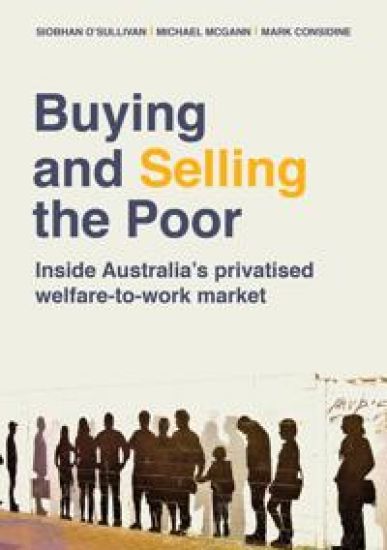
Buying and Selling the Poor

Buying and Selling the Poor

Siobhan O'Sullivan; Michael McGann; Mark Considine

Sydney University Press
2021
nidottu
Buying and Selling the Poor ventures behind the scenes of the multibillion-dollar welfare-to-work system, offering new insights into how Australia responds to unemployment and disadvantage. As the authors tell the story of four local employment offices, they paint a vivid picture of a critically important social service which many people are aware of but which few properly understand. They also reveal the wider impacts that processes of marketisation and welfare reform have had on these frontline services over decades, and how the work of frontline staff and service providers has been transformed. Buying and Selling the Poor looks closely at how these services operate, why some succeed where others fail, and what can be learned from the stories of staff and clients who have navigated the system. Three decades into this market experiment, how well are we doing in supporting our most vulnerable citizens to get back to work?
Democratic Accountability and International Human Development
Scholars and policymakers have long known that there is a strong link between human development and spending on key areas such as education and health. However, many states still neglect these considerations in favour of competing priorities, such as expanding their armies. This book examines how states arrive at these decisions, analysing how democratic accountability influences public spending and impacts on human development. The book shows how the broader paradigm of democratic accountability – extending beyond political democracy to also include bureaucratic and judicial institutions as well as taxation and other modes of resource mobilisation – can best explain how states allocate public resources for human development. Combining cross-country regression analysis with exemplary case studies from Pakistan, India, Botswana and Argentina, the book demonstrates that enhancing human capabilities requires not only effective party competition and fair elections, but also a particular nesting of public organisational structures that are tied to taxpaying citizens in an undisturbed chain of accountability. It draws out vital lessons for institutional design and our approach to the question of human development, particularly in the less developed states. This book will be of great interest to postgraduate students and researchers in the fields of political economy, public policy, governance, and development. It also provides valuable insights for those working in the international relations field, including inside major aid and investment organisations.
Getting Welfare to Work

Getting Welfare to Work

Mark Considine; Jenny M. Lewis; Siobhan O'Sullivan; Els Sol

Oxford University Press
2015
sidottu
Getting Welfare to Work traces the radical reform of the Australian, UK, and Dutch public employment services systems. Starting with major changes from 1998, this book examines how each national system has moved from traditional public services towards more privately provided and market-based methods. Each of these three countries developed innovative forms of contracting-out and complex incentive regimes to motivate welfare clients and to control the agencies charged with helping them. The Australian system pioneered the use of large, national contracts for services to all unemployed jobseekers. By the end of our study period this system was entirely outsourced to private agencies. Meanwhile the UK elected a form of contestability under Blair and Cameron, culminating in a new public-private financing model known as the 'Work Programme'. The Dutch had evolved their far more complex system from a traditional public service approach to one using a variety of specific contracts for private agencies. These innovations have changed welfare delivery and created both opportunities and new constraints for policy makers. Getting Welfare to Work tells the story of these bold policy reforms from the perspective of street-level bureaucrats. Interviews and surveys in each country over a fifteen year period are used to critically appraise this central pillar of the welfare state. The original data analysed in Getting Welfare to Work provides a unique comparative perspective on three intriguing systems. It points to new ways of thinking about modes of governance, system design, regulation of public services, and so-called activation of welfare clients. It also sheds light on the predicament of third sector organisations that contract to governments through competitive tenders with precise performance monitoring, raising questions of 'mission drift'.
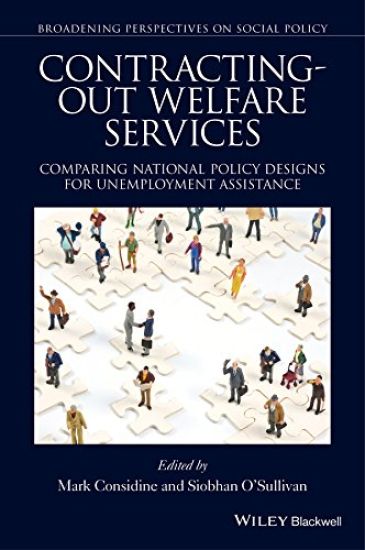
Contracting-out Welfare Services

Contracting-out Welfare Services

Siobhan O'Sullivan; Mark Considine

Wiley-Blackwell
2015
nidottu
Contracting-out Welfare Services focuses on the design and overhaul of welfare-to-work systems around the world in the light of the radical re-design of the welfare system; internationally based authors utilise a national/program case study, considering employment services policy and activation practices. International contributors bring a global comparative perspective to the subjectContributors are all experts in their field, who also draw on a much longer intellectual legacyUses employment services as a case study to advance understanding in relation to a host of broader principles and conceptsEach paper included within the text uses a national/program case study, and each considers employment services policy in general, and activation practices in particular
Democratic Accountability and International Human Development
Scholars and policymakers have long known that there is a strong link between human development and spending on key areas such as education and health. However, many states still neglect these considerations in favour of competing priorities, such as expanding their armies. This book examines how states arrive at these decisions, analysing how democratic accountability influences public spending and impacts on human development. The book shows how the broader paradigm of democratic accountability – extending beyond political democracy to also include bureaucratic and judicial institutions as well as taxation and other modes of resource mobilisation – can best explain how states allocate public resources for human development. Combining cross-country regression analysis with exemplary case studies from Pakistan, India, Botswana and Argentina, the book demonstrates that enhancing human capabilities requires not only effective party competition and fair elections, but also a particular nesting of public organisational structures that are tied to taxpaying citizens in an undisturbed chain of accountability. It draws out vital lessons for institutional design and our approach to the question of human development, particularly in the less developed states. This book will be of great interest to postgraduate students and researchers in the fields of political economy, public policy, governance, and development. It also provides valuable insights for those working in the international relations field, including inside major aid and investment organisations.
Making Public Policy

Making Public Policy

Mark Considine

Polity Press
2004
nidottu
Mark Considine's new book explores the nature of public policy-making in a world undergoing cataclysmic change. Running through the text is the core assertion that policy-making can best be seen as a form of intervention into specific social and cultural contexts, and not as an engineered solution to universal problems. The book provides a comprehensive and up-to-date introduction to key issues and contemporary debates in public policy. The author draws on a wide range of examples from around the world to develop a framework for understanding the way social contexts, policy histories and institutional pathways generate opportunities. Separate chapters focus on public action, context, discourse, institutional pathways, networks, organizations, governance, citizen engagement and accountability. Clearly-written and compelling, this will be essential reading for upper-level undergraduate students taking courses in public policy, social policy, environmental studies, health studies, European studies and development.
Making Public Policy

Making Public Policy

Mark Considine

Polity Press
2004
sidottu
Mark Considine's new book explores the nature of public policy-making in a world undergoing cataclysmic change. Running through the text is the core assertion that policy-making can best be seen as a form of intervention into specific social and cultural contexts, and not as an engineered solution to universal problems. The book provides a comprehensive and up-to-date introduction to key issues and contemporary debates in public policy. The author draws on a wide range of examples from around the world to develop a framework for understanding the way social contexts, policy histories and institutional pathways generate opportunities. Separate chapters focus on public action, context, discourse, institutional pathways, networks, organizations, governance, citizen engagement and accountability. Clearly-written and compelling, this will be essential reading for upper-level undergraduate students taking courses in public policy, social policy, environmental studies, health studies, European studies and development.
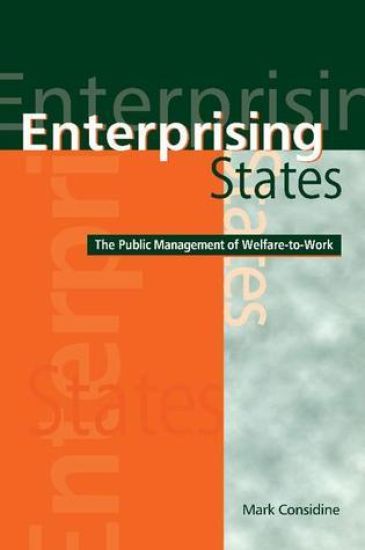
Enterprising States

Enterprising States

Mark Considine

Cambridge University Press
2001
sidottu
This book, first published in 2001, explores two shifts in the paradigms of governance in Western bureaucracies. They are the widespread use of privatisation, private firms and market methods to run core public services, and the conscious attempt to transform the role of citizenship from ideals of entitlement and security to notions of mutual obligation, selectivity and risk. Considine examines the most important service of the modern welfare state - unemployment assistance - to explain and theorise the nature of these radical changes. He undertakes research in the United Kingdom, the Netherlands, Australia and New Zealand, four countries which have been among the boldest reformers within the OECD, yet each adopting different models. Each case is a break from the standards of responsible democracy and legal-rational bureaucracy, with at least one government opting for a commercial paradigm based on targets and economic incentives and another opting for a model based on network governance, co-production and trust.
Enterprising States

Enterprising States

Mark Considine

Cambridge University Press
2001
pokkari
This book, first published in 2001, explores two shifts in the paradigms of governance in Western bureaucracies. They are the widespread use of privatisation, private firms and market methods to run core public services, and the conscious attempt to transform the role of citizenship from ideals of entitlement and security to notions of mutual obligation, selectivity and risk. Considine examines the most important service of the modern welfare state - unemployment assistance - to explain and theorise the nature of these radical changes. He undertakes research in the United Kingdom, the Netherlands, Australia and New Zealand, four countries which have been among the boldest reformers within the OECD, yet each adopting different models. Each case is a break from the standards of responsible democracy and legal-rational bureaucracy, with at least one government opting for a commercial paradigm based on targets and economic incentives and another opting for a model based on network governance, co-production and trust.
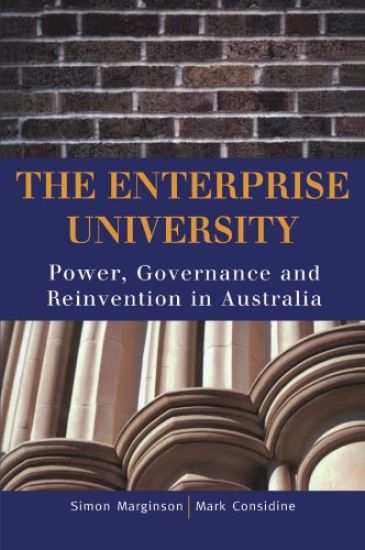
The Enterprise University

The Enterprise University

Simon Marginson; Mark Considine

Cambridge University Press
2000
pokkari
Throughout the industrialised world, universities have undergone remarkable changes since the mid-1980s. In Australia, interest has been intense, and publication of The Enterprise University was very timely. First published in 2001, it was the first systematic study of the Australian system since the momentous Dawkins reforms ten years earlier. The book is grounded in case studies of most of the major Australian universities: the authors interviewed a large number of senior managers. They also have taken account of global trends and have prepared the book in the light of international research on the university as an institution. The authors contend that the modern university can be understood as an 'enterprise university', characterised by corporate-style executive leadership. In a hard-hitting conclusion they propose novel policies and directions for Australia's higher education system.