Kirjojen hintavertailu – 12 903 731 kirjaa ja 27 kauppaa

Kirjailija

Mark Corner

Kirjat ja teokset yhdessä paikassa: 8 kirjaa, julkaisuja vuosilta 1990–2024, suosituimpiin kuuluu Divine Disorder and the Rescue of God. Vertaile teosten hintoja ja tarkista saatavuus suomalaisista kirjakaupoista.

8 kirjaa

Kirjojen julkaisuvuodet: 1990–2024.

Divine Disorder and the Rescue of God

Divine Disorder and the Rescue of God

Mark Corner; Richard H Roberts

Cascade Books
2024
sidottu
Divine Disorder and the Rescue of God is based on the idea that a kenotic approach is essential to a viable theology. It is deeply influenced by the way such an approach influenced the writings of Donald MacKinnon. Part I argues that God forces us to live in a state of uncertainty, even about God's existence. However compelling the sense of God's presence may be, religious experience cannot take that uncertainty away. We have to understand what sort of God would want to impose upon us the disorder of uncertainty. Part II explores this further in terms of God's willingness to give a degree of independence to the created order, while Part III compares the instability of the created order with that of the moral order. By giving human beings freedom, God opens up the possibility of failure, including that of God. The doctrine of the fall expresses the impossibility of giving human beings autonomy without risking disaster. In Parts IV and V the book looks more closely at the nature of this God who embraces risk, suffering, and even failure. Who is the deity behind this divine disorder? The focus from a Christian perspective is upon the risk, suffering, and failure displayed in the life of Christ. Jesus is drawn into something that it is beyond him to fathom--hence the troubled, uncertain character of his own life. But from a kenotic perspective, even a life marked by failure can be the focal point of God's self-revelation.
Divine Disorder and the Rescue of God

Divine Disorder and the Rescue of God

Mark Corner; Richard H Roberts

Cascade Books
2024
pokkari
Divine Disorder and the Rescue of God is based on the idea that a kenotic approach is essential to a viable theology. It is deeply influenced by the way such an approach influenced the writings of Donald MacKinnon. Part I argues that God forces us to live in a state of uncertainty, even about God's existence. However compelling the sense of God's presence may be, religious experience cannot take that uncertainty away. We have to understand what sort of God would want to impose upon us the disorder of uncertainty. Part II explores this further in terms of God's willingness to give a degree of independence to the created order, while Part III compares the instability of the created order with that of the moral order. By giving human beings freedom, God opens up the possibility of failure, including that of God. The doctrine of the fall expresses the impossibility of giving human beings autonomy without risking disaster. In Parts IV and V the book looks more closely at the nature of this God who embraces risk, suffering, and even failure. Who is the deity behind this divine disorder? The focus from a Christian perspective is upon the risk, suffering, and failure displayed in the life of Christ. Jesus is drawn into something that it is beyond him to fathom--hence the troubled, uncertain character of his own life. But from a kenotic perspective, even a life marked by failure can be the focal point of God's self-revelation.

A Tale of Two Unions

A Tale of Two Unions

Mark Corner

TRANSCRIPT VERLAG
2023
nidottu
Brexit is a tale of two unions, not one: the British and the European unions. Their origins are different, but both struggle to maintain unity in diversity and both have to face the challenge of populism and claims of democratic deficit. Mark Corner suggests that the »four nations« that make up the UK can only survive as part of a single nation-state, if the country looks more sympathetically at the very European structures from which it has chosen to detach itself. This study addresses both academic and lay audiences interested in the current situation of the UK, particularly the strains raised by devolution and Brexit.
Signs of God

Signs of God

Mark Corner

Routledge
2020
nidottu
Signs of God reveals why discussion of the nature of miracles is of central rather than marginal importance where belief in God is concerned. Miracles cannot be shunted to one side as an embarrassing hangover from a 'pre-scientific age'. Miracles have played an important role in the history of all the major world religions, and many religious believers claim that they continue to do so. Yet they have also been criticized from a philosophical viewpoint as incompatible with a belief in laws of nature, and those who seek to have their religious beliefs properly attuned to the modern world often prefer to do without them. This accessible book examines the nature of miracles both in philosophical and historical terms, and concludes that, whether or not miracles happen, it is difficult to see how religious belief could survive without them.
Signs of God

Signs of God

Mark Corner

CRC Press Inc
2017
sidottu
Signs of God reveals why discussion of the nature of miracles is of central rather than marginal importance where belief in God is concerned. Miracles cannot be shunted to one side as an embarrassing hangover from a 'pre-scientific age'. Miracles have played an important role in the history of all the major world religions, and many religious believers claim that they continue to do so. Yet they have also been criticized from a philosophical viewpoint as incompatible with a belief in laws of nature, and those who seek to have their religious beliefs properly attuned to the modern world often prefer to do without them. This accessible book examines the nature of miracles both in philosophical and historical terms, and concludes that, whether or not miracles happen, it is difficult to see how religious belief could survive without them.
Death be not Proud

Death be not Proud

Mark Corner

Verlag Peter Lang
2010
nidottu
Might people one day live for ever? Would they want to? What sense can be made of ideas commonly referred to in terms of an ‘afterlife’? What about notions of Heaven and Hell, of Purgatory and reincarnation? And in what sort of state are human beings expected to be during this ‘afterlife’ – immortal souls or resurrected bodies (and does either notion make sense)? What about the fact that any ‘afterlife’ concerns not just the fate of individuals but of society (‘communion of saints’) and even the physical universe itself? This book tries to survey some of the existing arguments about life ‘after’ death, with chapters on material from Christian tradition (particularly the New Testament and the Early Church) and from the philosophy of religion. It then attempts to reach its own conclusions, drawing on Kant and Barth in order to suggest that death is to be overcome rather than survived.
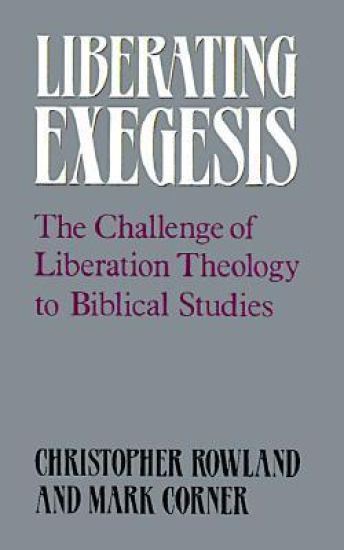
Liberating Exegesis

Liberating Exegesis

Christopher Rowland; Mark Corner

Westminster/John Knox Press,U.S.
1990
nidottu
This important book provides a sampling of liberation theology's use of biblical texts, relating it to the "standard" methods of interpretation in Europe and America. Divided into four sections, the book sets out contemporary readings of the parable of Jesus influenced by a liberationist perspective; identifies the biblical and theoretical foundations of liberation theology, comparing them with the dominant exegetical paradigm in the first world; explores the way in which liberation exegesis affects reading the canonical accounts of Jesus; and argues that liberation theology cannot be seen solely as a third-world phenomenon.