Kirjojen hintavertailu – 12 875 976 kirjaa ja 26 kauppaa

Kirjailija

Mark Denny

Kirjat ja teokset yhdessä paikassa: 25 kirjaa, julkaisuja vuosilta 1995–2026, suosituimpiin kuuluu Slings and Arrows. Vertaile teosten hintoja ja tarkista saatavuus suomalaisista kirjakaupoista.

25 kirjaa

Kirjojen julkaisuvuodet: 1995–2026.

How the Ocean Works

How the Ocean Works

Mark Denny

Princeton University Press
2008
pokkari
The world's oceans account for roughly 71 percent of the planet's surface and 99 percent of its livable volume. Any study of this huge habitat requires a solid foundation in the principles that underlie marine biology and physical and chemical oceanography, yet until now undergraduate textbooks have largely presented compilations of facts rather than explanations of principles. How the Ocean Works fills this gap, providing a concise and accessible college-level introduction to marine science that is also ideal for general readers. How are winds and currents driven? What is the dilemma of the two-layered ocean? Mark Denny explains key concepts like these in rich and fascinating detail. He explores early scientific knowledge of oceans, photosynthesis, trophic interactions and energy flow, and the impacts of human activities on marine and atmospheric systems. Focusing each chapter on a major topic and carefully explaining the principles and theory involved, Denny gives readers the conceptual building blocks needed to develop a coherent picture of the living ocean. How the Ocean Works is an indispensable resource that teaches readers how to think about the ocean--its biology, mechanics, and conservation. * Provides a concise, up-to-date introduction to marine science * Develops the conceptual basis needed to understand how the ocean works * Explains fundamental principles and theory * Includes color illustrations and informative diagrams * Serves as a college textbook and a reference for general readers
Blip, Ping, and Buzz

Blip, Ping, and Buzz

Mark Denny

Johns Hopkins University Press
2007
sidottu
Have you ever wondered how stealth planes achieve "invisibility," how sunken ships are found, or how fishermen track schools of fish in vast expanses of ocean? Radar and sonar echolocation-a simple matter of sending, receiving, and processing signals. Weaving history with simple science, Mark Denny deftly reveals the world of radar and sonar to the curious reader, technology buff, and expert alike. He begins with an early history of the Chain Home radar system used during World War II and then provides accessible and engaging explanations of the physics that make signal processing possible. Basic diagrams and formulas show how electromagnetic and sound waves are transmitted, received, and converted into images, allowing you to literally see in the dark. A section on bioacoustic echolocation, with a focus on the superior sonar systems of bats and whales and a discussion of the advanced technology of next-generation airborne signal processors, opens the imagination to fascinating possibilities for the future.
Ingenium

Ingenium

Mark Denny

Johns Hopkins University Press
2007
sidottu
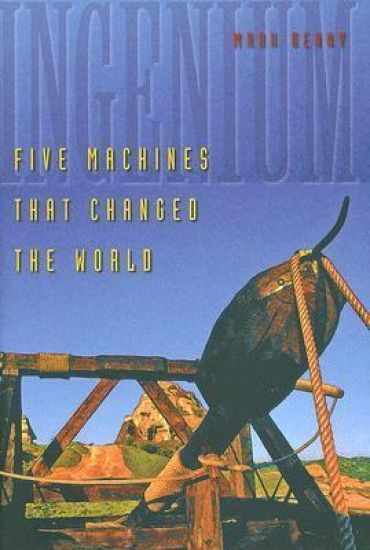
Ingenium is medieval English vernacular for "an ingenious contrivance." In this fascinating book, physicist Mark Denny considers five such contrivances-the bow and arrow, the waterwheel, the counterpoise siege engine (including the trebuchet), the pendulum clock anchor escapement, and the centrifugal governor-and demonstrates how they literally changed the world. Interweaving an entertaining narrative with diagrams, equations, and drawings, Denny shares the history of each device, explains the physics behind it, and describes how it was used, how it evolved, and why it is significant in today's world. Consider the bow and arrow, which transformed warfare by allowing soldiers to attack their enemies at a safe distance. Or the waterwheel, which enabled Old World civilizations to grind grain, pump water, and power machines during a period of extreme labor shortages. Medieval warriors engaged in an early form of biological warfare by using the trebuchet to launch dead animals or plague-ridden corpses over enormous fortress walls. The pendulum clock forever enslaved modern humans to the clock by linking the accurate measure of time to the burdens of schedules, deadlines, promptness, and tardiness. And the centrifugal governor gave rise to an entire branch of modern engineering science: feedback control. Reflecting on the inventors of these ancient machines and the times in which they lived, Denny concludes with thought-provoking observations about inventors, inventiveness, genius, and innovation. Whether you dream of making a better mousetrap or launching pumpkins into the stratosphere, Ingenium will tickle your fancy.
Chance in Biology

Chance in Biology

Mark Denny; Steven Gaines

Princeton University Press
2002
pokkari
Life is a chancy proposition: from the movement of molecules to the age at which we die, chance plays a key role in the natural world. Traditionally, biologists have viewed the inevitable "noise" of life as an unfortunate complication. The authors of this book, however, treat random processes as a benefit. In this introduction to chance in biology, Mark Denny and Steven Gaines help readers to apply the probability theory needed to make sense of chance events--using examples from ocean waves to spiderwebs, in fields ranging from molecular mechanics to evolution. Through the application of probability theory, Denny and Gaines make predictions about how plants and animals work in a stochastic universe. Is it possible to pack a variety of ion channels into a cell membrane and have each operate at near-peak flow? Why are our arteries rubbery? The concept of a random walk provides the necessary insight. Is there an absolute upper limit to human life span? Could the sound of a cocktail party burst your eardrums? The statistics of extremes allows us to make the appropriate calculations. How long must you wait to see the detail in a moonlit landscape? Can you hear the noise of individual molecules? The authors provide answers to these and many other questions. After an introduction to the basic statistical methods to be used in this book, the authors emphasize the application of probability theory to biology rather than the details of the theory itself. Readers with an introductory background in calculus will be able to follow the reasoning, and sets of problems, together with their solutions, are offered to reinforce concepts. The use of real-world examples, numerous illustrations, and chapter summaries--all presented with clarity and wit--make for a highly accessible text. By relating the theory of probability to the understanding of form and function in living things, the authors seek to pique the reader's curiosity about statistics and provide a new perspective on the role of chance in biology.
Air and Water

Air and Water

Mark Denny

Princeton University Press
1995
pokkari
Addressing general readers and biologists, Mark Denny shows how the physics of fluids (in this case, air and water) influences the often fantastic ways in which life forms adapt themselves to their terrestrial or aquatic "media."