
Kirjailija
Mark P. Sullivan
Kirjat ja teokset yhdessä paikassa: 12 kirjaa, julkaisuja vuosilta 2008–2025, suosituimpiin kuuluu The Mechanism for Strategic Coercion. Vertaile teosten hintoja ja tarkista saatavuus suomalaisista kirjakaupoista.
Nimi esiintyy myös muodoissa: Mark P Sullivan
12 kirjaa
Kirjojen julkaisuvuodet: 2008–2025.
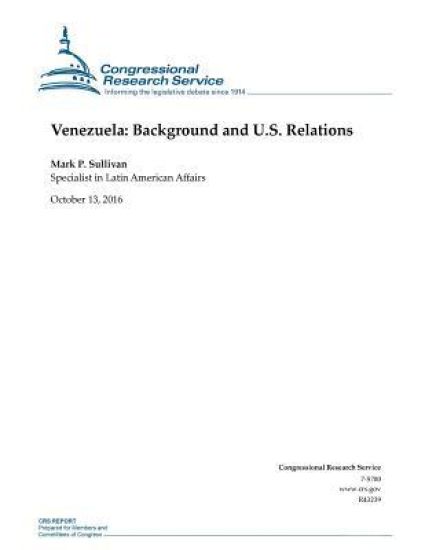
Venezuela: Background and U.S. Relations: R43239
Mark P. Sullivan; Congressional Research Service
Createspace Independent Publishing Platform
2016
nidottu
This report, divided into three main sections, examines the political and economic situation in Venezuela and U. S.-Venezuelan relations. The first section surveys the political transformation of Venezuela under the populist rule of President Hugo Ch vez (1999-2013) and the first two years of the government of President Nicol s Maduro, including the government's severe crackdown on opposition protests in 2014. The second section analyzes Venezuela's political and economic environment since 2015, including the opposition's December 2015 legislative victory and the Maduro government's attempts to thwart the powers of the legislature; efforts to remove President Maduro through a recall referendum; deteriorating economic and social conditions in the country; and the government's foreign policy orientation. The third section examines U. S. relations with Venezuela, including the imposition of sanctions on Venezuelan officials, and selected issues in U. S. relations-democracy and human rights, energy, counternarcotics, and terrorism concerns. Appendix A provides information on legislative initiatives in the 113th and 114th Congresses, and Appendix B provides links to selected U. S. government reports on Venezuela.
Latin America and the Caribbean: Key Issues for the 113th Congress
Mark P. Sullivan
Createspace Independent Publishing Platform
2015
nidottu
Cuba: U.S. Restrictions on Travel and Remittances
Mark P. Sullivan
Createspace Independent Publishing Platform
2014
nidottu
Cuba: U.S. Policy and Issues for the 113th Congress
Mark P. Sullivan
Createspace Independent Publishing Platform
2014
nidottu
Cuba remains a one-party communist state with a poor record on human rights. The country's political succession in 2006 from the long-ruling Fidel Castro to his brother Ra l was characterized by a remarkable degree of stability. In February 2013, Castro was reappointed to a second five-year term as president (until 2018, when he would be 86 years old), and selected 52- year old former Education Minister Miguel D az-Canel as his First Vice President, making him the official successor in the event that Castro cannot serve out his term.
Cuba: U.S. Policy and Issues for the 113th Congress
Mark P. Sullivan
Createspace Independent Publishing Platform
2014
nidottu
Cuba remains a one-party communist state with a poor record on human rights. The country's political succession in 2006 from the long-ruling Fidel Castro to his brother Ra l was characterized by a remarkable degree of stability. In February 2013, Castro was reappointed to a second five-year term as president (until 2018, when he would be 86 years old), and selected 52- year old former Education Minister Miguel D az-Canel as his First Vice President, making him the official successor in the event that Castro cannot serve out his term. Ra l Castro has implemented a number of gradual economic policy changes over the past several years, including an expansion of self-employment. A party congress held in April 2011 laid out numerous economic goals that, if implemented, could significantly alter Cuba's state-dominated economic model. Few observers, however, expect the government to ease its tight control over the political system. While the government reduced the number of political prisoners in 2010-2011, the number increased in 2012; moreover, short-term detentions and harassment have increased significantly over the past several years.
Venezuela: Background and U.S. Relations
Mark P. Sullivan
Createspace Independent Publishing Platform
2014
nidottu
Latin American: Terrorism Issues
Mark P. Sullivan
Createspace Independent Publishing Platform
2013
nidottu
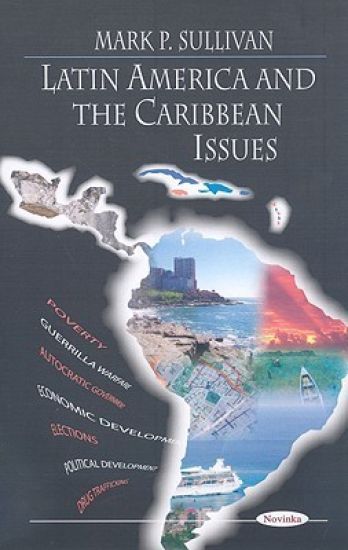
Over the past two decades, the Latin America and Caribbean region has made enormous strides in terms of political and economic development. Twelve countries held successful elections for head of government in 2006, including a close election in Mexico. To date in 2007, the Bahamas held elections in May; elections are scheduled for Jamaica and Guatemala in September, Argentina in October, and are due to be called in Trinidad and Tobago by October. Although the region overall experienced an economic setback in 2002-2003, it has rebounded since 2004, most recently experiencing a growth rate over 5% in 2006. Despite this progress, several nations face considerable challenges that affect U. S. interests and policy in the region. These include persistent poverty, violent guerrilla conflicts, autocratic leaders, drug trafficking, increasing crime, and the rise of a new form of populism in several countries. This book provides an overview of U. S. relations with Latin America and the Caribbean.
Under the populist rule of President Hugo Chávez, first elected in 1998 and most recently re-elected to a six-year term in December 2006, Venezuela has undergone enormous political changes, with a new constitution and unicameral legislature, and even a new name for the country, the Bolivarian Republic of Venezuela. U. S. officials and human rights organisations have expressed concerns about the deterioration of democratic institutions and threats to freedom of expression under President Chávez, who has survived several attempts to remove him from power. The government has benefited from the rise in world oil prices, which has sparked an economic boom and allowed Chávez to increase expenditures on social programs associated with his populist agenda. Since he was re-elected, Chávez has announced new measures to move the country toward socialism. His May 2007 closure of a popular Venezuelan television station (RCTV) that was critical of the government sparked student-led protests and international condemnation. The Chávez government's proposed constitutional reforms, subject to a referendum scheduled for December 2, 2007, include many amendments that have been controversial, such as the removal of presidential term limits and the government's ability to suspend certain constitutional rights during a state of emergency. The United States traditionally has had close relations with Venezuela, the fourth major supplier of foreign oil to the United States, but there has been friction in relations with the Chávez government. U. S. officials have expressed concerns about President Chávez's military arms purchases, his relations with such countries as Cuba and Iran, his efforts to export his brand of populism to other Latin American countries, and concerns about the state of democracy.