
Kirjailija
Mark Shepard
Kirjat ja teokset yhdessä paikassa: 19 kirjaa, julkaisuja vuosilta 1980–2025, suosituimpiin kuuluu How to Love Your Flute. Vertaile teosten hintoja ja tarkista saatavuus suomalaisista kirjakaupoista.
19 kirjaa
Kirjojen julkaisuvuodet: 1980–2025.
"All my actions have their source in my inalienable love of humankind." -- Gandhi Mahatma Gandhi is one of the least understood figures of all time -- even among his admirers. In this Annual Gandhi Lecture for the International Association of Gandhian Studies, Mark Shepard tackles some persistently wrong-headed views of Gandhi, offering us a more accurate picture of the man and his nonviolence. //////////////////////////////////////////////// "A model of Gandhian journalism. . . . Shepard] has put his finger on seemingly all of the popular (and some less common) misconceptions of both Gandhi and his philosophy, including some particularly important ones. . . . This book takes little space to cover its topic concisely and well. It would be some] of the most valuable pages many people could read about Gandhi." -- Global Conscience, July-Sept. 1990 //////////////////////////////////////////////// Mark Shepard is the author of "Mahatma Gandhi and His Myths," "The Community of the Ark," and "Gandhi Today," called by the American Library Association's Booklist "a masterpiece of committed reporting." His writings on social alternatives have appeared in over 30 publications in the United States, Canada, England, Norway, Germany, the Netherlands, Switzerland, Japan, and India. //////////////////////////////////////////////// SAMPLE I suspect that most of the myths and misconceptions surrounding Gandhi have to do with nonviolence. For instance, it's surprising how many people still have the idea that nonviolent action is passive. It's important for us to be clear about this: There is nothing passive about Gandhian nonviolent action. I'm afraid Gandhi himself helped create this confusion by referring to his method at first as "passive resistance," because it was in some ways like techniques bearing that label. But he soon changed his mind and rejected the term. Gandhi's nonviolent action was not an evasive strategy nor a defensive one. Gandhi was always on the offensive. He believed in confronting his opponents aggressively, in such a way that they could not avoid dealing with him. But wasn't Gandhi's nonviolent action designed to avoid violence? Yes and no. Gandhi steadfastly avoided violence toward his opponents. He did not avoid violence toward himself or his followers. Gandhi said that the nonviolent activist, like any soldier, had to be ready to die for the cause. And in fact, during India's struggle for independence, hundreds of Indians were killed by the British. The difference was that the nonviolent activist, while willing to die, was never willing to kill. Gandhi pointed out three possible responses to oppression and injustice. One he described as the coward's way: to accept the wrong or run away from it. The second option was to stand and fight by force of arms. Gandhi said this was better than acceptance or running away. But the third way, he said, was best of all and required the most courage: to stand and fight solely by nonviolent means.
Raw and real. Get Your Greater is the true story of Mark Shepard going from grate to great. After losing his mother before the age of 10 in a horrific act of violence, Mark's story continues with suffering mistreatment from his family, getting assaulted while in foster care, and later striving to survive poverty and homelessness living on the streets with his young sons. Get Your Greater tells an inspiring story of resilience, strength, ambition, and faith as Mark goes from sleeping on a cold bed of metal bars to leading a life filled with love and gratefulness. Homelessness was no stranger. Pulling himself up from the lowest of lows as a homeless teen and later as a grown man living on the streets of Washington, D. C., Mark escaped the unimaginable. His strength has helped him navigate a life filled with trauma, abandonment, sexual abuse, and physical cruelty. He shares how to build resilience as he recounts personal and poignant accounts that will leave you completely speechless. Get Your Greater reveals mercilessness that no child should ever feel... ordeals that no humanshould have to experience... yet Mark faced and ultimately overcame with strength and psychological resilience. Get Your Greater celebrates the movement of God through Mark's life-a movement that although always steady-would, at times, feel slow and require blind faith. And now Mark encourages you to have the same faith. The same ambition in life. To never give up. To be resilient, patient, and steadfast. When you read Get Your Greater, you learn that despite the path or personal trials of your life, there is a greater waiting for you. And all that's left? Go get it
The entanglements of people and data, code and space, knowledge and power: how data and algorithms shape the world—and shape us within that world. With the emergence of a post-truth world, we have witnessed the dissolution of the common ground on which truth claims were negotiated, individual agency enacted, and public spheres shaped. What happens when, as Nietzsche claimed, there are no facts, but only interpretations? In this book, Mark Shepard examines the entanglements of people and data, code and space, knowledge and power that have produced an uncommon ground—a disaggregated public sphere where the extraction of behavioral data and their subsequent processing and sale have led to the emergence of micropublics of ever-finer granularity. Shepard explores how these new post-truth territories are propagated through machine learning systems and social networks, which shape the public and private spaces of everyday life. He traces the balkanization and proliferation of online news and the targeted distribution of carefully crafted information through social media. He examines post-truth practices, showing how truth claims are embedded in techniques by which the world is observed, recorded, documented, and measured. Finally, he shows how these practices play out, at scales from the translocality of the home to the planetary reach of the COVID-19 pandemic—with stops along the way at an urban minimarket, an upscale neighborhood for the one percent, a Toronto waterfront district, and a national election.
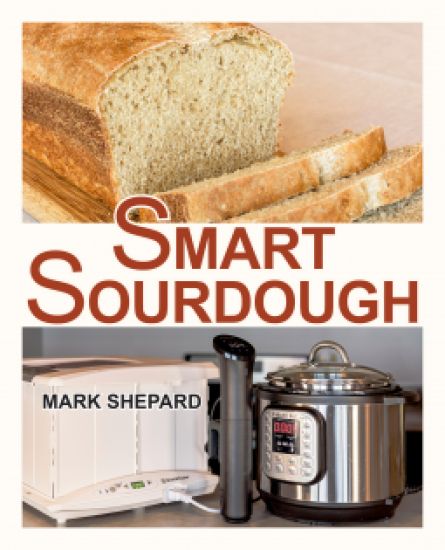
NO STARTER -- NO WASTE -- NO CHEAT -- NO FAIL100% NATURALLY FERMENTED BREAD IN JUST 24 HOURSThere's sourdough, and then there's SMART sourdough -- a whole new approach to an ancient bread Most sourdough recipes lead you through days or even weeks of developing a starter before you can make your bread -- and then into a lifetime of maintaining that starter. But this book is based on the belief that all that rigmarole is no longer needed. With modern methods of regulating temperature, and with the easy availability of baker's yeast, honest-to-goodness naturally fermented sourdough bread can be made from start to finish in less than a day. With all the benefits of naturally fermented sourdough, it's only the hassle of making it that has discouraged home bakers. Well, hassle no more. The age of smart sourdough has arrived./////////////////////////////////////////////////Mark Shepard began baking his own sourdough bread in 1979 and went on to publish the bestselling booklet "Simple Sourdough." In 2012, he began developing a sourdough method that's even simpler and more reliable -- one that could be used by anyone, with no fear of failure. Mark now lives in Bellingham, Washington, with his wife and fellow author, Anne L. Watson.
Simple flutes of bamboo, wood, metal, plastic, or clay can be a joy to play and make. This book gives you the basics of simple flute playing, then offers guidelines for making flutes of your own from a variety of materials. It even includes a handy chart for "where to put the holes." "Simple Flutes" is a must for simple flute players and makers ///////////////////////////////////////////////// Mark Shepard is the author of "How to Love Your Flute," hailed by Paul Horn as "a model for our times," as well as the craft guide "Simple Flutes." For many years, he was a professional artisan, making and selling flutes of bamboo or plastic. ///////////////////////////////////////////////// "Contains the essense of a tremendous amount of experience." -- Sam Hinton, Sing Out "An excellent overview." -- Monty Levenson, Tai Hei Shakuhachi "A slim, elegantly presented, and highly practical guide. . . . First-rate, user friendly." -- Midwest Book Review, Aug. 2002 "This thin volume contains a wealth of information." -- Linda Dailey Paulson, Dirty Linen, Oct.-Nov. 2002 ///////////////////////////////////////////////// CONTENTS 1 PLAYING The Sound The Hands The Notes Second Octave Sharps and Flats Breath and Tonguing Making Music Flute Care 2 MAKING Flute Qualities The Flute Tube The Mouthhole The Fingerholes Tuning Stoppers Finishes Plastic Bamboo Wood Clay Metal Other ///////////////////////////////////////////////// SAMPLE Here are the two most important rules for tuning: -- A hole will give a higher note if it is placed closer to the mouthhole. It will give a lower note if placed farther away. -- A hole will give a higher note if made larger. It will give a lower note if smaller. These rules mean you can "raise" a note by enlarging the hole or by placing the hole closer to the mouthhole. You can "lower" the note by using a smaller hole or by placing the hole farther from the mouthhole. It also means you can change the hole size and its placement without changing the note. A larger hole could be placed farther from the mouthhole, or a smaller hole placed closer to the mouthhole.
What If It's Perfect?: A simple course in making your life magical
Mark Shepard
Createspace Independent Publishing Platform
2014
nidottu
MediaCities
Jordan Geiger; Mark Shepard; Omar Khan
University at Buffalo Department of Architecture
2014
pokkari

A Guiding Life: Living, Fishing and Hunting the American Dream
Phil Fragasso; Mark Shepard
Erewhon Press
2012
nidottu
The Bully Proof Kid: Bullying Prevention From The Inside Out
Mark Shepard
Createspace Independent Publishing Platform
2011
nidottu
A complete guide for anyone who plays the flute or ever wanted to. Use it along with flute lessons or even to teach yourself! This book covers everything you need and more -- selection and care, flute technique, fingering, playing by ear, reading music, flute history, flutes around the world, and modern folk flutes. "How to Love Your Flute" will appeal to all flutists, from beginning to advanced. / / / / / / / / / / / / / / / / / / / / / / / / / Mark Shepard is the author of "How to Love Your Flute," hailed by Paul Horn as "a model for our times," as well as the craft guide "Simple Flutes." He has played flute professionally in a folk music trio, as a modern dance accompanist, and as a solo theater musician. / / / / / / / / / / / / / / / / / / / / / / / / / "Shepard has come up with the most unique flute manual I have ever seen. It is direct, complete, informative on every aspect, and -- most important -- comes from the standpoint of pure love and respect for the instrument...[This] book serves as a model for our times, and it is an inspiration for those who want to get more out of life through the joys of flute playing."-- Paul Horn, from the Preface || "Shepard's soul-felt passion for the flute resonates through his book like music. It's a comprehensive guide with something for everyone, from novice to professional, and so well written that it's a pleasure just to browse through it. This book inspires." -- Diana Barich, The Next Whole Earth Catalog || "Comprehensive and concise ... A highly readable and inspirational guide for flutists of every age and ability." -- Jeanne Baxtresser, first flute, Toronto Symphony Orchestra || "This book is guaranteed to have one of three influences on readers. For those who currently play, it's an affirmation to continue playing. For those who haven't picked up their flute in a while, it's encouragement to resume playing. As for those who've never played, Shepard provides a good compass for beginning your own musical journey." -- Linda Dailey Paulson, Dirty Linen, Oct./ Nov. 2000 || "Highly recommended." -- Midwest Book Review's The Bookwatch and Internet Bookwatch, Aug.2002 / / / / / / / / / / / / / / / / / / / / / / / / / CONTENTS || Preface, by Paul Horn || Introduction || Part 1 ~ FLUTE LORE || The World Family of Flutes | The Story of the Western Flute || Part 2 ~ SELECTION AND CARE || Finding Your Flute | Caring for Your Flute || Part 3 ~ FLUTE TECHNIQUE || Embouchure and Breath | Posture | Playing Notes | More About Embouchure and Breath | Fingering Technique | Tuning | Advanced Techniques | Special Effects || Part 4 ~ MAKING MUSIC || Scales and Chords | Playing by Ear | Reading Music | Living Music || Part 5 ~ MODERN FOLK FLUTES || Finding a Folk Flute | Caring for a Folk Flute | Playing a Folk Flute || APPENDIX || How the Flute Works | Miscellaneous Fingering Charts | Reading List / / / / / / / / / / / / / / / / / / / / / / / / / SAMPLE TEXT || Question: Should I take lessons, or instead teach myself? || Answer: There are advantages to both ways. You may be a person who will benefit more from personal instruction than from reading a book. Or you may be the type of person who needs the deadlines of a scheduled lesson to get you to practice. If you are serious about performing classical music, you will want to become absorbed in a tradition that seems imparted best in a teacher/student relationship. || There are also advantages to teaching yourself. Money and/or schedule constraints could be factors. You might prefer the freedom of organizing and pacing your own learning process. Or you might even have trouble finding a teacher with whom you work well, or who can teach you the kind of flute playing you want to learn. || Whichever way you decide to go, don't let anyone tell you that you can't learn the flute without lessons.