

Kirjailija
Mark Stevenson
Kirjat ja teokset yhdessä paikassa: 15 kirjaa, julkaisuja vuosilta 2002–2025, suosituimpiin kuuluu "Do You See What I See?". Vertaile teosten hintoja ja tarkista saatavuus suomalaisista kirjakaupoista.
15 kirjaa
Kirjojen julkaisuvuodet: 2002–2025.



Honey Bee Pests and Diseases
Jean-Pierre Y. Scheerlinck; Mark Stevenson; Robert Owen
Exisle Publishing
2023
nidottu
Honey Bee Pests and Diseases provides up-to-date information on the management of honey bee diseases found globally, not just in the U. S., Europe, or Australia. Of particular interest are the explanations of how pathogens affect honey bees. This facet of diseases is usually left out of honey bee disease books. Written in an easy to understand way, and richly illustrated with photographs and diagrams, chapters cover integrated pest management (IPM), epidemiology, viruses, brood diseases, mites, parasites, as well as other problems a colony might face. The book is largely based on the Ph. D. research of Dr. Robert Owen, who studied the effect of bee diseases in Australia and overseas with particular reference to Varroa. Both Prof. Jean-Pierre Scheerlinck and Prof. Mark Stevenson have extensive and well-recognized experience in honey bee research.

Our systems are failing. Old models - for education, healthcare and government, food production, energy supply - are creaking under the weight of modern challenges. As the world's population heads towards 10 billion, it's clear we need new approaches. Futurologist Mark Stevenson sets out to find them, across four continents. From Brazilian favelas to high tech Boston, from rural India to a shed inventor in England's home counties, We Do Things Differently travels the world to find the advance guard re-imagining our future. At each stop, he meets innovators who have already succeeded in challenging the status quo, pioneering new ways to make our world more sustainable, equitable and humane. Populated by extraordinary characters, We Do Things Differently paints an enthralling picture of what can be done to address the world's most pressing dilemmas, offering a much needed dose of down-to-earth optimism. It is a window on (and a roadmap to) a different and better future.

Education Forward: Moving Schools into the Future
Guy Claxton; Mark Stevenson; Valerie Hanson
Crux Publishing
2017
nidottu
Too often, we think of school as a fixed-rail path we all have to follow: teachers teach, students learn, exams are taken, futures set. That's how it's been since the introduction of compulsory schooling in the 19th century. But parents, teachers and corporations around the world are now voicing their dissatisfaction with education systems that are no longer fit for purpose. Too many of our young people are not being adequately prepared for the unprecedented challenges they will face in a world that is changing as rapidly as ours is. We should be preparing them for the test of life, not a life of tests. A group of distinctive voices - working in education and beyond - has produced a collection of essays that presents a call to action, a positive way forward, and a programme of change. Education Forward challenges us all to find another story for the future of schools.

Card-Based Control Systems for a Lean Work Design
Matthias Thurer; Mark Stevenson; Charles Protzman
CRC Press
2017
sidottu
Many shops have simplified their production control by using card-based systems such as kanban and Constant Work-in-Process (ConWIP). Although these systems provide a simple and highly effective visual approach for controlling manufacturing and service operations, all too many shops struggle with failed implementations or achieve results that fall below expectations. These outcomes can be attributed to a poor fit between the actual control problem and the solution applied. This book takes a different approach to most other books on the subject as it starts with an introduction to the control problem, instead of the control solution. Card-Based Control Systems for a Lean Work Design outlines how the problems encountered in typical manufacturing shops and service providers can be characterized, which allows for improved problem diagnosis. The first four chapters of the book lay the foundations for problem diagnosis. The next three chapters then discuss, in sequence, each of the three "traditional" card-based control systems: kanban, ConWIP, and Paired-cell Overlapping Loops of Cards with Authorization (POLCA). The book explains how each of these card-based control systems works and identifies the specific type of control problem to which each system applies. The next two chapters focus on Control of Balance by Card-Based Navigation (COBACABANA), a system developed for high-variety shops producing made-to-order, customized products. This is the first book to discuss this novel approach, which includes the use of cards to estimate due dates or delivery time allowances. The book closes with a framework that provides guidance on which system to apply. This framework contrasts the control problem with the control solution. The potential of combining card-based systems is also discussed to create a nested solution.

Kartenbasierte Steuerungssysteme für eine schlanke Arbeitsgestaltung
Matthias Thürer; Mark Stevenson; Charles W. Protzman
Springer Gabler
2016
nidottu
Das Buch beschreibt – erstmalig in deutscher Übersetzung – die Grundlagen von Kanban, ConWIP und POLCA. Es ist das erste Werk, das ein kartenbasiertes Steuerungssystem für komplexe Auftragsfertigungen präsentiert – COBACABANA. In vielen Fällen sind auftretende Steuerungsprobleme und gewählte Lösungen nicht richtig aufeinander abgestimmt. Deshalb unterscheidet sich dieses Buch vom typischen Vorgehen. Zunächst werden die Eigenschaften typischer Probleme in Produktions- und Dienstleistungsunternehmen skizziert und die Grundlage für eine Problemdiagnose geschaffen. Anschließend werden vier alternative kartenbasierte Steuerungssysteme (Kanban, ConWIP, POLCA, COBACABANA) zur Bewältigung der Steuerungsprobleme vorgestellt. Die Schätzung von Fälligkeitsterminen oder Lieferfristen bildet eine Erweiterung des Anwendungsbereiches kartenbasierter Systeme. Dieses Buch ist ein praktischer Leitfaden, der bei der Suche nach der passenden Lösung eines speziellen Steuerungsproblems wirkungsvoll unterstützt. Im Anhang findet sich eine anschauliche Zusammenfassung für jedes System zum Nachschlagen.

Card-Based Control Systems for a Lean Work Design
Matthias Thurer; Mark Stevenson; Charles Protzman
Productivity Press
2016
nidottu
Many shops have simplified their production control by using card-based systems such as kanban and Constant Work-in-Process (ConWIP). Although these systems provide a simple and highly effective visual approach for controlling manufacturing and service operations, all too many shops struggle with failed implementations or achieve results that fall below expectations. These outcomes can be attributed to a poor fit between the actual control problem and the solution applied. This book takes a different approach to most other books on the subject—as it starts with an introduction to the control problem, instead of the control solution. Card-Based Control Systems for a Lean Work Design outlines how the problems encountered in typical manufacturing shops and service providers can be characterized, which allows for improved problem diagnosis. The first four chapters of the book lay the foundations for problem diagnosis. The next three chapters then discuss, in sequence, each of the three "traditional" card-based control systems: kanban, ConWIP, and Paired-cell Overlapping Loops of Cards with Authorization (POLCA). The book explains how each of these card-based control systems works and identifies the specific type of control problem to which each system applies. The next two chapters focus on Control of Balance by Card-Based Navigation (COBACABANA), a system developed for high-variety shops producing made-to-order, customized products. This is the first book to discuss this novel approach, which includes the use of cards to estimate due dates or delivery time allowances. The book closes with a framework that provides guidance on which system to apply. This framework contrasts the control problem with the control solution. The potential of combining card-based systems is also discussed to create a nested solution.

Mark Stevenson has been to the future a few years ahead of the rest of us - and reckons it has a lot going for it. His voyage of discovery takes him to Oxford to meet Transhumanists (they intend to live forever), to Boston where he confronts a robot with mood swings, to an underwater cabinet meeting in the Indian Ocean, and Australia to question the Outback's smartest farmer. He clambers around space planes in the Mojave desert, gets to grips with the potential of nanotechnology, delves deep into the possibilities of biotech, sees an energy renaissance on a printer, a revolution in communications, has his genome profiled, and glimpses the next stage of human evolution ... and tries to make sense of what's in store. Insightful and often very funny, An Optimist's Tour of the Future is a book that tracks one curious man's journey to find out what's in store.
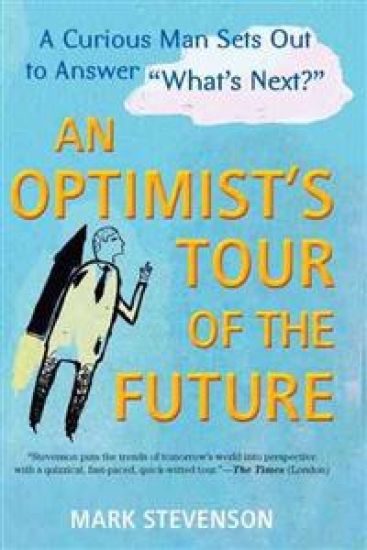
AN Optimist's Tour of the Future: One Curious Man Sets Out to Answer "What's Next?"
Mark Stevenson
Penguin Publishing Group
2012
nidottu
In the tradition of Bill Bryson's A Short History of Nearly Everything, a smart and entertaining guide to the future. Mark Stevenson-a writer, deep thinker, and stand-up comedian-set out simply, asking, "What's next for our species?" and then traveled the globe in pursuit of the answers. Along the way, he visited the Australian outback to visit the farmers who can save us from climate change, met a robot with mood swings, and talked to the Spaniard who's putting a hotel in space. While some might be overwhelmed, or even dismayed by the looming realities of genome sequencing, synthetic biology, a nuclear renaissance, and carbon scrubbing, Stevenson remains, well, optimistic. Drawing on his singular humor and storytelling to break down these sometimes complicated discoveries, An Optimist's Tour of the Future paints a wonderfully readable, and completely enthralling portrait of where we'll be when we grow up- and why it's not so scary.

Spatial Analysis in Epidemiology
Dirk U. Pfeiffer; Timothy P. Robinson; Mark Stevenson; Kim B. Stevens; David J. Rogers; Archie C.A. Clements
Oxford University Press
2008
nidottu
This book provides a practical, comprehensive and up-to-date overview of the use of spatial statistics in epidemiology - the study of the incidence and distribution of diseases. Used appropriately, spatial analytical methods in conjunction with GIS and remotely sensed data can provide significant insights into the biological patterns and processes that underlie disease transmission. In turn, these can be used to understand and predict disease prevalence. This user-friendly text brings together the specialised and widely-dispersed literature on spatial analysis to make these methodological tools accessible to epidemiologists for the first time. With its focus is on application rather than theory, Spatial Analysis in Epidemiology includes a wide range of examples taken from both medical (human) and veterinary (animal) disciplines, and describes both infectious diseases and non-infectious conditions. Furthermore, it provides worked examples of methodologies using a single data set from the same disease example throughout, and is structured to follow the logical sequence of description of spatial data, visualisation, exploration, modelling and decision support. This accessible text is aimed at graduate students and researchers dealing with spatial data in the fields of epidemiology (both medical and veterinary), ecology, zoology and parasitology, environmental science, geography and statistics.

Spatial Analysis in Epidemiology
Dirk U. Pfeiffer; Timothy P. Robinson; Mark Stevenson; Kim B. Stevens; David J. Rogers; Archie C.A. Clements
Oxford University Press
2008
sidottu
This book provides a practical, comprehensive and up-to-date overview of the use of spatial statistics in epidemiology - the study of the incidence and distribution of diseases. Used appropriately, spatial analytical methods in conjunction with GIS and remotely sensed data can provide significant insights into the biological patterns and processes that underlie disease transmission. In turn, these can be used to understand and predict disease prevalence. This user-friendly text brings together the specialised and widely-dispersed literature on spatial analysis to make these methodological tools accessible to epidemiologists for the first time. With its focus is on application rather than theory, Spatial Analysis in Epidemiology includes a wide range of examples taken from both medical (human) and veterinary (animal) disciplines, and describes both infectious diseases and non-infectious conditions. Furthermore, it provides worked examples of methodologies using a single data set from the same disease example throughout, and is structured to follow the logical sequence of description of spatial data, visualisation, exploration, modelling and decision support. This accessible text is aimed at graduate students and researchers dealing with spatial data in the fields of epidemiology (both medical and veterinary), ecology, zoology and parasitology, environmental science, geography and statistics.

The word "bat" can denote an animal, a sports apparatus, the blink of an eye, or more. While humans can select the appropriate meanings when hearing such words, Internet keyword searches and machine translations demonstrate that computers all too often fail at the process of Word Sense Disambiguation (WSD). This book provides an overview of the field, descriptions of novel research, accounts of previous approaches and methodologies, and an evaluation of a practical computer system that has been found to produce accurate disambiguation decisions in English.

The word "bat" can denote an animal, a sports apparatus, the blink of an eye, or more. While humans can select the appropriate meanings when hearing such words, Internet keyword searches and machine translations demonstrate that computers all too often fail at the process of Word Sense Disambiguation (WSD). This book provides an overview of the field, descriptions of novel research, accounts of previous approaches and methodologies, and an evaluation of a practical computer system that has been found to produce accurate disambiguation decisions in English.