Kirjailija
Mark Twain
Kirjat ja teokset yhdessä paikassa: 3 873 kirjaa, julkaisuja vuosilta 1867–2027, suosituimpiin kuuluu Christmas Classics. Vertaile teosten hintoja ja tarkista saatavuus suomalaisista kirjakaupoista.
3 873 kirjaa
Kirjojen julkaisuvuodet: 1867–2027.
The prince and the pauper (English Edition)
Mark Twain
Createspace Independent Publishing Platform
2016
pokkari

Classics to Color: The Adventures of Huckleberry Finn
Mark Twain
Racehorse for Young Readers
2016
pokkari
The Classics to Color series converts timeless tales into fun and relaxing coloring books. Experience the aesthetic aspect of these marvelous works like never before by adding your own artistic touch! The Adventures of Huckleberry Finn is undeniably a classic piece of literature, often hailed as one of the most important novels of all time. Now, you can color individual scenes from Huck Finn’s famous journey in this fun coloring book. Decorative images with accompanying text highlight the exciting narrative, illustrating some of the most noteworthy scenes from Twain’s definitive work. This book contains thirty-eight engaging full page illustrations culled from the finest moments from this rousing ride. Whether it’s Huck and Jim travelling up the Mississippi on a raft or Huck loathing and opposing his etiquette lessons from Miss Watson, this book is filled with iconic scenes from the novel for you to envision however you like! Familiarize yourself with Mark Twain’s The Adventures of Huckleberry Finn and find your own great escape while coloring these fun illustrations.

Why the Humorous Story Can Only Be Told by Americans I do not claim that I can tell a story as it ought to be told. I only claim to know how a story ought to be told. There are several kinds of stories, but only one difficult kind-the humorous. The humorous story is American, the comic story is English, the witty story is French. The humorous story depends for its effect upon the manner of the telling; the comic story and the witty story upon the matter. The humorous story may wander around as much as it pleases, but the comic and witty stories must be brief and end with a point. The humorous story bubbles gently along, the others burst. The teller of the comic story does not slur the nub; he shouts it at you-every time. And when he prints it, he italicizes it, puts some whooping exclamation-points after it, and sometimes explains it in a parenthesis. All of which is very depressing, and makes one want to renounce joking and lead a better life. Get Your Copy Now
A Double barrelled detective story
Mark Twain
Createspace Independent Publishing Platform
2016
nidottu
Mark Twain, whose real name is Samuel Langhorne Clemens, born November 30, 1835 in Florida, Missouri, United States, and died April 21, 1910 in Redding, Connecticut, is a writer, And American humorist. After a career as a military officer, a printer and a journalist with miners in Nevada, he became known through his novel The Adventures of Tom Sawyer (1876) and his sequel, The Adventures of Huckleberry Finn (1885). A child of the Border Mark Twain comes from a long-established family on the American continent, whose trajectory has married the pioneer front drawn by settlers. Twain's childhood environment is therefore the world of the American "Border". However, the Clemens family, like Twain himself when he reached adulthood, did not count among the adventurers and clearing people who had set out in the vanguard of the colonization movement towards the West. It slipped into the wake of this vast population movement and settled on land already worked by settlers where social life is already relatively stable.....
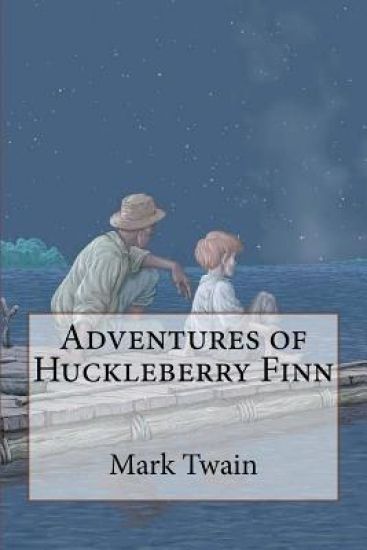
Adventures of Huckleberry Finn Mark Twain
Mark Twain
Createspace Independent Publishing Platform
2016
nidottu
Adventures of Huckleberry Finn (or, in more recent editions, The Adventures of Huckleberry Finn) is a novel by Mark Twain, first published in the United Kingdom in December 1884 and in the United States in February 1885. Commonly named among the Great American Novels, the work is among the first in major American literature to be written throughout in vernacular English, characterized by local color regionalism. It is told in the first person by Huckleberry "Huck" Finn, a friend of Tom Sawyer and narrator of two other Twain novels (Tom Sawyer Abroad and Tom Sawyer, Detective). It is a direct sequel to The Adventures of Tom Sawyer. The book is noted for its colorful description of people and places along the Mississippi River. Set in a Southern antebellum society that had ceased to exist about 20 years before the work was published, Adventures of Huckleberry Finn is an often scathing satire on entrenched attitudes, particularly racism. Perennially popular with readers, Adventures of Huckleberry Finn has also been the continued object of study by literary critics since its publication. It was criticized upon release because of its coarse language and became even more controversial in the 20th century because of its perceived use of racial stereotypes and because of its frequent use of the racial slur "nigger", despite strong arguments that the protagonist and the tenor of the book are anti-racist.
Plot summary The term gilded age, commonly given to the era, comes from the title of this book. Twain and Warner got the name from Shakespeare's King John (1595): "To gild refined gold, to paint the lily... is wasteful and ridiculous excess." citation needed] Gilding gold, which would be to put gold on top of gold, is excessive and wasteful, characteristics of the age Twain and Warner wrote about in their novel. Another interpretation of the title, of course, is the contrast between an ideal "Golden Age", and a less worthy "Gilded Age", as gilding is only a thin layer of gold over baser metal, so the title now takes on a pejorative meaning as to the novel's time, events and people. The novel concerns the efforts of a poor rural Tennessee family to become affluent by selling the 75,000 acres (300 km2) of unimproved land acquired by their patriarch, Silas "Si" Hawkins, in a timely manner. After several adventures in Tennessee, the family fails to sell the land and Si Hawkins dies. The rest of the Hawkins story line focuses on their beautiful adopted daughter, Laura. In the early 1870s, she travels to Washington, D. C. to become a lobbyist. With a senator's help, she enters Society and attempts to persuade Congressmen to require the federal government to purchase the land. A parallel story written by Warner concerns two young upperclass men, Philip Sterling and Henry Brierly, who seek their fortunes in land in a novel way. They make a journey with a group intent on surveying land in Tennessee in order to acquire it for speculation. Philip is good-natured but plodding. He is in love with Ruth Bolton, an aspiring physician and feminist. Henry is a born salesman, charming but superficial. The theme of the novel is that the lust for getting rich through land speculation pervades society, illustrated by the Hawkinses as well as Ruth's well-educated father, who nevertheless cannot resist becoming enmeshed in self-evidently dubious money-making schemes. The Hawkins sections were written by Twain; these include several humorous sketches. Examples are the steamboat race that leads to a wreck (Chapter IV) and Laura's toying with a clerk in a Washington bookstore (Chapter XXXVI). Notable too is the comic presence throughout the book of the eternally optimistic and eternally broke Micawber-like character, Colonel Beriah Sellers. The character was named Escol Sellers in the first edition and changed to Beriah when an actual George Escol Sellers of Philadelphia objected. A real Beriah Sellers then also turned up, causing Twain to use the name Mulberry Sellers in The American Claimant. The Sellers character was modeled after Twain's maternal cousin, James Lampton, and the land-purchase plot parallels Twain's father's purchase of a Tennessee parcel whose prospective sale, Twain wrote in his autobiography, "kept us hoping and hoping, during 40 years, and forsook us at last". The main action of the story takes place in Washington, D. C., and satirizes the greed and corruption of the governing class. Twain also satirizes the social pretensions of the newly rich. Laura's Washington visitors include "Mrs. Patrique Oreille (pronounced O-rey)", the wife of "a wealthy Frenchman from Cork". The book does not touch upon other themes now associated with the "Gilded Age", such as industrialization, monopolies, and the corruption of urban political machines. This may be because this book was written at the very beginning of the period.
The Mysterious stranger and other stories
Mark Twain
Createspace Independent Publishing Platform
2016
nidottu
The Mysterious Stranger is the novel attempted by the American author Mark Twain. He worked on it intermittently from 1897 through 1908. Twain wrote multiple versions of the story; each involves a supernatural character called "Satan" or "No. 44". All the versions remained unfinished (with the debatable exception of the last one, No. 44, the Mysterious Stranger). Mark Twain, whose real name is Samuel Langhorne Clemens, born November 30, 1835 in Florida, Missouri, United States, and died April 21, 1910 in Redding, Connecticut, is a writer, And American humorist. After a career as a military officer, a printer and a journalist with miners in Nevada, he became known through his novel The Adventures of Tom Sawyer (1876) and his sequel, The Adventures of Huckleberry Finn (1885). A child of the Border Mark Twain comes from a long-established family on the American continent, whose trajectory has married the pioneer front drawn by settlers. Twain's childhood environment is therefore the world of the American "Border". However, the Clemens family, like Twain himself when he reached adulthood, did not count among the adventurers and clearing people who had set out in the vanguard of the colonization movement towards the West. It slipped into the wake of this vast population movement and settled on land already worked by settlers where social life is already relatively stable. His mother, Jane Lampton, was born in Kentucky in a family that is probably one of the first generations of pioneers to cross the Appalachian Mountains; The family legend lends him a distant ancestry with the Lampton, dukes of Durham. The paternal branch of the family is native to the South of the country. His grandfather, a farmer in Virginia, migrated to Kentucky in the early 19th century to become a commissioner of revenue. Twain's father, John Marshall Clemens, studied law in the East and returned to Adair County (Kentucky) where he married Jane Lampton in 1823. He served as an attorney and ran his life After fortune. His quest takes him successively to Tennessee, Gainesboro and then to Jamestown in Fentress County, Tennessee where he invests his savings in 75,000 acres of land. The small number of cases of justice to treat pushes it to the reconversion: it becomes a merchant, opening a store of general supply, typical of the border. He tries his luck in several localities of Tennessee and then joins John Adams Quarles, his wife's brother-in-law, in Missouri on the advice of the latter. The village of Florida (Monroe County) in which the family settles is the scene of the birth of Samuel Langhorn Clemens, the fifth child of the family.

Life On The Mississippi Mark Twain
Mark Twain
Createspace Independent Publishing Platform
2016
nidottu
Life on the Mississippi is a memoir by Mark Twain detailing his days as a steamboat pilot on the Mississippi River before and after the American Civil War. The book begins with a brief history of the river. It continues with anecdotes of Twain's training as a steamboat pilot, as the 'cub' of an experienced pilot. He describes, with great affection, the science of navigating the ever-changing Mississippi River. In the second half, the book describes Twain's return, many years later, to travel on a steamboat from St. Louis to New Orleans. He describes the competition from railroads, the new, large cities, and his observations on greed, gullibility, tragedy, and bad architecture. He also tells some stories that are most likely tall tales. Simultaneously published in 1883 in the U. S. and in England, it is said to be the first book composed on a typewriter.
The Prince and the Pauper Mark Twain
Mark Twain
Createspace Independent Publishing Platform
2016
nidottu

"Prints i nischij" - pervyj i samyj izvestnyj istoricheskij roman amerikanskogo pisatelja Marka Tvena. V nem rasskazyvaetsja o prikljuchenijakh anglijskogo printsa junogo Eduarda Tjudora i malenkogo oborvysha Toma Kenti, kak dve kapli vody pokhozhikh drug na druga, i na vremja pomenjavshikhsja mestami. Dlja srednego shkolnogo vozrasta. Perevodchik: Chukovskij Kornej Ivanovich, Chukovskij Nikolaj KorneevichRedaktor: Anashina N.
This article is about Mark Twain's fictional republic. For the kingdom in J. R. R. Tolkien's The Lord of the Rings, see Gondor. Gondour is a fictitious republic created by Mark Twain in his short story "The Curious Republic of Gondour", and popularized by Robert A. Heinlein and his heirs. Twain proposed a state in which all citizens have at least one vote, but where further votes (up to a dozen) could be acquired through education, which was provided by the state for free, or by relative wealth. Furthermore, no one was accepted to any public office without passing strenuous competitive examinations. Heinlein's Expanded Universe spells it as Gondor. Nevil Shute uses the idea of multiple votes according to attainment in his novel In the Wet.
Summary In a small city on the banks of the Mississippi comes a young lawyer from New York, David Wilson, soon nicknamed the pudd'nhead for wanting to kill half a dog not belonging to him Moreover his favorite pastime is to collect the fingerprints of the passers-by. His fame is made ... At the same time, Roxana, a young M tis slave (one-sixteenth of black blood) raised and fed two blondinet boys, his and his master, Percy Driscoll, brother of the county court judge. To avoid the sale of her son in a plantation, she substitutes the two infants. The fake Tom should make a great career ... Twenty years later, two young Italian nobles, twins, arrived in the same town. Tom the impostor plundered, plays and sells his own mother in a plantation. He eventually murdered his uncle and guardian. But Wilson with his fingerprints puts everyone in his place ... And the twins? This is an other story... "The reader knows from the beginning the author of the murder and how the crime will be solved. The circumstances of the denouement, however, were at that time a great novelty, taking fingerprints was not then commonplace for the detection of crimes in the United States. Even a man for whom it was a hobby was treated as a nigaud, a 'pudd'nhead'. (Introduction by Langston Hughes to the novel) The story also describes Missouri's pre-Civil War racism, even vis-a-vis the seemingly white people with a trace of black blood and the acceptance of this state of affairs by everyone, The black population.
The American Claimant is an 1892 novel by American humorist and writer Mark Twain. Twain wrote the novel with the help of phonographic dictation, the first author (according to Twain himself) to do so. This was also (according to Twain) an attempt to write a book without mention of the weather, the first of its kind in fictitious literature. Indeed, all the weather is contained in an appendix, at the back of the book, which the reader is encouraged to turn to from time to time. The American Claimant is a comedy of mistaken identities and multiple role switches. Its cast of characters include an American enamored of British hereditary aristocracy and a British earl entranced by American democracy. Colonel Mulberry Sellers: An eccentric white-headed old man who becomes the rightful heir to the Earl of Rossmore after the death of his relative, Simon Lathers. According to his wife, Sellers is a "scheming, generous, good-hearted, moonshiny, hopeful, no-account failure" who is well beloved for his generosity and approachability. Although many of his eccentric money-making schemes are failures, he occasionally "makes a strike," as he calls it, and makes quite a bit of money. One such strike is the exceedingly popular "Pigs in the Clover" toy which he invented and patented. According to the tin signs by his door, Sellers is an attorney at law and claim agent, a materializer, a hypnotizer, and a mind-cure dabbler. He has also been named "Perpetual Member of the Diplomatic Body representing the multifarious sovereignties and civilizations of the globe near the republican court of the United States of America." The explanatory note at the beginning of the novel indicates that Colonel Sellers is the same character as Eschol Sellers in the first edition of Twain's earlier novel Gilded Age(1873) and Beriah Sellers in later editions. The note also identifies Colonel Sellers as the same character as Mulberry Sellers in John T. Raymond's dramatization of Gilded Age.