Kirjojen hintavertailu – 12 859 819 kirjaa ja 27 kauppaa

Kirjailija

Markus Schedl

Kirjat ja teokset yhdessä paikassa: 6 kirjaa, julkaisuja vuosilta 2008–2024, suosituimpiin kuuluu Music Information Retrieval. Vertaile teosten hintoja ja tarkista saatavuus suomalaisista kirjakaupoista.

6 kirjaa

Kirjojen julkaisuvuodet: 2008–2024.

Technical and Regulatory Perspectives on Information Retrieval and Recommender Systems

Technical and Regulatory Perspectives on Information Retrieval and Recommender Systems

Markus Schedl; Vito Walter Anelli; Elisabeth Lex

Springer International Publishing AG
2024
sidottu
This book provides an in-depth treatment of three important topical areas related to regulatory, ethical, and technical discussions in the context of information retrieval and recommender systems (IRRSs): (1) bias, fairness, and non-discrimination, (2) transparency and explainability, and (3) privacy and security. Sometimes referred to as trustworthiness dimensions, they are analyzed by taking an interdisciplinary perspective and incorporating views from computer science, social sciences, psychology, and law and by particularly considering the related technical challenges, societal impact, ethical considerations, and regulatory approaches. After an introduction, the book first provides an overview of recent initiatives and already operational policies to regulate AI technology and discusses them in the context of IRRSs, focusing on regulations in Europe, the US, and China. Subsequent chapters present categories of biases, their relation to fairness and non-discrimination and ways to discover and mitigate harmful biases; major facets of transparency, with a focus on explainability (including common strategies to achieve it), traceability, and auditability; and privacy and security including technical approaches to mitigate privacy risks such as anonymization techniques and encryption methods. Eventually, the last chapter provides an outlook on the grand challenges in IRRSs, such as dealing with discrepancies between formal attempts, human perception, and regulatory frameworks for trustworthy IRRSs; understanding the capabilities and limitations of existing solutions in terms of fairness, transparency, and privacy; and adopting a multistakeholder perspective when developing solutions for fair, transparent, and privacy-preserving IRRSs. The book targets a mostly technical readership and aims to equip it with the necessary understanding of the ethical implications of their research and development in IRRSs as well as of recent policy initiatives and regulatory approaches. While a basic knowledge of IRRSs is assumed to fully comprehend the more technical and algorithmic parts of the book, even a lay audience in terms of technical background should benefit from the book.
Psychology-informed Recommender Systems

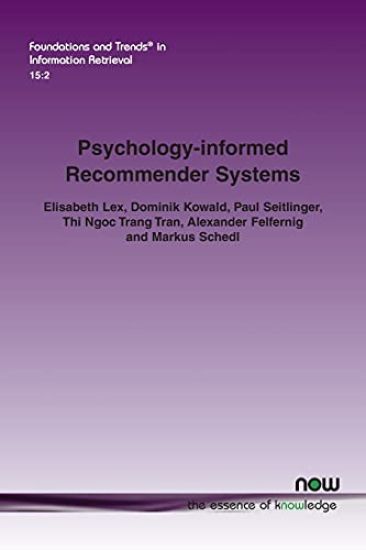
Psychology-informed Recommender Systems

Elisabeth Lex; Dominik Kowald; Paul Seitlinger; Thi Ngoc Trang Tran; Alexander Felfernig; Markus Schedl

Now Publishers Inc
2021
nidottu
Personalized recommender systems have become indispensable in today’s online world. Most of today’s recommendation algorithms are data-driven and based on behavioral data. While such systems can produce useful recommendations, they are often uninterpretable, black-box models that do not incorporate the underlying cognitive reasons for user behavior in the algorithms’ design. This survey presents a thorough review of the state of the art of recommender systems that leverage psychological constructs and theories to model and predict user behavior and improve the recommendation process – so-called psychology-informed recommender systems. The survey identifies three categories of psychology-informed recommender systems: cognition-inspired, personality-aware, and affect-aware recommender systems. For each category, the authors highlight domains in which psychological theory plays a key role. Further, they discuss selected decision-psychological phenomena that impact the interaction between a user and a recommender. They also focus on related work that investigates the evaluation of recommender systems from the user perspective and highlight user-centric evaluation frameworks, and potential research tasks for future work at the end of this survey.
Music Similarity and Retrieval

Music Similarity and Retrieval

Peter Knees; Markus Schedl

Springer-Verlag Berlin and Heidelberg GmbH Co. K
2018
nidottu
This book provides a summary of the manifold audio- and web-based approaches to music information retrieval (MIR) research. In contrast to other books dealing solely with music signal processing, it addresses additional cultural and listener-centric aspects and thus provides a more holistic view. Consequently, the text includes methods operating on features extracted directly from the audio signal, as well as methods operating on features extracted from contextual information, either the cultural context of music as represented on the web or the user and usage context of music. Following the prevalent document-centered paradigm of information retrieval, the book addresses models of music similarity that extract computational features to describe an entity that represents music on any level (e.g., song, album, or artist), and methods to calculate the similarity between them. While this perspective and the representations discussed cannot describe all musical dimensions, theyenable us to effectively find music of similar qualities by providing abstract summarizations of musical artifacts from different modalities. The text at hand provides a comprehensive and accessible introduction to the topics of music search, retrieval, and recommendation from an academic perspective. It will not only allow those new to the field to quickly access MIR from an information retrieval point of view but also raise awareness for the developments of the music domain within the greater IR community. In this regard, Part I deals with content-based MIR, in particular the extraction of features from the music signal and similarity calculation for content-based retrieval. Part II subsequently addresses MIR methods that make use of the digitally accessible cultural context of music. Part III addresses methods of collaborative filtering and user-aware and multi-modal retrieval, while Part IV explores current and future applications of music retrieval and recommendation.>
Music Similarity and Retrieval

Music Similarity and Retrieval

Peter Knees; Markus Schedl

Springer-Verlag Berlin and Heidelberg GmbH Co. K
2016
sidottu
This book provides a summary of the manifold audio- and web-based approaches to music information retrieval (MIR) research. In contrast to other books dealing solely with music signal processing, it addresses additional cultural and listener-centric aspects and thus provides a more holistic view. Consequently, the text includes methods operating on features extracted directly from the audio signal, as well as methods operating on features extracted from contextual information, either the cultural context of music as represented on the web or the user and usage context of music. Following the prevalent document-centered paradigm of information retrieval, the book addresses models of music similarity that extract computational features to describe an entity that represents music on any level (e.g., song, album, or artist), and methods to calculate the similarity between them. While this perspective and the representations discussed cannot describe all musical dimensions, theyenable us to effectively find music of similar qualities by providing abstract summarizations of musical artifacts from different modalities. The text at hand provides a comprehensive and accessible introduction to the topics of music search, retrieval, and recommendation from an academic perspective. It will not only allow those new to the field to quickly access MIR from an information retrieval point of view but also raise awareness for the developments of the music domain within the greater IR community. In this regard, Part I deals with content-based MIR, in particular the extraction of features from the music signal and similarity calculation for content-based retrieval. Part II subsequently addresses MIR methods that make use of the digitally accessible cultural context of music. Part III addresses methods of collaborative filtering and user-aware and multi-modal retrieval, while Part IV explores current and future applications of music retrieval and recommendation.>
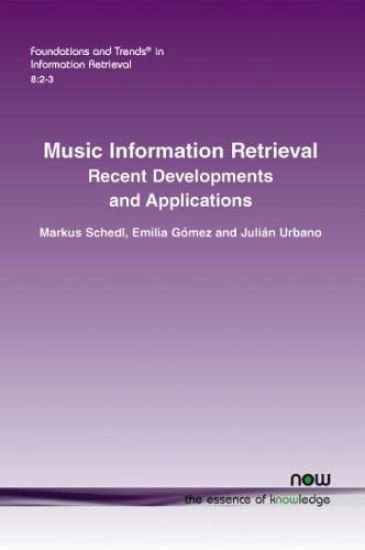
Music Information Retrieval

Music Information Retrieval

Markus Schedl; Emilia Gómez; Julián Urbano

now publishers Inc
2014
nidottu
Music Information Retrieval surveys the young but established field of research that is Music Information Retrieval (MIR). In doing so, it pays particular attention to the latest developments in MIR, such as semantic auto-tagging and user-centric retrieval and recommendation approaches. It starts by reviewing the well-established and proven methods for feature extraction and music indexing, from both the audio signal and contextual data sources about music items, such as web pages or collaborative tags. These in turn enable a wide variety of music retrieval tasks, such as semantic music search or music identification (“query by example""). Subsequently, it elaborates on the current work on user analysis and modeling in the context of music recommendation and retrieval, addressing the recent trend towards user-centric and adaptive approaches and systems. A discussion follows about the important aspect of how various MIR approaches to different problems are evaluated and compared. It concludes with a discussion about the major open challenges facing MIR.