Kirjojen hintavertailu – 12 903 724 kirjaa ja 27 kauppaa

Kirjailija

Marshall T. Poe

Kirjat ja teokset yhdessä paikassa: 6 kirjaa, julkaisuja vuosilta 2001–2011, suosituimpiin kuuluu The Russian Moment in World History. Vertaile teosten hintoja ja tarkista saatavuus suomalaisista kirjakaupoista.

6 kirjaa

Kirjojen julkaisuvuodet: 2001–2011.

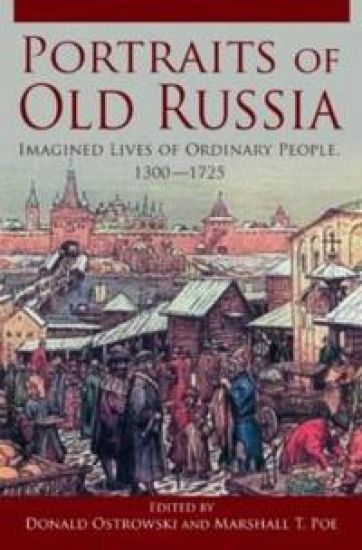
Portraits of Old Russia

Portraits of Old Russia

Donald Ostrowski; Marshall T. Poe

Routledge
2011
sidottu
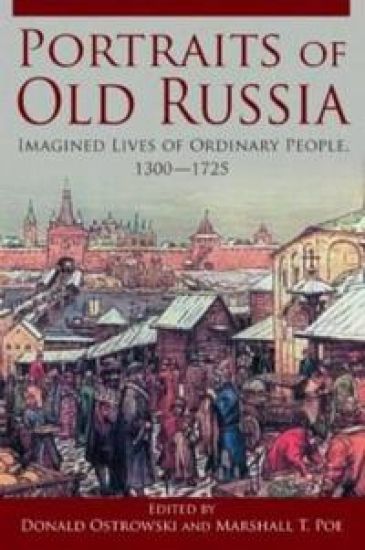
This book introduces readers to a little-known place and time in world history – early modern Russia, from its beginnings as Muscovy, in the fourteenth century, through the reign of Peter I (1689-1725) – by portraying the lives of representative individuals from the major levels of the society of that era. The portraits, written by professional historians, are imaginative reconstructions or composites of individual lives, rather than biographies. The portraits are arranged into socio-political categories, and include members of ruling families, government servitors, clerks, military personnel, church prelates, monks, provincial landowners, townspeople and artisans, Siberian explorers and traders, free peasants, serfs, slaves and holy fools. Using these portraits, the book brings old Russian society to life in an interesting way.
Portraits of Old Russia

Portraits of Old Russia

Donald Ostrowski; Marshall T. Poe

Routledge
2011
nidottu
This book introduces readers to a little-known place and time in world history – early modern Russia, from its beginnings as Muscovy, in the fourteenth century, through the reign of Peter I (1689-1725) – by portraying the lives of representative individuals from the major levels of the society of that era. The portraits, written by professional historians, are imaginative reconstructions or composites of individual lives, rather than biographies. The portraits are arranged into socio-political categories, and include members of ruling families, government servitors, clerks, military personnel, church prelates, monks, provincial landowners, townspeople and artisans, Siberian explorers and traders, free peasants, serfs, slaves and holy fools. Using these portraits, the book brings old Russian society to life in an interesting way.
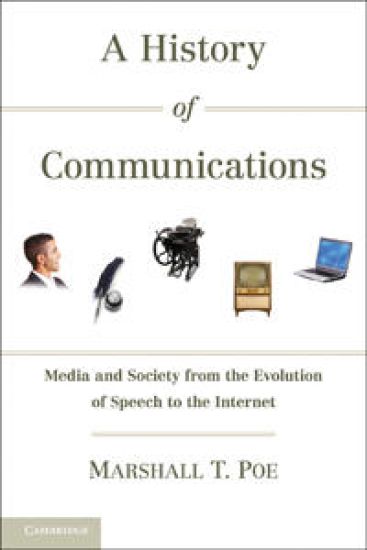
A History of Communications

A History of Communications

Marshall T. Poe

Cambridge University Press
2010
pokkari
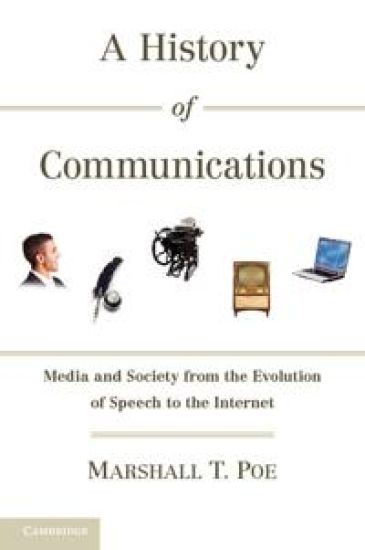
A History of Communications advances a theory of media that explains the origins and impact of different forms of communication - speech, writing, print, electronic devices and the Internet - on human history in the long term. New media are 'pulled' into widespread use by broad historical trends and these media, once in widespread use, 'push' social institutions and beliefs in predictable directions. This view allows us to see for the first time what is truly new about the Internet, what is not, and where it is taking us.
A History of Communications

A History of Communications

Marshall T. Poe

Cambridge University Press
2010
sidottu
A History of Communications advances a theory of media that explains the origins and impact of different forms of communication - speech, writing, print, electronic devices and the Internet - on human history in the long term. New media are 'pulled' into widespread use by broad historical trends and these media, once in widespread use, 'push' social institutions and beliefs in predictable directions. This view allows us to see for the first time what is truly new about the Internet, what is not, and where it is taking us.
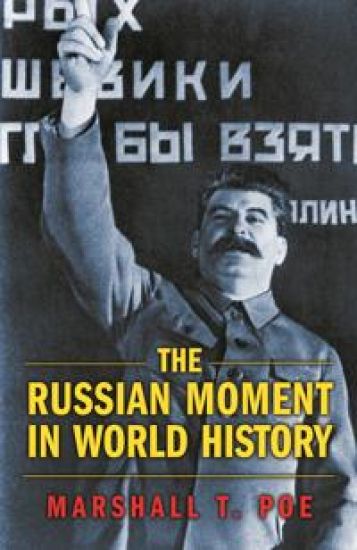
The Russian Moment in World History

The Russian Moment in World History

Marshall T. Poe

Princeton University Press
2006
pokkari
Is Russian history one big inevitable failure? The Soviet Union's demise and Russia's ensuing troubles have led many to wonder. But this is to look through a skewed prism indeed. In this provocative and elegantly written short history of Russia, Marshall Poe takes us well beyond the Soviet haze deep into the nation's fascinating--not at all inevitable, and in key respects remarkably successful--past. Tracing Russia's course from its beginnings to the present day, Poe shows that Russia was the only non-Western power to defend itself against Western imperialism for centuries. It did so by building a powerful state that molded society to its military needs. Thus arose the only non-Western path to modern society--a unique path neither "European" nor "Asian" but, most aptly, "Russian." From the fifteenth to the eighteenth centuries, Russia prevailed despite unparalleled onslaughts by powerful Western armies. However, while Europe nurtured limited government, capitalism, and scientific and cultural revolution, early Russian society cultivated autocracy and command economics. Both Europe and Russia eventually created modern infrastructures, but the European model proved more productive and powerful. The post-World War I communist era can be seen as a natural continuation of Russia's autocratic past that, despite its tragic turns, kept Russia globally competitive for decades. The Russian moment in world history thus began with its first confrontations with Europe in the fifteenth century, and ended in 1991 with the Soviet collapse. Written with verve and great insight, The Russian Moment in World History will be widely read and vigorously debated by those who seek a clear and unequivocal understanding of the complex history that has made Russia what it is today.
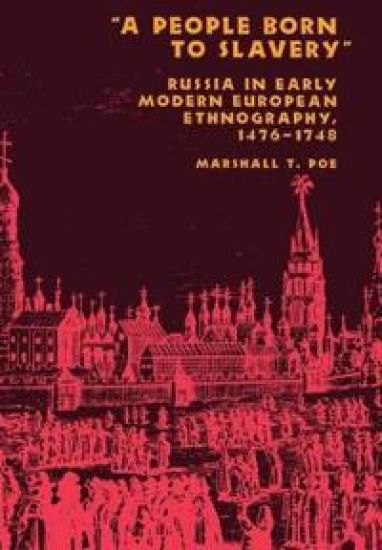
A People Born to Slavery"

A People Born to Slavery"

Marshall T. Poe

Cornell University Press
2001
sidottu
Many Americans and Europeans have for centuries viewed Russia as a despotic country in which people are inclined to accept suffering and oppression. What are the origins of this stereotype of Russia as a society fundamentally apart from nations in the West, and how accurate is it? In the first book devoted to answering these questions, Marshall T. Poe traces the roots of today's perception of Russia and its people to the eyewitness descriptions of sixteenth- and seventeenth-century European travelers. His fascinating account—the most complete review of early modern European writings about Russia ever undertaken—explores how the image of "Russian tyranny" took hold in the popular imagination and eventually became the basis for the notion of "Oriental Despotism" first set forth by Montesquieu. Poe, the preeminent scholar of these valuable primary sources, carefully assesses their reliability. He argues convincingly that although the foreigners exaggerated the degree of Russian "slavery," they accurately described their encounters and correctly concluded that the political culture of Muscovite autocracy was unlike that of European kingship. With his findings, Poe challenges the notion that all Europeans projected their own fantasies onto Russia. Instead, his evidence suggests that many early travelers produced, in essence, reliable ethnographies, not works of exotic "Orientalism."