Kirjojen hintavertailu – 12 859 819 kirjaa ja 27 kauppaa

Kirjailija

Marsilio Ficino

Kirjat ja teokset yhdessä paikassa: 32 kirjaa, julkaisuja vuosilta 1999–2026, suosituimpiin kuuluu Platonis Et Quae Vel Platonis Esse Feruntur Vel Platonica Solent Comitari Scripta Graece Omnia Ad Codices Manuscriptos. Vertaile teosten hintoja ja tarkista saatavuus suomalaisista kirjakaupoista.

32 kirjaa

Kirjojen julkaisuvuodet: 1999–2026.

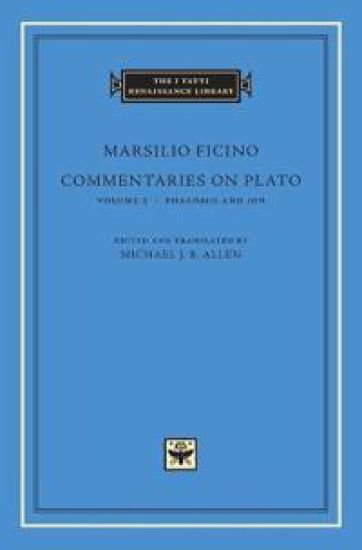
Commentaries on Plato

Commentaries on Plato

Marsilio Ficino

Harvard University Press
2008
sidottu
Marsilio Ficino (1433–1499), the Florentine scholar-philosopher-magus, was largely responsible for the Renaissance revival of Plato. The publication of his Latin translations of the dialogues in 1484 was an intellectual event of the first magnitude, making the Platonic canon accessible to western Europe after the passing of a millennium and establishing Plato as an authority for Renaissance thought. This volume contains Ficino’s extended analysis and commentary on the Phaedrus, which he explicates as a meditation on “beauty in all its forms” and a sublime work of theology. In the commentary on the Ion, Ficino explores a poetics of divine inspiration that leads to the Neoplatonist portrayal of the soul as a rhapsode whose song is an ascent into the mind of God. Both works bear witness to Ficino’s attempt to revive a Christian Platonism and what might be called an Orphic Christianity.
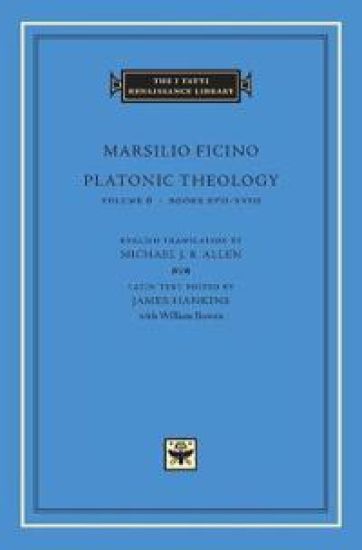
Platonic Theology

Platonic Theology

Marsilio Ficino

Harvard University Press
2006
sidottu
The Platonic Theology is a visionary work and the philosophical masterpiece of Marsilio Ficino (1433-1499), the Florentine scholar-philosopher-magus who was largely responsible for the Renaissance revival of Plato. A student of the Neoplatonic schools of Plotinus and Proclus, he was committed to reconciling Platonism with Christianity, in the hope that such a reconciliation would initiate a spiritual revival and return of the golden age. His Platonic evangelizing was eminently successful and widely influential, and his Platonic Theology, translated into English for the first time in this edition, is one of the keys to understanding the art, thought, culture, and spirituality of the Renaissance. This sixth and final volume of the I Tatti Renaissance Library edition includes comprehensive indexes to the whole work.
Platonic Theology

Platonic Theology

Marsilio Ficino

Harvard University Press
2005
sidottu

Halvin toimitettuna 39,90 €

The Platonic Theology is a visionary work and the philosophical masterpiece of Marsilio Ficino (1433-1499), the Florentine scholar-philosopher-magus who was largely responsible for the Renaissance revival of Plato. A student of the Neoplatonic schools of Plotinus and Proclus, he was committed to reconciling Platonism with Christianity, in the hope that such a reconciliation would initiate a spiritual revival and return of the golden age. His Platonic evangelizing was eminently successful and widely influential, and his Platonic Theology, translated into English for the first time in this edition, is one of the keys to understanding the art, thought, culture, and spirituality of the Renaissance. This is the fifth of a projected six volumes.
Platonic Theology

Platonic Theology

Marsilio Ficino

Harvard University Press
2004
sidottu
The Platonic Theology is a visionary work and the philosophical masterpiece of Marsilio Ficino (1433-1499), the Florentine scholar-philosopher-magus who was largely responsible for the Renaissance revival of Plato. A student of the Neoplatonic schools of Plotinus and Proclus, he was committed to reconciling Platonism with Christianity, in the hope that such a reconciliation would initiate a spiritual revival and return of the golden age. His Platonic evangelizing was eminently successful and widely influential, and his Platonic Theology, translated into English for the first time in this edition, is one of the keys to understanding the art, thought, culture, and spirituality of the Renaissance. This is the fourth of a projected six volumes.
Platonic Theology

Platonic Theology

Marsilio Ficino

Harvard University Press
2003
sidottu
The Platonic Theology is a visionary work and the philosophical masterpiece of Marsilio Ficino (1433–1499), the Florentine scholar-philosopher-magus who was largely responsible for the Renaissance revival of Plato. A student of the Neoplatonic schools of Plotinus and Proclus, he was committed to reconciling Platonism with Christianity, in the hope that such a reconciliation would initiate a spiritual revival and return of the golden age. His Platonic evangelizing was eminently successful and widely influential, and his Platonic Theology, translated into English for the first time in this edition, is one of the keys to understanding the art, thought, culture, and spirituality of the Renaissance.
The Letters of Marsilio Ficino

The Letters of Marsilio Ficino

Marsilio Ficino

Shepheard-Walwyn (Publishers) Ltd
2003
sidottu
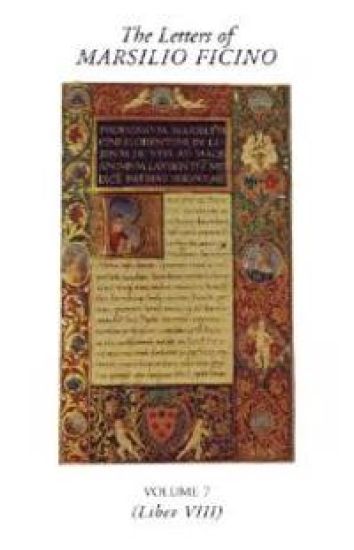
As leader of the Platonic Academy in Florence, Marsilio Ficino was teacher and guide to a remarkable circle of men. He inspired leading statesmen, scholars and churchmen throughout Europe, who travelled to meet him or conducted an extensive correspondence with him. The ideas they discussed appeared again and again and in the works of literature and art that followed: in Spenser, Shakespeare and Donne, in Botticelli, Michelangelo, Raphael, Durer and many more. Volume 7 (Book VIII of the Latin edition) is dedicated to one of Ficino's correspondents, King Matthias Corvinus of Hungary. Most of the dated letters are from June 1487 to October 1488, part of Florence's "golden decade", when Lorenzo de' Medici's astute politicking made him not only the peacemaker of the warring states of Italy, but also virtually controller of papal foreign policy. Ficino made good use of his time. Between 1482 and 1484 his major works were published: the "Platonic Theology", the "Christian Religion" and his translation from Greek into Latin of Plato's "Dialogues". He then turned to the translation of Plotinus. Important letters in this volume include his oration "God is Love", delivered to the clergy and people of Florence on the occasion of his installation as a canon of the cathedral in 1487. There are also letters comparing Moses with Plato and Socrates with Christ.
Platonic Theology

Platonic Theology

Marsilio Ficino

Harvard University Press
2002
sidottu
The Platonic Theology is a visionary work and the philosophical masterpiece of Marsilio Ficino (1433-1499), the Florentine scholar-philosopher-magus who was largely responsible for the Renaissance revival of Plato. A student of the Neoplatonic schools of Plotinus and Proclus, he was committed to reconciling Platonism with Christianity, in the hope that such a reconciliation would initiate a spiritual revival and return of the golden age. His Platonic evangelizing was eminently successful and widely influential, and his Platonic Theology, translated into English for the first time in this edition, is one of the keys to understanding the art, thought, culture, and spirituality of the Renaissance.
Platonic Theology

Platonic Theology

Marsilio Ficino

Harvard University Press
2001
sidottu
The Platonic Theology is a visionary work and the philosophical masterpiece of Marsilio Ficino (1433-1499), the Florentine scholar-philosopher-magus who was largely responsible for the Renaissance revival of Plato. A student of the Neoplatonic schools of Plotinus and Proclus, he was committed to reconciling Platonism with Christianity, in the hope that such a reconciliation would initiate a spiritual revival and return of the golden age. His Platonic evangelizing was eminently successful and widely influential, and his Platonic Theology, translated into English for the first time in this edition, is one of the keys to understanding the art, thought, culture, and spirituality of the Renaissance.
The Letters of Marsilio Ficino

The Letters of Marsilio Ficino

Marsilio Ficino

Shepheard-Walwyn (Publishers) Ltd
2001
sidottu
Chronologically, this translation comprises the third book of Ficino's letters ("Liber III"), as published during his lifetime, and dates from August 1476 to May 1477. They follow volume 1 and are therefore published as volume 2. Both book two and three of Ficino's Letters were dedicated to King Matthias of Hungary whom Ficino regarded as a model of the philosopher king referred to in Plato's "Republic". Indeed, Matthias was no ordinary king. He became one of the very few Christian leaders to defeat the Ottoman Turks decisively during the period of their empire's almost continuous growth from the early 1300s to the death of Suleiman I in 1566. King Matthias was also a devotee of philosophy, keenly interested in the practical study of Plato. Members of Ficino's Academy dwelt at this court, and an invitation to visit his court was extended to Ficino himself. Ficino's Academy was consciously modelled on the philosophical schools of antiquity. It was not merely an institute of learning. The bond between Ficino and the other members of the Academy was their mutual love, based on the love of the Self in each, a love capable of expression in all fields of human activity. It was because such love was the basis of his School that Ficnio could write (letter 21) - "the desire of him, who strives for anything other than love, is often totally frustrated by the event. But he alone who loves nothing more than love itself, by desiring immediately attains, and in always attaining continues to desire." It is the principle of unity to which Ficnio repeatedly returns in this volume. He returns to it not just as a philosophical concept, but as an immediate perception. In his letter to Paul of Middelburg ("distinguished scientist and astronomer"), Ficino observes - "If any age can be called a golden one it is undoubtedly the one that produces minds of gold in abundance. And no one who considers the wonderful discoveries of our age will doubt that it is a golden one. For this golden age has restored to the light the liberal arts that were almost extinct: grammar, poetry, rhetoric, painting, sculpture, architecture, music and the ancient art of singing to the Orphic lyre."
The Letters of Marsilio Ficino

The Letters of Marsilio Ficino

Marsilio Ficino

Shepheard-Walwyn (Publishers) Ltd
1999
sidottu
Marsilio Ficino (1433-99) directed the Platonic Academy in Florence, and it was the work of this Academy that gave the Renaissance in the 15th century its impulse and direction. During his childhood Ficino was selected by Cosimo de' Medici for an education in the humanities. Later Cosimo directed him to learn Greek and then to translate all the works of Plato into Latin. This enormous task he completed in about five years. He then wrote two important books, "The Platonic Theology" and "The Christian Religion", showing how the Christian religion and Platonic philosophy were proclaiming the same message. The extraordinary influence the Platonic Academy came to exercise over the age arose from the fact that its leading spirits were already seeking fresh inspiration from the ideals of the civilizations of Greece and Rome,and especially from the literary and philosophical sources of those ideals. Florence was the cultural and artistic centre of Europe at the time and leading men in so many fields were drawn to the Academy: Lorenzo de' Medici (Florence's ruler), Alberti (the architect) and Poliziano (the poet). Moreover, Ficino bound together an enormous circle of correspondents throughout Europe, from the Pope in Rome to John Colet in London, from Reuchlin in Germany to de Ganay in France. Published during his lifetime, "The Letters" have not previously been translated into English. This third volume consists of the 39 letters Ficino published in his book IV, which he dedicated to Matthias Corvinus, King of Hungary. During the period covered by the letters in this volume, Ficino was working on a revision of his translations of Plato's dialogues and his commentaries on them. Some of the letters consist largely of passages taken from the dialogues, for example, those in praise of matrimony, medicine and philosophy. the largest single letter is a life of Plato which furnishes some interesting parallels with Ficino's own life, as described in a near contemporary biography by Giovanni Corsi which is included, partly for this reason, at the end of the volume. Corsi comments - "The first thing which encouraged me to write about this man was that he himself not only investigated the precepts and mysteries (of the Platonic Academy) but also penetrated, laid open and expounded them to others. This was something which no one else for the previous thousand years so much as attempted, let alone accomplished."