Kirjojen hintavertailu – 12 903 725 kirjaa ja 27 kauppaa

Kirjailija

Martha C. Nussbaum

Kirjat ja teokset yhdessä paikassa: 53 kirjaa, julkaisuja vuosilta 1986–2026, suosituimpiin kuuluu Justicia Para Los Animales: Nuestra Responsabilidad Colectiva / Justice for Animals. Vertaile teosten hintoja ja tarkista saatavuus suomalaisista kirjakaupoista.

Nimi esiintyy myös muodoissa: Martha C Nussbaum

53 kirjaa

Kirjojen julkaisuvuodet: 1986–2026.

Frygtens monarki

Frygtens monarki

Martha C. Nussbaum

Forlaget Klim
2019
nidottu
Den mest indflydelsesrige nulevende filosof udgives for første gang i fuld oversættelse på dansk. Martha Nussbaum er optaget af følelsernes betydning - for vores evne til at knytte os til hinanden og opbygge samfund. Hendes nyeste udgivelse er en suveræn, urovækkende og dog opløftende bog, som med Nussbaums vanlige udsyn tager udgangspunkt i det nye politiske landskab i den vestlige verden, men hæver sig over Trump-figuren og i stedet går gennem den antikke historie for at række ud mod fløjene og modarbejde tidens polarisering. Dét har vi brug for for at modvirke den splittende frygt og uro, som ses i globaliseringens kølvand.
The Monarchy of Fear

The Monarchy of Fear

Martha C. Nussbaum

SIMON SCHUSTER
2019
nidottu

Halvin toimitettuna 22,20 €

From one of the world's most celebrated moral philosophers comes a thorough examination of the current political crisis and recommendations for how to mend our divided country. For decades Martha C. Nussbaum has been an acclaimed scholar and humanist, earning dozens of honors for her books and essays. In The Monarchy of Fear she turns her attention to the current political crisis that has polarized American since the 2016 election. Although today's atmosphere is marked by partisanship, divisive rhetoric, and the inability of two halves of the country to communicate with one another, Nussbaum focuses on what so many pollsters and pundits have overlooked. She sees a simple truth at the heart of the problem: the political is always emotional. Globalization has produced feelings of powerlessness in millions of people in the West. That sense of powerlessness bubbles into resentment and blame. Blame of immigrants. Blame of Muslims. Blame of other races. Blame of cultural elites. While this politics of blame is exemplified by the election of Donald Trump and the vote for Brexit, Nussbaum argues it can be found on all sides of the political spectrum, left or right. Drawing on a mix of historical and contemporary examples, from classical Athens to the musical Hamilton, The Monarchy of Fear untangles this web of feelings and provides a roadmap of where to go next.
Living with Hate in American Politics and Religion

Living with Hate in American Politics and Religion

Jeffrey Israel; Martha C. Nussbaum

Columbia University Press
2019
sidottu
In the United States, people are deeply divided along lines of race, class, political party, gender, sexuality, and religion. Many believe that historical grievances must eventually be left behind in the interest of progress toward a more just and unified society. But too much in American history is unforgivable and cannot be forgotten. How then can we imagine a way to live together that does not expect people to let go of their entrenched resentments? Living with Hate in American Politics and Religion offers an innovative argument for the power of playfulness in popular culture to make our capacity for coexistence imaginable. Jeffrey Israel explores how people from different backgrounds can pursue justice together, even as they play with their divisive grudges, prejudices, and desires in their cultural lives. Israel calls on us to distinguish between what belongs in a raucous “domain of play” and what belongs in the domain of the political. He builds on the thought of John Rawls and Martha Nussbaum to defend the liberal tradition against challenges posed by Frantz Fanon from the left and Leo Strauss from the right. In provocative readings of Lenny Bruce’s stand-up comedy, Philip Roth’s Portnoy’s Complaint, and Norman Lear’s All in the Family, Israel argues that postwar Jewish American popular culture offers potent and fruitful examples of playing with fraught emotions. Living with Hate in American Politics and Religion is a powerful vision of what it means to live with others without forgiving or forgetting.
Anger and Forgiveness

Anger and Forgiveness

Martha C. Nussbaum

Oxford University Press Inc
2019
nidottu

Halvin toimitettuna 25,20 €

Anger is not just ubiquitous, it is also popular. Many people think it is impossible to care sufficiently for justice without anger at injustice. Many believe that it is impossible for individuals to vindicate their own self-respect or to move beyond an injury without anger. To not feel anger in those cases would be considered suspect. Is this how we should think about anger, or is anger above all a disease, deforming both the personal and the political? In this wide-ranging book, Martha C. Nussbaum, one of our leading public intellectuals, argues that anger is conceptually confused and normatively pernicious. It assumes that the suffering of the wrongdoer restores the thing that was damaged, and it betrays an all-too-lively interest in relative status and humiliation. Studying anger in intimate relationships, casual daily interactions, the workplace, the criminal justice system, and movements for social transformation, Nussbaum shows that anger's core ideas are both infantile and harmful. Is forgiveness the best way of transcending anger? Nussbaum examines different conceptions of this much-sentimentalized notion, both in the Jewish and Christian traditions and in secular morality. Some forms of forgiveness are ethically promising, she claims, but others are subtle allies of retribution: those that exact a performance of contrition and abasement as a condition of waiving angry feelings. In general, she argues, a spirit of generosity (combined, in some cases, with a reliance on impartial welfare-oriented legal institutions) is the best way to respond to injury. Applied to the personal and the political realms, Nussbaum's profoundly insightful and erudite view of anger and forgiveness puts both in a startling new light.
The Therapy of Desire

The Therapy of Desire

Martha C. Nussbaum

Princeton University Press
2018
pokkari
The Epicureans, Skeptics, and Stoics practiced philosophy not as a detached intellectual discipline but as a worldly art of grappling with issues of daily and urgent human significance. In this classic work, Martha Nussbaum maintains that these Hellenistic schools have been unjustly neglected in recent philosophic accounts of what the classical "tradition" has to offer. By examining texts of philosophers such as Epicurus, Lucretius, and Seneca, she recovers a valuable source for current moral and political thought and encourages us to reconsider philosophical argument as a technique through which to improve lives. Written for general readers and specialists, The Therapy of Desire addresses compelling issues ranging from the psychology of human passion through rhetoric to the role of philosophy in public and private life.
Aging Thoughtfully

Aging Thoughtfully

Martha C. Nussbaum; Saul Levmore

Oxford University Press Inc
2018
sidottu
We all age differently, but we can learn from shared experiences and insights. The conversations, or paired essays, in Aging Thoughtfully combine a philosopher's approach with a lawyer-economist's. Here are ideas about when to retire, how to refashion social security to help the elderly poor, how to learn from King Lear -- who did not retire successfully -- and whether to enjoy or criticize anti-aging cosmetic procedures. Some of the concerns are practical: philanthropic decisions, relations with one's children and grandchildren, the purchase of annuities, and how to provide for care in old age. Other topics are cultural, ranging from the treatment of aging women in a Strauss opera and various popular films, to a consideration of Donald Trump's (and other men's) marriages to much younger women. These engaging, thoughtful, and often humorous exchanges show how stimulating discussions about our inevitable aging can be, and offer valuable insight into how we all might age more thoughtfully, and with zest and friendship.
Not for Profit

Not for Profit

Martha C. Nussbaum

Princeton University Press
2016
pokkari
In this short and powerful book, celebrated philosopher Martha Nussbaum makes a passionate case for the importance of the liberal arts at all levels of education. Historically, the humanities have been central to education because they have been seen as essential for creating competent democratic citizens. But recently, Nussbaum argues, thinking about the aims of education has gone disturbingly awry in the United States and abroad. We increasingly treat education as though its primary goal were to teach students to be economically productive rather than to think critically and become knowledgeable, productive, and empathetic individuals. This shortsighted focus on profitable skills has eroded our ability to criticize authority, reduced our sympathy with the marginalized and different, and damaged our competence to deal with complex global problems. And the loss of these basic capacities jeopardizes the health of democracies and the hope of a decent world. In response to this dire situation, Nussbaum argues that we must resist efforts to reduce education to a tool of the gross national product. Rather, we must work to reconnect education to the humanities in order to give students the capacity to be true democratic citizens of their countries and the world. In a new preface, Nussbaum explores the current state of humanistic education globally and shows why the crisis of the humanities has far from abated. Translated into over twenty languages, Not for Profit draws on the stories of troubling--and hopeful--global educational developments. Nussbaum offers a manifesto that should be a rallying cry for anyone who cares about the deepest purposes of education.
Anger and Forgiveness

Anger and Forgiveness

Martha C. Nussbaum

Oxford University Press Inc
2016
sidottu

Halvin toimitettuna 30,30 €

We live in a culture of apology and forgiveness. But while there are a few thinkers who are critical of forgiveness as being too supine, and extol the virtues of retribution and 'getting even,' philosopher and intellectual Martha C. Nussbaum criticizes forgiveness from the other side: that in the realm of personal relations, forgiveness is at its heart inquisitorial and disciplinary. In this volume based on her 2014 Locke Lectures, Nussbaum paints a startling new portrait that strips the notion of forgiveness down to its Judeo-Christian roots, where it was structured by the moral relationship between a score-keeping God and penitent, self-abasing, and erring mortals. The relationship between a wronged human and another is, she says, based on this primary God-human relationship. Nussbaum agrees with Nietzsche in seeing in forgiveness a displaced vindictiveness and a concealed resentment that are ungenerous and unhelpful in human relations. She says forgiveness can give aid and comfort to a certain narcissism of resentment that a loving and generous person should eschew-in favor of a generosity that gets ahead of forgiveness and prevents its procedural thoughts from taking place. With a wide range of literary and classical references as background, Nussbaum pursues her penetrating and wide-ranging exploration of anger and forgiveness from the personal realm into the political, as well as into a so-called middle realm where we interact with people and groups who are not our close friends or family. A great deal of resentment toward others is in this middle realm, and she argues that the Stoics were right-we should try and understand how petty most slights are, and avoid anger to begin with.
Litteraturens etikk

Litteraturens etikk

Martha C. Nussbaum

Pax
2016
nidottu
Utvalg og innledning av Irene Engelstad Hvorfor leser vi? Hvordan reagerer vi på det vi leser? Og hva skjer med vår forestillingsevne? Lidenskapen i litteraturen kan berøre og forvirre, men også øke vår evne til rasjonell tenkning, hevder den amerikanske filosofen Martha Nussbaum. Hun er opptatt av leserens sensibilitet og fantasi og har særlig interessert seg for litteraturens etikk. Her handler det om risikable følelser - fra Evripedes, via Brontë til Beckett. Litteraturforsker Irene Engelstad har valgt ut seks tekster fra Nussbaums omfattende forfatterskap, og presenterer dem i en undersøkende innledning.
Political Emotions

Political Emotions

Martha C. Nussbaum

The Belknap Press
2015
nidottu

Halvin toimitettuna 30,90 €

How can we achieve and sustain a "decent" liberal society, one that aspires to justice and equal opportunity for all and inspires individuals to sacrifice for the common good? In this book, a continuation of her explorations of emotions and the nature of social justice, Martha Nussbaum makes the case for love. Amid the fears, resentments, and competitive concerns that are endemic even to good societies, public emotions rooted in love—in intense attachments to things outside our control—can foster commitment to shared goals and keep at bay the forces of disgust and envy. Great democratic leaders, including Abraham Lincoln, Mohandas Gandhi, and Martin Luther King Jr., have understood the importance of cultivating emotions. But people attached to liberalism sometimes assume that a theory of public sentiments would run afoul of commitments to freedom and autonomy. Calling into question this perspective, Nussbaum investigates historical proposals for a public "civil religion" or "religion of humanity" by Jean-Jacques Rousseau, Auguste Comte, John Stuart Mill, and Rabindranath Tagore. She offers an account of how a decent society can use resources inherent in human psychology, while limiting the damage done by the darker side of our personalities. And finally she explores the cultivation of emotions that support justice in examples drawn from literature, song, political rhetoric, festivals, memorials, and even the design of public parks." Love is what gives respect for humanity its life," Nussbaum writes, "making it more than a shell." Political Emotionsis a challenging and ambitious contribution to political philosophy.
The New Religious Intolerance

The New Religious Intolerance

Martha C. Nussbaum

The Belknap Press
2013
nidottu

Halvin toimitettuna 45,20 €

What impulse prompted some newspapers to attribute the murder of 77 Norwegians to Islamic extremists, until it became evident that a right-wing Norwegian terrorist was the perpetrator? Why did Switzerland, a country of four minarets, vote to ban those structures? How did a proposed Muslim cultural center in lower Manhattan ignite a fevered political debate across the United States? In The New Religious Intolerance, Martha C. Nussbaum surveys such developments and identifies the fear behind these reactions. Drawing inspiration from philosophy, history, and literature, she suggests a route past this limiting response and toward a more equitable, imaginative, and free society. Fear, Nussbaum writes, is "more narcissistic than other emotions." Legitimate anxieties become distorted and displaced, driving laws and policies biased against those different from us. Overcoming intolerance requires consistent application of universal principles of respect for conscience. Just as important, it requires greater understanding. Nussbaum challenges us to embrace freedom of religious observance for all, extending to others what we demand for ourselves. She encourages us to expand our capacity for empathetic imagination by cultivating our curiosity, seeking friendship across religious lines, and establishing a consistent ethic of decency and civility. With this greater understanding and respect, Nussbaum argues, we can rise above the politics of fear and toward a more open and inclusive future.
Creating Capabilities

Creating Capabilities

Martha C. Nussbaum

The Belknap Press
2013
nidottu

Halvin toimitettuna 31,00 €

If a country’s Gross Domestic Product increases each year, but so does the percentage of its people deprived of basic education, health care, and other opportunities, is that country really making progress? If we rely on conventional economic indicators, can we ever grasp how the world’s billions of individuals are really managing? In this powerful critique, Martha Nussbaum argues that our dominant theories of development have given us policies that ignore our most basic human needs for dignity and self-respect. For the past twenty-five years, Nussbaum has been working on an alternate model to assess human development: the Capabilities Approach. She and her colleagues begin with the simplest of questions: What is each person actually able to do and to be? What real opportunities are available to them? The Capabilities Approach to human progress has until now been expounded only in specialized works. Creating Capabilities, however, affords anyone interested in issues of human development a wonderfully lucid account of the structure and practical implications of an alternate model. It demonstrates a path to justice for both humans and nonhumans, weighs its relevance against other philosophical stances, and reveals the value of its universal guidelines even as it acknowledges cultural difference. In our era of unjustifiable inequity, Nussbaum shows how—by attending to the narratives of individuals and grasping the daily impact of policy—we can enable people everywhere to live full and creative lives.
Anger, Mercy, Revenge

Anger, Mercy, Revenge

Lucius Annaeus Seneca; Robert A Kaster; Martha C Nussbaum; Robert A. Kaster; Martha C. Nussbaum

University of Chicago Press
2012
nidottu

Halvin toimitettuna 40,60 €

Lucius Annaeus Seneca (4 BCE - 65 CE) was a Roman Stoic philosopher, dramatist, statesman, and adviser to the emperor Nero, all during the Silver Age of Latin literature. The "Complete Works of Lucius Annaeus Seneca" is a fresh and compelling series of new English-language translations of his works in eight accessible volumes. Edited by world-renowned classicists Elizabeth Asmis, Shadi Bartsch, and Martha C. Nussbaum, this engaging collection restores Seneca - whose works have been highly praised by modern authors from Desiderius Erasmus to Ralph Waldo Emerson - to his rightful place among the classical writers most widely studied in the humanities. "Anger, Mercy, Revenge" comprises three key writings: the moral essays "On Anger" and "On Clemency" - the latter penned as advice for the young emperor Nero - and the "Apocolocyntosis", a brilliant satire lampooning the end of the reign of Claudius. Friend and tutor, as well as philosopher, Seneca welcomed the end of Claudius' sovereignty and the beginning of the age of Nero in tones alternately serious, poetic, and comic - making "Anger, Mercy, Revenge" a collection just as complicated, astute, and ambitious as its author.
Philosophical Interventions

Philosophical Interventions

Martha C. Nussbaum

Oxford University Press Inc
2012
sidottu

Halvin toimitettuna 48,90 €

This volume collects the notable published book reviews of Martha C. Nussbaum, a philosopher and high profile public intellectual who comments often on issues in philosophy, politics, gender equality, economics, and the law. Many of her engagements have been through the medium of the book review, which she has published prolifically in academic journals and in high profile venues like The New Republic and The New York Times for over 20 years. This volume collects 25 of what she considers to be her key reviews. The reviews date from 1986 and range to the present, and engage with authors like Roger Scruton, Allan Bloom, Charles Taylor, Judith Butler, Richard Posner, Catherine MacKinnon, and other prominent intellectuals of our time. Throughout, her views defy ideological predictability, heralding interesting work from unlikely sources, deftly critiquing where it is deserved, and generally providing a compelling picture of how intellectuals might engage with broad social concerns. Nussbaum will provide a new introduction that explains her selection, and provides her view of the role of public intellectuals.
Anger, Mercy, Revenge

Anger, Mercy, Revenge

Lucius Annaeus Seneca; Robert A Kaster; Martha C Nussbaum; Robert A. Kaster; Martha C. Nussbaum

University of Chicago Press
2010
sidottu
Lucius Annaeus Seneca (4 BCE to 65 CE) was a Roman Stoic philosopher, dramatist, statesman, and advisor to the emperor Nero, all during the Silver Age of Latin literature. Here, with the publication of "Anger, Mercy, Revenge" and "Natural Questions", the University of Chicago Press proudly inaugurates "The Complete Works of Lucius Annaeus Seneca", a fresh and compelling series of new English-language translations of his works in eight accessible volumes. Edited by world-renowned classicists Elizabeth Asmis, Shadi Bartsch, and Martha C. Nussbaum, this engaging collection restores Seneca - whose works have been highly praised by modern authors from Erasmus to Emerson - to his rightful place among those classical writers most widely studied in the humanities. "Anger, Mercy, Revenge" comprises three key writings: the moral essays 'On Anger' and 'On Clemency' - which were penned as advice for the then young emperor Nero - and the Apocolocyntosis, a brilliant satire lampooning the end of the reign of Claudius. "Natural Questions" is a stand-alone treatise in which Seneca compiles and comments on the physical sciences of his day, offering us a valuable look at the ancient scientific mind at work. Both volumes introduce the Latinless reader to the writings of one of the ancient world's most fascinating - and acclaimed - philosophical figures, making them perfect for the undergraduate student and lay scholar alike.
From Disgust to Humanity

From Disgust to Humanity

Martha C Nussbaum

Oxford University Press Inc
2010
sidottu
A distinguished professor of law and philosophy at the University of Chicago, a prolific writer and award-winning thinker, Martha Nussbaum stands as one of our foremost authorities on law, justice, freedom, morality, and emotion. In From Disgust to Humanity, Nussbaum aims her considerable intellectual firepower at the bulwark of opposition to gay equality: the politics of disgust. Nussbaum argues that disgust has long been among the fundamental motivations of those who are fighting for legal discrimination against lesbian and gay citizens. When confronted with same-sex acts and relationships, she writes, they experience "a deep aversion akin to that inspired by bodily wastes, slimy insects, and spoiled food--and then cite that very reaction to justify a range of legal restrictions, from sodomy laws to bans on same-sex marriage." Leon Kass, former head of President Bush's President's Council on Bioethics, even argues that this repugnance has an inherent "wisdom," steering us away from destructive choices. Nussbaum believes that the politics of disgust must be confronted directly, for it contradicts the basic principle of the equality of all citizens under the law. "It says that the mere fact that you happen to make me want to vomit is reason enough for me to treat you as a social pariah, denying you some of your most basic entitlements as a citizen." In its place she offers a "politics of humanity," based not merely on respect, but something akin to love, an uplifting imaginative engagement with others, an active effort to see the world from their perspectives, as fellow human beings. Combining rigorous analysis of the leading constitutional cases with philosophical reflection about underlying concepts of privacy, respect, discrimination, and liberty, Nussbaum discusses issues ranging from non-discrimination and same-sex marriage to "public sex." Recent landmark decisions suggest that the views of state and federal courts are shifting toward a humanity-centered vision, and Nussbaum's powerful arguments will undoubtedly advance that cause. Incisive, rigorous, and deeply humane, From Disgust to Humanity is a stunning contribution to Oxford's distinguished Inalienable Rights series.

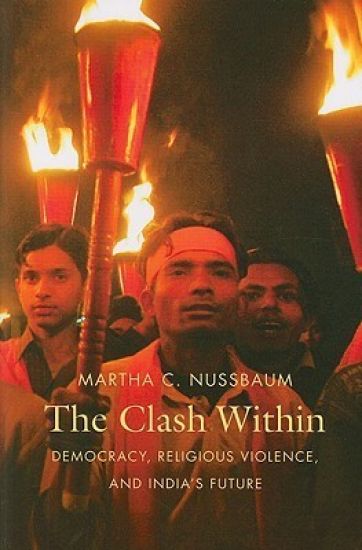
The Clash Within

The Clash Within

Martha C. Nussbaum

The Belknap Press
2008
nidottu
While America is focused on religious militancy and terrorism in the Middle East, democracy has been under siege from religious extremism in another critical part of the world. As Martha Nussbaum reveals in this penetrating look at India today, the forces of the Hindu right pose a disturbing threat to its democratic traditions and secular state. Since long before the 2002 Gujarat riots--in which nearly two thousand Muslims were killed by Hindu extremists--the power of the Hindu right has been growing, threatening India's hard-won constitutional practices of democracy, tolerance, and religious pluralism. Led politically by the Bharatiya Janata Party, the Hindu right has sought the subordination of other religious groups and has directed particular vitriol against Muslims, who are cast as devils in need of purging. The Hindu right seeks to return to a "pure" India, unsullied by alien polluters of other faiths, yet the BJP's defeat in recent elections demonstrates the power that India's pluralism continues to wield. The future, however, is far from secure, and Hindu extremism and exclusivity remain a troubling obstacle to harmony in South Asia. Nussbaum's long-standing professional relationship with India makes her an excellent guide to its recent history. Ultimately she argues that the greatest threat comes not from a clash between civilizations, as some believe, but from a clash within each of us, as we oscillate between self-protective aggression and the ability to live in the world with others. India's story is a cautionary political tale for all democratic states striving to act responsibly in an increasingly dangerous world.