Kirjailija
Martin Aigner
Kirjat ja teokset yhdessä paikassa: 17 kirjaa, julkaisuja vuosilta 1976–2020, suosituimpiin kuuluu Das BUCH der Beweise. Vertaile teosten hintoja ja tarkista saatavuus suomalaisista kirjakaupoista.
17 kirjaa
Kirjojen julkaisuvuodet: 1976–2020.

Das BUCH der Beweise
Martin Aigner; Günter M. Ziegler
Springer-Verlag Berlin and Heidelberg GmbH Co. KG
2018
sidottu
Diese fünfte deutsche Auflage enthält ein ganz neues Kapitel über van der Waerdens Permanenten-Vermutung, sowie weitere neue, originelle und elegante Beweise in anderen Kapiteln. Aus den Rezensionen: “… es ist fast unmöglich, ein Mathematikbuch zu schreiben, das von jedermann gelesen und genossen werden kann, aber Aigner und Ziegler gelingt diese Meisterleistung in virtuosem Stil. […] Dieses Buch erweist der Mathematik einen unschätzbaren Dienst, indem es Nicht-Mathematikern vorführt, was Mathematiker meinen, wenn sie über Schönheit sprechen.” Aus der Laudatio für den “Steele Prize for Mathematical Exposition” 2018"Was hier vorliegt ist eine Sammlung von Beweisen, die in das von Paul Erdös immer wieder zitierte BUCH gehören, das vom lieben (?) Gott verwahrt wird und das die perfekten Beweise aller mathematischen Sätze enthält. Manchmal lässt der Herrgott auch einige von uns Sterblichen in das BUCH blicken, und die so resultierenden Geistesblitze erhellen den Mathematikeralltag mit eleganten Argumenten, überraschenden Zusammenhängen und unerwarteten Volten."www.mathematik.de, Mai 2002"Eine einzigartige Sammlung eleganter mathematischer Beweise nach der Idee von Paul Erdös, verständlich geschrieben von exzellenten Mathematikern. Dieses Buch gibt anregende Lösungen mit Aha-Effekt, auch für Nicht-Mathematiker."www.vismath.de"Ein prächtiges, äußerst sorgfältig und liebevoll gestaltetes Buch! Erdös hatte die Idee DES BUCHES, in dem Gott die perfekten Beweise mathematischer Sätze eingeschrieben hat. Das hier gedruckte Buch will eine "very modest approximation" an dieses BUCH sein.... Das Buch von Aigner und Ziegler ist gelungen ..." Mathematische Semesterberichte, November 1999"Wer (wie ich) bislang vergeblich versucht hat, einen Blick ins BUCH zu werfen, wird begierig in Aigners und Zieglers BUCH der Beweise schmökern."www.mathematik.de, Mai 2002
Proofs from THE BOOK
Martin Aigner; Günter M. Ziegler
Springer-Verlag Berlin and Heidelberg GmbH Co. K
2018
sidottu
Halvin toimitettuna 65,60 €
This revised and enlarged sixth edition of Proofs from THE BOOK features an entirely new chapter on Van der Waerden’s permanent conjecture, as well as additional, highly original and delightful proofs in other chapters. From the citation on the occasion of the 2018 "Steele Prize for Mathematical Exposition" “… It is almost impossible to write a mathematics book that can be read and enjoyed by people of all levels and backgrounds, yet Aigner and Ziegler accomplish this feat of exposition with virtuoso style. […] This book does an invaluable service to mathematics, by illustrating for non-mathematicians what it is that mathematicians mean when they speak about beauty.” From the Reviews"... Inside PFTB (Proofs from The Book) is indeed a glimpse of mathematical heaven, where clever insights and beautiful ideas combine in astonishing and glorious ways. There is vast wealth within its pages, one gem after another. ... Aigner and Ziegler... write: "... all we offer is the examples that we have selected, hoping that our readers will share our enthusiasm about brilliant ideas, clever insights and wonderful observations." I do. ... "Notices of the AMS, August 1999"... This book is a pleasure to hold and to look at: ample margins, nice photos, instructive pictures and beautiful drawings ... It is a pleasure to read as well: the style is clear and entertaining, the level is close to elementary, the necessary background is given separately and the proofs are brilliant. ..." LMS Newsletter, January 1999"Martin Aigner and Günter Ziegler succeeded admirably in putting together a broad collection of theorems and their proofs that would undoubtedly be in the Book of Erdös. The theorems are so fundamental, their proofs so elegant and the remaining open questions so intriguing that every mathematician, regardless of speciality, can benefit from reading this book. ..." SIGACT News, December 2011
Es kommt nicht oft vor, dass ein einzelnes Problem ein ganzes mathematisches Gebiet hervorruft. Das allseits bekannte 4-Farben Problem war solch ein singuläres Ereignis: Aus den Lösungsversuchen entwickelte sich die Graphentheorie, die heute zu den unverzichtbaren Grundlagen der Diskreten Mathematik und Informatik und weiterer angewandter Wissenschaften gehört. Das Buch versucht zweierlei: Es will erstens alle wichtigen Begriffe, Ideen und Sätze für eine Einführung in die Graphentheorie im Bachelorstudium bereitstellen, und zweitens ein tieferes Verständnis für dieses wunderbare Gebiet vermitteln, durch einen Rückblick, wie alles mit dem 4-Farben Problem begann, und einen Ausblick auf die erstaunliche Lösung und den damit aufgeworfenen Fragen.
Markov's Theorem and 100 Years of the Uniqueness Conjecture
Martin Aigner
Springer International Publishing AG
2015
nidottu
This book takes the reader on a mathematical journey, from a number-theoretic point of view, to the realm of Markov’s theorem and the uniqueness conjecture, gradually unfolding many beautiful connections until everything falls into place in the proof of Markov’s theorem. What makes the Markov theme so attractive is that it appears in an astounding variety of different fields, from number theory to combinatorics, from classical groups and geometry to the world of graphs and words. On the way, there are also introductory forays into some fascinating topics that do not belong to the standard curriculum, such as Farey fractions, modular and free groups, hyperbolic planes, and algebraic words. The book closes with a discussion of the current state of knowledge about the uniqueness conjecture, which remains an open challenge to this day. All the material should be accessible to upper-level undergraduates with some background in number theory, and anything beyond this level isfully explained in the text. This is not a monograph in the usual sense concentrating on a specific topic. Instead, it narrates in five parts – Numbers, Trees, Groups, Words, Finale – the story of a discovery in one field and its many manifestations in others, as a tribute to a great mathematical achievement and as an intellectual pleasure, contemplating the marvellous unity of all mathematics.
Proofs from THE BOOK
Martin Aigner; Günter M. Ziegler
Springer-Verlag Berlin and Heidelberg GmbH Co. K
2014
nidottu
This revised and enlarged fifth edition features four new chapters, which contain highly original and delightful proofs for classics such as the spectral theorem from linear algebra, some more recent jewels like the non-existence of the Borromean rings and other surprises. From the Reviews"... Inside PFTB (Proofs from The Book) is indeed a glimpse of mathematical heaven, where clever insights and beautiful ideas combine in astonishing and glorious ways. There is vast wealth within its pages, one gem after another. ... Aigner and Ziegler... write: "... all we offer is the examples that we have selected, hoping that our readers will share our enthusiasm about brilliant ideas, clever insights and wonderful observations." I do. ... "Notices of the AMS, August 1999"... This book is a pleasure to hold and to look at: ample margins, nice photos, instructive pictures and beautifuldrawings ... It is a pleasure to read as well: the style is clear and entertaining, the level is close to elementary, the necessary background is given separately and the proofs are brilliant. ..." LMS Newsletter, January 1999"Martin Aigner and Günter Ziegler succeeded admirably in putting together a broad collection of theorems and their proofs that would undoubtedly be in the Book of Erdös. The theorems are so fundamental, their proofs so elegant and the remaining open questions so intriguing that every mathematician, regardless of speciality, can benefit from reading this book. ... "SIGACT News, December 2011.
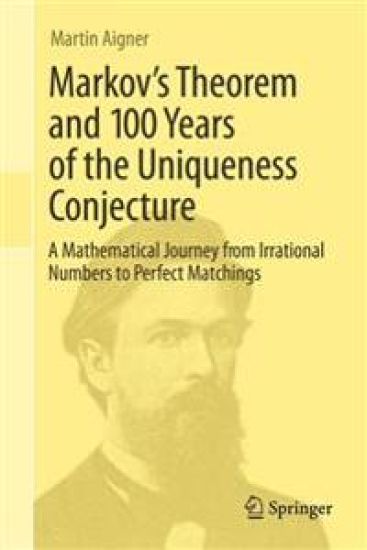
Markov's Theorem and 100 Years of the Uniqueness Conjecture
Martin Aigner
Springer International Publishing AG
2013
sidottu
This book takes the reader on a mathematical journey, from a number-theoretic point of view, to the realm of Markov’s theorem and the uniqueness conjecture, gradually unfolding many beautiful connections until everything falls into place in the proof of Markov’s theorem. What makes the Markov theme so attractive is that it appears in an astounding variety of different fields, from number theory to combinatorics, from classical groups and geometry to the world of graphs and words. On the way, there are also introductory forays into some fascinating topics that do not belong to the standard curriculum, such as Farey fractions, modular and free groups, hyperbolic planes, and algebraic words. The book closes with a discussion of the current state of knowledge about the uniqueness conjecture, which remains an open challenge to this day. All the material should be accessible to upper-level undergraduates with some background in number theory, and anything beyond this level isfully explained in the text. This is not a monograph in the usual sense concentrating on a specific topic. Instead, it narrates in five parts – Numbers, Trees, Groups, Words, Finale – the story of a discovery in one field and its many manifestations in others, as a tribute to a great mathematical achievement and as an intellectual pleasure, contemplating the marvellous unity of all mathematics.
It is now generally recognized that the field of combinatorics has, over the past years, evolved into a fully-fledged branch of discrete mathematics whose potential with respect to computers and the natural sciences is only beginning to be realized. Still, two points seem to bother most authors: The apparent difficulty in defining the scope of combinatorics and the fact that combinatorics seems to consist of a vast variety of more or less unrelated methods and results. As to the scope of the field, there appears to be a growing consensus that combinatorics should be divided into three large parts: (a) Enumeration, including generating functions, inversion, and calculus of finite differences; (b) Order Theory, including finite posets and lattices, matroids, and existence results such as Hall's and Ramsey's; (c) Configurations, including designs, permutation groups, and coding theory. The present book covers most aspects of parts (a) and (b), but none of (c). The reasons for excluding (c) were twofold. First, there exist several older books on the subject, such as Ryser [1] (which I still think is the most seductive introduction to combinatorics), Hall [2], and more recent ones such as Cameron-Van Lint [1] on groups and designs, and Blake-Mullin [1] on coding theory, whereas no compre hensive book exists on (a) and (b).
Zahlentheorie, neben Geometrie wohl das lteste Gebiet der Mathematik, hat im Lauf der Zeit nichts von ihrem Reiz eingeb t - ganz im Gegenteil: Die Faszination zeitloser Probleme wie der Fermatschen Vermutung genau so wie aktuelle Anwendungen in Kryptographie lassen sie lebendiger denn je erscheinen. Das vorliegende Buch tr gt dazu bei, die Zahlentheorie in den Bachelor-Lehrplan einzubauen. Es ist kein umfassendes Lehrbuch, sondern will den Stoff einer einsemestrigen 4+2-st ndigen Vorlesung von 14 Wochen vermitteln, wie sie mit gro em Erfolg mehrmals an der FU Berlin gehalten wurde. Der Text umfasst etwa 140 Seiten, pro Woche gibt es 10 bungen, die direkt in den Stoff einflie en. Als zus tzliche Lernhilfe gibt es f r viele bungen Hinweise und kurze L sungen f r alle bungen am Schluss des Buches, und ferner ein ausf hrliches Literaturverzeichnis, nach Kapiteln gegliedert und mit Kommentaren versehen. Au erdem werden die ben tigten Grundlagen in einem Anhang kurz zusammengestellt. Das Buch ist als Skriptum f r Bachelorstudenten der Mathematik ab dem 3. Semester gedacht, insbesondere auch f r Lehramtsstudenten, die sich in Zahlentheorie vertiefen wollen.
Combinatorial enumeration is a readily accessible subject full of easily stated, but sometimes tantalizingly difficult problems. This book leads the reader in a leisurely way from the basic notions to a variety of topics, ranging from algebra to statistical physics. Its aim is to introduce the student to a fascinating field, and to be a source of information for the professional mathematician who wants to learn more about the subject. The book is organized in three parts: Basics, Methods, and Topics. There are 666 exercises, and as a special feature every chapter ends with a highlight, discussing a particularly beautiful or famous result.
The advent of fast computers and the search for efficient algorithms revolutionized combinatorics and brought about the field of discrete mathematics. This book is an introduction to the main ideas and results of discrete mathematics, and with its emphasis on algorithms it should be interesting to mathematicians and computer scientists alike. The book is organized into three parts: enumeration, graphs and algorithms, and algebraic systems. There are 600 exercises with hints and solutions to about half of them. The only prerequisites for understanding everything in the book are linear algebra and calculus at the undergraduate level.
Combinatorial enumeration is a readily accessible subject full of easily stated, but sometimes tantalizingly difficult problems. This book leads the reader in a leisurely way from the basic notions to a variety of topics, ranging from algebra to statistical physics. Its aim is to introduce the student to a fascinating field, and to be a source of information for the professional mathematician who wants to learn more about the subject. The book is organized in three parts: Basics, Methods, and Topics. There are 666 exercises, and as a special feature every chapter ends with a highlight, discussing a particularly beautiful or famous result.
The advent of fast computers and the search for efficient algorithms revolutionized combinatorics and brought about the field of discrete mathematics. This book is an introduction to the main ideas and results of discrete mathematics, and with its emphasis on algorithms it should be interesting to mathematicians and computer scientists alike. The book is organized into three parts: enumeration, graphs and algorithms, and algebraic systems. There are 600 exercises with hints and solutions to about half of them. The only prerequisites for understanding everything in the book are linear algebra and calculus at the undergraduate level. Praise for the German edition ... This book is a well-written introduction to discrete mathematics and is highly recommended to every student of mathematics and computer science as well as to teachers of these topics. --Konrad Engel for MathSciNet Martin Aigner is a professor of mathematics at the Free University of Berlin. He received his PhD at the University of Vienna and has held a number of positions in the USA and Germany before moving to Berlin. He is the author of several books on discrete mathematics, graph theory, and the theory of search. The Monthly article Turan's graph theorem earned him a 1995 Lester R. Ford Prize of the MAA for expository writing, and his book Proofs from the BOOK with Gunter M. Ziegler has been an international success with translations into 12 languages.
Das Standardwerk über Diskrete Mathematik in deutscher Sprache. Großer Wert wird auf die Übungen gelegt, die etwa ein Viertel des Textes ausmachen. Die Übungen sind nach Schwierigkeitsgrad gegliedert, im Anhang findet man Lösungen für etwa die Hälfte der Übungen. Das Buch eignet sich für Lehrveranstaltungen im Bereich Diskrete Mathematik, Kombinatorik, Graphen und Algorithmen.
This book offers a well-organized, easy-to-follow introduction to combinatorial theory, with examples, notes and exercises. "...a very good introduction to combinatorics. This book can warmly be recommended first of all to students interested in combinatorics." Publicationes Mathematicae Debrecen
Vor 50 Jahren gab es den Begriff "Diskrete Mathematik" nicht, und er ist auch heute im deutschen Sprachraum keineswegs gebrauchlich. Vorlesungen dazu werden nicht iiberall und schon gar nicht mit einem einheitlichen Themenkatalog angeboten (im Gegensatz zum Beispiel zu den USA, wo sie seit langem einen festen Platz haben). Die Mathematiker verstehen unter Diskreter Mathematik meist Kombinatorik oder Graphentheorie, die Informatiker Diskrete Strukturen oder Boolesche Algebren. Das Hauptanliegen dieses Buches ist daher, solch einen Themenkatalog zu prasentieren, der alle Grundlagen fiir ein weiterfiihrendes Studium enthalt. Die Diskrete Mathematik beschaftigt sich vor allem mit endlichen Mengen. Was kann man in endlichen Mengen studieren? Ais allererstes kann man sie abzahlen, dies ist das klassische Thema der Kombinatorik - in Teil I werden wir die wich tigsten Ideen und Methoden zur Abzahlung kennenlernen. Auf endlichen Mengen ist je nach Aufgabenstellung meist eine einfache Struktur in Form von Relationen gegeben, von denen die anwendungsreichsten die Graphen sind. Diese Aspekte fas sen wir in Teil II unter dem Titel Graphen uncl Algorithmen zusammen. Und schlieBlich existiert auf endlichen Mengen oft eine algebraische Struktur (oder man kann eine solche auf natiirliche Weise erklaren). Algebraische Systeme sind der Inhalt von Teil III. Diese drei Gesichtspunkte bilden den roten Faden des Buches. Ein weiterer Aspekt, der die Darstellung durchgehend pragt, betrifft den Begriff der Optimierung.