Kirjojen hintavertailu – 12 859 824 kirjaa ja 27 kauppaa

Kirjailija

Martin C. Libicki

Kirjat ja teokset yhdessä paikassa: 29 kirjaa, julkaisuja vuosilta 2002–2025, suosituimpiin kuuluu Internet Freedom and Political Space. Vertaile teosten hintoja ja tarkista saatavuus suomalaisista kirjakaupoista.

Nimi esiintyy myös muodoissa: Martin C Libicki

29 kirjaa

Kirjojen julkaisuvuodet: 2002–2025.

How Insurgencies End

How Insurgencies End

Ben Connable; Martin C. Libicki

RAND
2010
pokkari
This volume tested conventional wisdom about how insurgencies end against the evidence from 89 insurgencies. It compares a quantitative and qualitative analysis of insurgency case studies with lessons from insurgency and counterinsurgency literature. While no two insurgencies are the same, the authors find that modern insurgencies last about ten years and that a government's chance of winning may increase slightly over time. Other findings include that withdrawal of state support cripples insurgencies, civil defense forces are useful for both sides, and pseudo democracies fare poorly against insurgents.
Cyberdeterrence and Cyberwar

Cyberdeterrence and Cyberwar

Martin C. Libicki

RAND
2009
pokkari
The protection of cyberspace, the information medium, has become a vital national interest because of its importance both to the economy and to military power. An attacker may tamper with networks to steal information for the money or to disrupt operations. Future wars are likely to be carried out, in part or perhaps entirely, in cyberspace. It might therefore seem obvious that maneuvering in cyberspace is like maneuvering in other media, but nothing would be more misleading. Cyberspace has its own laws; for instance, it is easy to hide identities and difficult to predict or even understand battle damage, and attacks deplete themselves quickly. Cyberwar is nothing so much as the manipulation of ambiguity. The author explores these topics in detail and uses the results to address such issues as the pros and cons of counterattack, the value of deterrence and vigilance, and other actions governments can take to protect themselves in the face of deliberate cyberattack. For more than 60 years, decisionmakers in the public and private sectors have turned to the RAND Corporation for objective analysis and effective solutions that address the challenges facing the nation and the world.
Living Conditions in Anbar Province in June 2008

Living Conditions in Anbar Province in June 2008

Keith Crane; Martin C Libicki; Audra K Grant; James B Bruce; Omar Al-Shahery

RAND
2009
pokkari
In 2008, RAND carried out a survey of conditions in Anbar Province, once one of Iraq's most violent areas. The resulting data on demographics, employment, income and standards of living, education, health, housing and public infrastructure, the effects of war, and agriculture should foster greater understanding of current conditions in al-Anbar and help identify areas on which to focus future assistance.
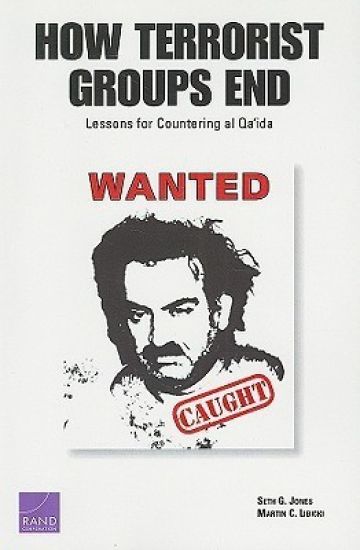
How Terrorist Groups End

How Terrorist Groups End

Seth G. Jones; Martin C. Libicki

RAND
2008
pokkari
All terrorist groups eventually end. But how? Most modern groups have ended because they joined the political process or local police and intelligence agencies arrested or killed key members. This has significant implications for dealing with al Qa'ida and suggests fundamentally rethinking post-9/11 U. S. counterterrorism strategy: Policing and intelligence, not military force, should form the backbone of U. S. efforts against al Qa'ida. All terrorist groups end. But how do they end? Most groups since 1968 have ended because they joined the political process or are defeated by police and intelligence services. This has significant implications for countering al Qa'ida.
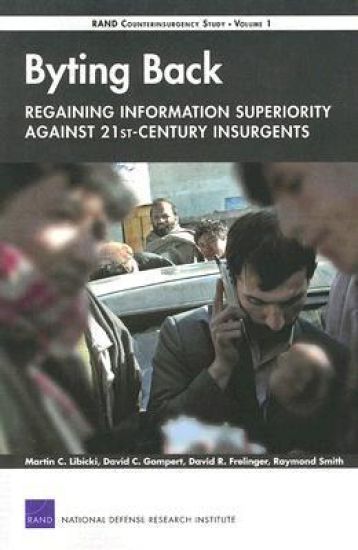
Byting Back

Byting Back

Martin C Libicki; David C Gompert; David R Frelinger; Raymond Smith

RAND
2007
nidottu
Libicki et al. argue that information collection requirements and systems for counterinsurgency are important because the community that conducts counterinsurgency crosses national and institutional boundaries and because the indigenous population plays a large role in determining the outcome of an insurgency. They then demonstrate what this focus implies for counterinsurgency requirements, collection, networking, and systems design.
Conquest in Cyberspace

Conquest in Cyberspace

Martin C. Libicki

Cambridge University Press
2007
sidottu
With billions of computers in existence, cyberspace, 'the virtual world created when they are connected,' is said to be the new medium of power. Computer hackers operating from anywhere can enter cyberspace and take control of other people's computers, stealing their information, corrupting their workings, and shutting them down. Modern societies and militaries, both pervaded by computers, are supposedly at risk. As Conquest in Cyberspace explains, however, information systems and information itself are too easily conflated, and persistent mastery over the former is difficult to achieve. The author also investigates how far 'friendly conquest' in cyberspace extends, such as the power to persuade users to adopt new points of view. He discusses the role of public policy in managing cyberspace conquests and shows how the Internet is becoming more ubiquitous and complex, such as in the use of artificial intelligence.
Conquest in Cyberspace

Conquest in Cyberspace

Martin C. Libicki

Cambridge University Press
2007
pokkari
With billions of computers in existence, cyberspace, 'the virtual world created when they are connected,' is said to be the new medium of power. Computer hackers operating from anywhere can enter cyberspace and take control of other people's computers, stealing their information, corrupting their workings, and shutting them down. Modern societies and militaries, both pervaded by computers, are supposedly at risk. As Conquest in Cyberspace explains, however, information systems and information itself are too easily conflated, and persistent mastery over the former is difficult to achieve. The author also investigates how far 'friendly conquest' in cyberspace extends, such as the power to persuade users to adopt new points of view. He discusses the role of public policy in managing cyberspace conquests and shows how the Internet is becoming more ubiquitous and complex, such as in the use of artificial intelligence.
Exploring Terrorist Targeting Preferences
Governments spend billions to protect against terrorism. Might it help to understand what al Qaeda would achieve with each specific attack? This book examines various hypotheses of terrorist targeting: is it (1) to coerce, (2) to damage economies, (3) to rally the faithful, or (4) a decision left to affiliates? This book analyzes past attacks, post hoc justifications, and expert opinion to weigh each hypothesis.