Kirjojen hintavertailu – 12 903 725 kirjaa ja 27 kauppaa
Kirjailija
Martin E. Marty
Kirjat ja teokset yhdessä paikassa: 60 kirjaa, julkaisuja vuosilta 1973–2022, suosituimpiin kuuluu Visions of Utopia. Vertaile teosten hintoja ja tarkista saatavuus suomalaisista kirjakaupoista.
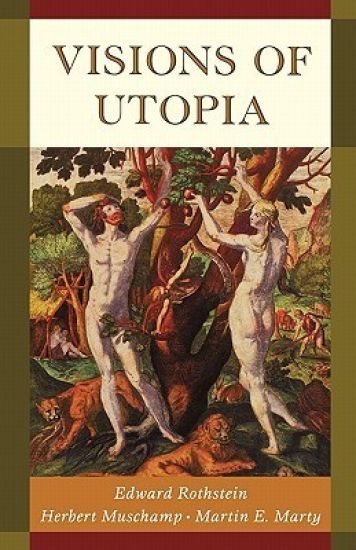
From the sex-free paradise of the Shakers to the worker's paradise of Marx, utopian ideas seem to have two things in common--they all are wonderfully plausible at the start and they all end up as disasters. In Visions of Utopia, three leading cultural critics--Edward Rothstein, Martin Marty, and Herbert Muschamp--look at the history of utopian thinking, exploring why they fail and why they are still worth pursuing. Rothstein contends that every utopia is really a dystopia-- one that overlooks the nature of humanity and the impossibilities of paradise. He traces the ideal in politics and technology and suggests that only in art--and especially in music--does the desire for utopia find satisfaction. Marty examines several models of utopia--from Thomas More's to a 1960s experimental city that he helped to plan--to show that, even though utopias can never be realized, we should not be too quick to condemn them. They can express dimensions of the human spirit that might otherwise be stifled and can plant ideas that may germinate in more realistic and practical soil. Muschamp looks at Utopianism as exemplified in two different ways: the Buddhist tradition and the work of visionary Viennese architect Adolph Loos. Utopian thinking embodies humanity's noblest impulses, yet it can lead to horrors such as Nazi Germany and the Soviet Regime. In Visions of Utopia, these leading thinkers offer an intriguing look at the paradoxes of paradise.
In this new edition of Overcoming America / America Overcoming, Stephen Rowe shows how the COVID-19 pandemic in tandem with Trumpism have brought basic dynamics of the American situation to high relief, and hence provide opportunity to address them – before it is too late. The dynamics he identifies are those of moral disease and political paralysis as symptomatic of the fact that America herself has been overtaken by the modern values which she exported to the rest of the world. He points to a way out of the current and potentially fatal malaise and violence: join other societies which are also struggling to move beyond the modern and consciously reappropriate those elements of tradition which have to do with cultivation of the mature human being. To avoid fundamentalism, Rowe discusses how this reappropriation must be undertaken in dialogue with those who also have come to recognize the unsustainable quality of the modern life, and who have been able to live beyond the nihilistic wish to tear it down. This book supports the call for an emerging global ethic and spirituality, providing resources of articulation and interpretation that allow for an ongoing dialogue between traditional and modern values—both worthy and problematic in their own ways—through which reliable policy and healthy living become possible.
From National Book Award–winning author Martin Marty, the surprising story of a Christian classic born in a Nazi prison cellFor fascination, influence, inspiration, and controversy, Dietrich Bonhoeffer's Letters and Papers from Prison is unmatched by any other book of Christian reflection written in the twentieth century. A Lutheran pastor and theologian, Bonhoeffer spent two years in Nazi prisons before being executed at age thirty-nine, just a month before the German surrender, for his role in the plot to kill Hitler. The posthumous Letters and Papers from Prison has had a tremendous impact on both Christian and secular thought since it was first published in 1951, and has helped establish Bonhoeffer's reputation as one of the most important Protestant thinkers of the twentieth century. In this, the first history of the book's remarkable global career, National Book Award-winning author Martin Marty tells how and why Letters and Papers from Prison has been read and used in such dramatically different ways, from the cold war to today. In his late letters, Bonhoeffer raised tantalizing questions about the role of Christianity and the church in an increasingly secular world. Marty tells the story of how, in the 1960s and the following decades, these provocative ideas stirred a wide range of thinkers and activists, including civil rights and antiapartheid campaigners, "death-of-God" theologians, and East German Marxists. In the process of tracing the eventful and contested history of Bonhoeffer's book, Marty provides a compelling new perspective on religious and secular life in the postwar era.
Positive mentoring relationships are essential to the formation of strong Christian leaders. This simple truth is often held as self-evident, but why? How can theological and biblical insights inform mentoring relationships? And what do these vital relationships look like across a range of Christian experience? Opening multiple angles of vision on the practice of mentoring, Dean K. Thompson and D. Cameron Murchison have assembled an eminent group of scholars to reflect on these and other pressing questions. With contributions from twenty-one remarkable writers, this broad-ranging volume explores mentoring in biblical and theological perspective, within the context of diverse national and international communities, and across generations.
From the Founding Fathers through the present, Christianity has exercised powerful influence in the United States—from its role in shaping politics and social institutions to its hand in inspiring art and culture. The Encyclopedia of Christianity in the United States outlines the myriad roles Christianity has played and continues to play. This masterful five-volume reference work includes biographies of major figures in the Christian church in the United States, influential religious documents and Supreme Court decisions, and information on theology and theologians, denominations, faith-based organizations, immigration, art—from decorative arts and film to music and literature—evangelism and crusades, the significant role of women, racial issues, civil religion, and more. The first volume opens with introductory essays that provide snapshots of Christianity in the U. S. from pre-colonial times to the present, as well as a statistical profile and a timeline of key dates and events. Entries are organized from A to Z. The final volume closes with essays exploring impressions of Christianity in the United States from other faiths and other parts of the world, as well as a select yet comprehensive bibliography. Appendices help readers locate entries by thematic section and author, and a comprehensive index further aids navigation.
Known locally as the birthplace of American religious freedom, Flushing, Queens, in New York City is now so diverse and densely populated that it has become a microcosm of world religions. City of Gods explores the history of Flushing from the colonial period to the aftermath of September 11, 2001, spanning the origins of Vlissingen and early struggles between Quakers, Dutch authorities, Anglicans, African Americans, Catholics, and Jews to the consolidation of New York City in 1898, two World's Fairs and postwar commemorations of Flushing's heritage, and, finally, the Immigration Act of 1965 and the arrival of Hindus, Sikhs, Muslims, Buddhists, and Asian and Latino Christians. A synthesis of archival sources, oral history, and ethnography, City of Gods is a thought-provoking study of religious pluralism. Using Flushing as the backdrop to examine America's contemporary religious diversity and what it means for the future of the United States, R. Scott Hanson explores both the possibilities and limits of pluralism. Hanson argues that the absence of widespread religious violence in a neighborhood with such densely concentrated religious diversity suggests that there is no limit to how much pluralism a pluralist society can stand. Seeking to gauge interaction and different responses to religious and ethnic diversity, the book is set against two interrelated questions: how and where have the different religious and ethnic groups in Flushing associated with others across boundaries over time; and when has conflict or cooperation arisen? By exploring pluralism from a historical and ethnographic context, City of Gods takes a micro approach to help bring an understanding of pluralism from a sometimes abstract realm into the real world of everyday lives in which people and groups are dynamic and integrating agents in a complex and constantly changing world of local, national, and transnational dimensions. Perhaps the most extreme example of religious and ethnic pluralism in the world, Flushing is an ideal place to explore how America's long experiment with religious freedom and religious pluralism began and continues. City of Gods reaches far beyond Flushing to all communities coming to terms with immigration, religion, and ethnic relations, raising the question as to whether Flushing will come together in new and lasting ways to build bridges of dialogue or will it further fragment into a Tower of Babel.
Known locally as the birthplace of American religious freedom, Flushing, Queens, in New York City is now so diverse and densely populated that it has become a microcosm of world religions. City of Gods explores the history of Flushing from the colonial period to the aftermath of September 11, 2001, spanning the origins of Vlissingen and early struggles between Quakers, Dutch authorities, Anglicans, African Americans, Catholics, and Jews to the consolidation of New York City in 1898, two World’s Fairs and postwar commemorations of Flushing’s heritage, and, finally, the Immigration Act of 1965 and the arrival of Hindus, Sikhs, Muslims, Buddhists, and Asian and Latino Christians. A synthesis of archival sources, oral history, and ethnography, City of Gods is a thought-provoking study of religious pluralism. Using Flushing as the backdrop to examine America’s contemporary religious diversity and what it means for the future of the United States, R. Scott Hanson explores both the possibilities and limits of pluralism. Hanson argues that the absence of widespread religious violence in a neighborhood with such densely concentrated religious diversity suggests that there is no limit to how much pluralism a pluralist society can stand. Seeking to gauge interaction and different responses to religious and ethnic diversity, the book is set against two interrelated questions: how and where have the different religious and ethnic groups in Flushing associated with others across boundaries over time; and when has conflict or cooperation arisen? By exploring pluralism from a historical and ethnographic context, City of Gods takes a micro approach to help bring an understanding of pluralism from a sometimes abstract realm into the real world of everyday lives in which people and groups are dynamic and integrating agents in a complex and constantly changing world of local, national, and transnational dimensions. Perhaps the most extreme example of religious and ethnic pluralism in the world, Flushing is an ideal place to explore how America’s long experiment with religious freedom and religious pluralism began and continues. City of Gods reaches far beyond Flushing to all communities coming to terms with immigration, religion, and ethnic relations, raising the question as to whether Flushing will come together in new and lasting ways to build bridges of dialogue or will it further fragment into a Tower of Babel.
Power, Politics, and the Missouri Synod follows the rise of two Lutheran clergymen - Herman Otten and J. A. O. Preus - who led different wings of a conservative movement that seized control of a theologically conservative but socially and politically moderate church denomination (LCMS) and drove "moderates" from the church in the 1970s. The schism within what was then one of the largest Protestant denominations in the United States ultimately reshaped the landscape of American Lutheranism and fostered the polarization that characterizes today's Lutheran churches.
The future of America, in many ways, depends upon an understanding of the proper role of religion in our shared life as a republic. Discussions and debates on the topic have too often generated noise, platitudes, stereotypes, name-calling, and the distortion of vitally important issues, instead of constructive conversation among citizens--until now. Of all the voices commenting about American religion today, none is more credible or better known than that of historian Martin E. Marty. A respected scholar, author, editor, and media commentator, he has-perhaps better than anyone else in the field-a deep grasp on the complex issues surrounding public religion.