Kirjojen hintavertailu – 12 903 725 kirjaa ja 27 kauppaa

Kirjailija

Martin Haspelmath

Kirjat ja teokset yhdessä paikassa: 6 kirjaa, julkaisuja vuosilta 1993–2015, suosituimpiin kuuluu A Grammar of Lezgian. Vertaile teosten hintoja ja tarkista saatavuus suomalaisista kirjakaupoista.

6 kirjaa

Kirjojen julkaisuvuodet: 1993–2015.

Understanding Morphology

Understanding Morphology

Martin Haspelmath; Andrea Sims

Routledge
2015
sidottu
This new edition of Understanding Morphology has been fully revised in line with the latest research. It now includes 'big picture' questions to highlight central themes in morphology, as well as research exercises for each chapter. Understanding Morphology presents an introduction to the study of word structure that starts at the very beginning. Assuming no knowledge of the field of morphology on the part of the reader, the book presents a broad range of morphological phenomena from a wide variety of languages. Starting with the core areas of inflection and derivation, the book presents the interfaces between morphology and syntax and between morphology and phonology. The synchronic study of word structure is covered, as are the phenomena of diachronic change, such as analogy and grammaticalization. Theories are presented clearly in accessible language with the main purpose of shedding light on the data, rather than as a goal in themselves. The authors consistently draw on the best research available, thus utilizing and discussing both functionalist and generative theoretical approaches. Each chapter includes a summary, suggestions for further reading, and exercises. As such this is the ideal book for both beginning students of linguistics, or anyone in a related discipline looking for a first introduction to morphology.
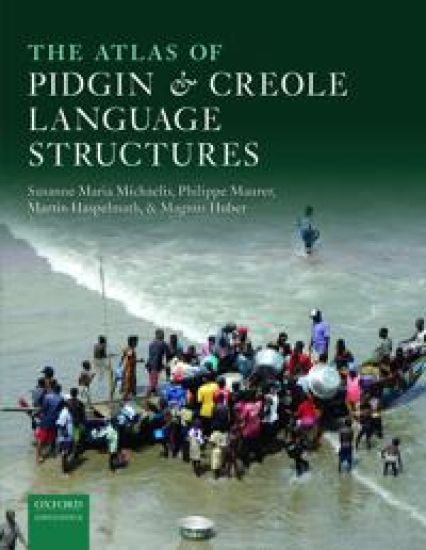
The Atlas of Pidgin and Creole Language Structures

The Atlas of Pidgin and Creole Language Structures

Susanne Maria Michaelis; Philippe Maurer; Martin Haspelmath; Magnus Huber

Oxford University Press
2013
sidottu
The Atlas presents full colour maps of the distribution among the pidgins and creoles of 130 structural linguistic features drawn from their phonology, syntax, morphology, and lexicons. In addition there are some maps with relevant sociolinguistic features. The languages include pidgins, creoles, and other contact languages based on English, Dutch, Portuguese, Spanish, and French and languages from Africa, Asia, Australia, and the Americas. Each map is accompanied by a detailed description and discussion of the feature. The project is the successor to the successful World Atlas of Language Structures and draws on the same linguistic, cartographic, and computing knowledge and skills of the Max Planck Institute for Evolutionary Anthropology in Leipzig. The Atlas is published alongside a three-volume Survey of Pidgins and Creoles which describes the histories and linguistic characteristics of 76 languages. The books have been designed, edited, and written by the world's leading experts in the field and represent the most systematic and comprehensive guide ever published to the world's pidgins, creoles and mixed languages. Individually and together the books are a unique resource of outstanding value for linguists of all persuasions throughout the world.
Understanding Morphology

Understanding Morphology

Martin Haspelmath; Andrea Sims

Hodder Education
2010
nidottu
This new edition of Understanding Morphology has been fully revised in line with the latest research. It now includes 'big picture' questions to highlight central themes in morphology, as well as research exercises for each chapter. Understanding Morphology presents an introduction to the study of word structure that starts at the very beginning. Assuming no knowledge of the field of morphology on the part of the reader, the book presents a broad range of morphological phenomena from a wide variety of languages. Starting with the core areas of inflection and derivation, the book presents the interfaces between morphology and syntax and between morphology and phonology. The synchronic study of word structure is covered, as are the phenomena of diachronic change, such as analogy and grammaticalization. Theories are presented clearly in accessible language with the main purpose of shedding light on the data, rather than as a goal in themselves. The authors consistently draw on the best research available, thus utilizing and discussing both functionalist and generative theoretical approaches. Each chapter includes a summary, suggestions for further reading, and exercises. As such this is the ideal book for both beginning students of linguistics, or anyone in a related discipline looking for a first introduction to morphology.
Indefinite Pronouns

Indefinite Pronouns

Martin Haspelmath

Oxford University Press
2001
nidottu
This is an open access title available under the terms of a CC BY-NC-ND 4.0 International licence. It is free to read at Oxford Scholarship Online and offered as a free PDF download from OUP and selected open access locations. Most of the world's languages have indefinite pronouns, that is, expressions such as 'someone', 'anything', and 'nowhere'. Martin Haspelmath presents the first comprehensive and encyclopaedic investigation of indefinite pronouns in the languages of the world, mapping out the range of variation in their functional and formal properties. He shows that cross-linguistic diversity is severely constrained by a set of implicational universals and by a number of unrestricted universals. The author treats his subject matter broadly within the Humboldt-Greenberg tradition of language typology, but also considers the contribution of other theoretical approaches to an understanding of the functional and formal properties of indefinite pronouns. The book is organized into four logically ordered steps: selection of a part of grammar-indefinite pronouns-that can be identified across languages by formal and functional criteria; investigation of the properties of indefinite pronouns in a world-wide sample of forty languages; formulation of generalizations that emerge from the data, summarized in the form of an implicational map; and theoretically-informed explanations of the generalizations, which go beyond system-internal statements, appealing to cognitive semantics, functional pressures, and universals of language change (especially grammaticalization).
Indefinite Pronouns

Indefinite Pronouns

Martin Haspelmath

Clarendon Press
1997
sidottu
This is an open access title available under the terms of a CC BY-NC-ND 4.0 International licence. It is free to read at Oxford Scholarship Online and offered as a free PDF download from OUP and selected open access locations. Most of the world's languages have indefinite pronouns, that is, expressions such as someone, anything, and nowhere. Martin Haspelmath presents the first comprehensive and encyclopaedic investigation of indefinite pronouns in the languages of the world, mapping out the range of variation in their functional and formative properties. He shows that cross-linguistic diversity is severely constrained by a set of implicational universals and by a number of unrestricted universals. The author treats his subject matter broadly within the Humboldt-Greenberg tradition of language typology, but also considers the contribution of other theoretical approaches to an understanding of the functional and formal properties of indefinite pronouns. The book is organized into four logically ordered steps: selection of a part of grammar-- indefinite pronouns--that can be identified across languages by formal and functional criteria; investigation of the properties of indefinite pronouns in a world-wide sample of forty languages; formulation of generalizations that emerge from the data, summarized in the form of an implicational map; and theoretically informed explanations of the generalizations, which go beyond system-internal statements, appealing to cognitive semantics, functional pressures, and universals of language change (especially grammaticalization).
A Grammar of Lezgian

A Grammar of Lezgian

Martin Haspelmath

De Gruyter Mouton
1993
sidottu
The series builds an extensive collection of high quality descriptions of languages around the world. Each volume offers a comprehensive grammatical description of a single language together with fully analyzed sample texts and, if appropriate, a word list and other relevant information which is available on the language in question. There are no restrictions as to language family or area, and although special attention is paid to hitherto undescribed languages, new and valuable treatments of better known languages are also included. No theoretical model is imposed on the authors; the only criterion is a high standard of scientific quality. To discuss your book idea or submit a proposal, please contact Birgit Sievert.