Kirjojen hintavertailu – 12 903 729 kirjaa ja 27 kauppaa

Kirjailija

Martin Luck

Kirjat ja teokset yhdessä paikassa: 6 kirjaa, julkaisuja vuosilta 1997–2022, suosituimpiin kuuluu Biological Science. Vertaile teosten hintoja ja tarkista saatavuus suomalaisista kirjakaupoista.

Nimi esiintyy myös muodoissa: Martin Lück

6 kirjaa

Kirjojen julkaisuvuodet: 1997–2022.

Biological Science

Biological Science

Jon Scott; Gus Cameron; Anne Goodenough; Dawn Hawkins; Jenny Koenig; Martin Luck; Despo Papachristodoulou; Alison Snape; Kay Yeoman; Mark Goodwin

Oxford University Press
2022
nidottu
Biological Science: Exploring the Science of Life responds to the key needs of lecturers and their students by placing a clear central narrative, carefully-structured active learning, and confidence with quantitative concepts and scientific enquiry central to its approach. Written by a team of dedicated and passionate academics, and shaped by feedback from over 55 institutions, its straightforward narrative, reinforced by key concept overview videos for every chapter, communicate key ideas clearly: the right information is provided at the right time, and at the right depth. Its pause and think features, self-check quizzes, and graded end of chapter questions, augmented by flashcards of key terms, directly support active learning. The combination of narrative text and learning features promote a rich, active learning experience: read, watch, and do. Its combination of Quantitative Toolkits, Scientific Process panels, and the Life and its Exploration chapters provide more insight and support than any other general biology text; they prepare students to engage with this quantitative and experimental discipline with confidence, and set them on a path for success throughout their future studies. With coverage that spans the full scale of biological science - from molecule to ecosystem - and with an approach that fully supports flexible, self-paced learning, Biological Science: Exploring the Science of Life will set you on a path towards a deeper understanding of the key concepts in biology, and a greater appreciation of biology as a dynamic experimental science. Digital formats and resources Biological Science: Exploring the Science of Life is available for students and institutions to purchase in a variety of formats. The enhanced ebook is enriched with features that offer extra learning support: www.oxfordtextbooks.co.uk/ebooks - Key concepts videos support students from the start of every chapter and as they make their way through every Module. - Self-check questions at the end of each chapter section give students quick and formative feedback, building their confidence and comprehension as they study and revise. - Quantitative skills video screencasts help students to master the foundational skills required by this discipline. - Interactive figures give students the control they need to step through, and gain mastery over, key concepts. - Per-chapter flashcard glossaries help students to recall the key terms and concepts on which further study can be built.
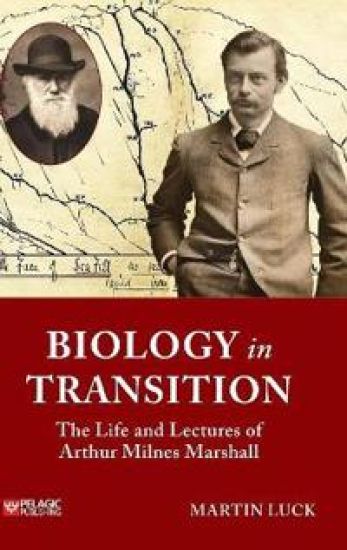
Biology in Transition

Biology in Transition

Martin Luck

Pelagic Publishing
2018
sidottu
Arthur Milnes Marshall was a 19th-century scientist who gave lectures addressing the biological debates of his time. They covered topics including evolution, embryology, development and inheritance, with Charles Darwin’s name and those of other important biologists distributed liberally throughout. Marshall was a zoologist, embryologist, anatomist and Darwin enthusiast, as well as an accomplished mountaineer and sportsman. He was a humanist, an admired academic teacher and brilliant public educator. The lectures reveal his passion for communicating his subject, to his students and to the working men and women of Manchester, and they provide a remarkable snapshot of the state of biological science at the close of the 19th century. His death in 1893 aged only 41, on a climbing expedition in the Lake District, left a fascinating time capsule in the form of lectures from a critical transitional period in the history of biology. Evolution by natural selection was the established doctrine but genes were undefined, with Mendel’s work yet to be recognised. Embryology was suggesting recapitulation but ancestry, genetics and missing links awaited liberation from theoreticians and the stones of palaeontology. Microscopy was flourishing and cell science was finding its feet, but DNA and molecular science were far in the future. Had Marshall lived and worked into the 20th century, these lectures would undoubtedly have been superseded and forgotten. Instead, they reveal biology’s transformation from a descriptive exercise to an experimental science, its rejection of purpose and design in evolution, and the shift of its axis from continental Europe to Britain and the United States. Professor Martin Luck discovered these lectures (published by CF Marshall in two volumes shortly after his brother’s death) languishing in a university corridor. His careful curation, introductions to each lecture and copious annotations on the organisms, theories and scientists discussed, illuminate their significance as prequels to modern biology. Marshall’s own story brings the lectures and their social context into sharp relief. Biology in Transition will interest anyone curious about the history of science, especially biology, evolution, genetics and its 19th-century pioneers.
Your Student Research Project

Your Student Research Project

Martin Luck

Routledge
2017
sidottu
The ability to produce valid research has never been more crucial to the academic community than it is today, but how do you go about getting the funding for such projects? How do you identify which funding organisations are likely to be sympathetic to your needs, and convince them that they will benefit from funding you? Abby Day Peters guides you step by step through the process of focusing your research and identifying your funding partner to provide the very best chance of success. But, perhaps more importantly, she also goes on to explain how to build and maintain a relationship with the partner, thereby assisting future research. In addition, the book gives advice on writing and successful publication following completion of the research project. The text is extremely lively and enjoyable to read, with many valuable insights from both sides of the funding process, and features real-life case studies and interviews throughout.
Hormones

Hormones

Martin Luck

Oxford University Press
2014
nidottu
Hormones play an integral part in the balance and workings of the body. While many people are broadly aware of their existence, there are many misconceptions and few are aware of the nature and importance of the endocrine system. In this Very Short Introduction, Martin Luck explains what hormones are, what they do, where they come from, and how they work. He explains how the endocrine system operates, highlighting the importance of hormones in the regulation of water and salt in the body, how they affect reproduction and our appetites, and how they help us adjust to different environments, such as travel across time zones. In this fresh and modern treatment, Luck also touches on the ethical and moral issues surrounding research methods, testing on animals, and hormone misuse. ABOUT THE SERIES: The Very Short Introductions series from Oxford University Press contains hundreds of titles in almost every subject area. These pocket-sized books are the perfect way to get ahead in a new subject quickly. Our expert authors combine facts, analysis, perspective, new ideas, and enthusiasm to make interesting and challenging topics highly readable.
Your Student Research Project

Your Student Research Project

Martin Luck

Gower Publishing Ltd
1999
nidottu
Now that you are approaching the final stages of your degree, have you ever wondered how you're going to cope with writing your dissertation? Apart from the practicalities of suddenly having to think and work in a completely different, and more in-depth, way trom before, how are you going to fit it in with the rest of your work and also have a social life? Your Student Research Project will show you how. This book gives you practical advice on how to cope with your project and make a success of your studies. It: ¢ is written in clear, accessible language ¢ provides a clear outline of practical guidance on how to run your project, from thinking about what topic to cover to the most effective way of presenting it ¢ explains how to work with your supervisor and the other important people around you ¢ shows you how to squeeze the maximum value from the effort you put in ¢ enables you to recognize how you have changed in the process and ¢ encourages you to exploit the skills and experiences you have gained in the world beyond your degree. It takes a different approach from other books on research methods because it considers the project as only one part of your existence. It concentrates on advice, ideas and examples while still giving thought to how you will manage your work within a crowded and exciting life. Above all, Your Student Research Project helps you to keep track of where you are heading and to make the right preparations for the future.
Zentralbankpolitik in Italien

Zentralbankpolitik in Italien

Martin Lück

Peter Lang AG
1997
nidottu
Italien ist das Land der Gegensatze. Es ist aber auch die Wiege des europaischen Bankwesens. Die Geschichte seiner Zentralbank, der Banca d'Italia, birgt einen reichen Erfahrungsschatz dafur, wie sich ein Wahrungsinstitut in die okonomische, rechtliche und politische Ordnung eines Landes einfugen kann. Die Einbettung in dieses Umfeld pragt den Charakter der Notenbank starker als deren rechtlicher Status. Vor diesem Hintergrund gewinnt die Diskussion um die Unabhangigkeit von Zentralbanken eine ganz neue Dimension. In der Europaischen Wahrungsunion wird es nur noch eine Zentralbank geben. Sie wird eine starke "formale" Unabhangigkeit erhalten. Die Arbeit lenkt dagegen den Blick auf die Erfahrungen Italiens mit den "tatsachlichen" Handlungsmoglichkeiten einer Notenbank. Erstmals in deutscher Sprache wird die facettenreiche Institution Banca d'Italia sowohl in bezug auf ihre juristische Struktur als auch auf ihr tatsachliches Handeln analysiert. Das Ergebnis hinterlasst einige Skepsis bezuglich der Eignung formaler Zentralbankunabhangigkeit als stabilitatspolitisches Allheilmittel."