
Kirjailija
Martin Luther
Kirjat ja teokset yhdessä paikassa: 962 kirjaa, julkaisuja vuosilta 1856–2026, suosituimpiin kuuluu Isä Meidän Selitys. Vertaile teosten hintoja ja tarkista saatavuus suomalaisista kirjakaupoista.
962 kirjaa
Kirjojen julkaisuvuodet: 1856–2026.
Luther, M: Martin Luther's Hochzeitsgeschenk, Oder Handbuchl
Martin Luther
KESSINGER PUBLISHING, LLC
2009
nidottu


About this VolumeAs a professor for Old Testament, Martin Luther never wrote out a full commentary on Matthew. He preached on it regularly, however, both in the traditional texts of the church year, and especially in his sermon series on Matthew 18-24 (begun in Luther's Works Volume 67 and continued here), preached to the people of Wittenberg over the course of four years (1537-1540). In July 1537, Johann Bugenhagen (1485-1558), the pastor of St. Mary's Church in Wittenberg, departed for Denmark to organize the reformation there, and Luther began preaching in Bugenhagen's stead, on Sundays as well as on Wednesdays and Saturdays. Luther's Wednesday sermons on Matthew's Gospel, 56 in all, probably began on July 11, 1537. The last sermon in this series on Matthew was preached on September 19, 1540. Luther thus continued preaching even after Bugenhagen's return in July 1539, though he moved his Matthew sermons to Sunday afternoons beginning in August. Luther's preaching here is joined closely with the events of 1537-1540. In his exposition of Matthew 18-24, Luther both explains the text and takes the occasion from it to warn his hearers of the dangers he sees threatening the Reformation, such as the temptation to engage in former superstitions, to compromise with the pope, to take advantages of one's neighbor through usury and greed, and to neglect the role of the Law in the life of the believer. Amidst his teaching from Matthew on the forgiveness of sins, divorce, infant Baptism, repentance, the divinity of Christ, the marks of the church, the resurrection, and the end of the world, Luther also seeks to strengthen his hearers to endure persecution-from imperial troops loyal to the pope or from Turkish armies-which he sees approaching just over the horizon. These are earnest sermons of biblical exposition, antithesis, and admonition, in the attempt to guard the people from the devil and all temptations that would snatch them away from Christ. Features: Commentary on Matthew 19-24Detailed footnotes explaining historical and theological contextFully indexedClear, accurate translation in modern American English Edited by Benjamin T. G. Mayes and Translated by Kevin G. WalkerAbout the SeriesThe 28 planned new volumes are intended to reflect both modern and sixteenth-century interests and to expand the coverage of genres underrepresented in the existing volumes, such as Luther's sermons and disputations. The primary basis for the translation is the comprehensive Weimar edition.

About the VolumeThis volume contains Annotations on Matthew 1-18 (1534-35/1538), and the first chapter of Sermons on Matthew 18-24 (1537-40/1796-1847). In December 1533, a new cycle of preaching on Matthew began in the Wittenberg Castle Church. Luther himself inaugurated the series with three sermons on Matthew 1. Then the preaching on Matthew was assigned to the Wittenberg doctoral student Hieronymus Weller (1499-1572). Behind Weller's sermons, however, stood Luther, who prepared notes to help his student preach. The notes touched both on the interpretation of the scriptural passages and on homiletical strategies for preaching them. In annotating Matthew's text for another doctor of theology, Luther grappled with questions of the exegesis of the Synoptic Gospels at a high level of technical detail. Luther drew especially on the discipline of rhetoric-the use of language to persuade and move human beings-to interpret Matthew's narrative and Jesus' speech presented there and to identify strategies for the effective homiletical presentation of those texts to Weller's contemporary audience. As a modern reader, you will want to explore Luther's treatment of the application of rhetoric to the tasks of exegesis and preaching, as well as for its exegesis of controverted passages. For Luther, trained as a Nominalist and later embracing humanist studies, a rhetorical understanding of Christ's speech-and the rhetorical application of His Word in the present-is vitally important for Christians. The crucial knowledge about God is not philosophical knowledge about the divine nature in relation to the creation, which could be obtained by reason or meditation or observation. Rather, it is the knowledge of God's "counsel and will," which must be revealed in Christ's Word and proclaimed through the continuing ministry preached by His disciples. This was the task Luther sought to model for his timid student in the Annotations on Matthew. About the SeriesThe 28 planned new volumes are intended to reflect both modern and sixteenth-century interests and to expand the coverage of genres underrepresented in the existing volumes, such as Luther's sermons and disputations. The primary basis for the translation is the comprehensive Weimar edition.

About this VolumeFew other books communicate the Gospel to Luther's contemporaries so powerfully as Luther's Church Postil (sermons for the church year). Now for the first time, Luther's authorized, final edition of the Church Postil, edited originally by Caspar Cruciger for the summer half of the year, is presented here in English. This volume brings forth Luther's sermons on Epistle and Gospel texts from Easter through Pentecost. In 1535, Luther wrote to a friend, "Concerning the earlier version of the] postil, you have more respect for it than I do. I would like the whole book to be destroyed. And this is what I am doing: I am entrusting to Dr. Caspar Cruciger the work of re-editing the whole into a new and better form, which would be of benefit to the whole Church everywhere. He is the sort of man, unless love deceives me, who will correspond to Elisha, if I were Elijah (if one may compare small things with great), a man of peace and quiet, to whom I shall commend the church after I depart]; Philip does this too." Benefits of Luther's Works, American Edition, vol. 77 (Church Postil III): Accurate and clear translation (An early 20th-century version of these sermons was inaccurate and stilted.)Commentary on the chief biblical text for the seasons of Epiphany, Ascension, and PentecostIncludes the careful, explanatory introductions and footnotes that have become a hallmark of Luther's Works: American EditionFully indexedEdited by Benjamin T. G. Mayes and James L. LangebartelsAbout the SeriesThe 28 planned new volumes are intended to reflect both modern and sixteenth-century interests and to expand the coverage of genres underrepresented in the existing volumes, such as Luther's sermons and disputations. The primary basis for the translation is the comprehensive Weimar edition.

About this VolumeVolumes 22-24 of Luther's Works: American Edition did not give us all of Luther's preaching on the Gospel of John. Now, in the new volume 69, we have Luther's exposition of Jesus' high priestly prayer in John 17, as well as his preached meditations on the entire passion and resurrection of our Lord according to John. In LW 69, Luther is an expert guide through the mysteries of Lent and Easter. Dr. Christopher Boyd Brown's introductions and footnotes in many ways surpass the scholarly apparatus of the old series. Brown sets Luther's commentary in the context of patristic, medieval, and contemporary Reformation commentaries on John in order to show what was most important to Luther as he preached on Christ's passion. The last part of the new volume is truly unique. For the first time, we have collected and translated all of Luther's sermons on John 20:19-31, where Jesus breathes on His disciples, gives them the Holy Spirit, and bestows on them His authority to forgive and retain sins. This passage, which is quoted and explained in many editions of the Small Catechism, as well as in the twenty-eighth article of the Augsburg Confession, has been the center of not a little controversy over the years. The sermons here in LW 69 show in what ways Luther's explanation of this passage changed through his career, and in what ways it stayed the same. In every sermon Luther's concern to uphold the forgiveness of sins through the word of absolution is clear and heartening. About the SeriesThe twenty planned new volumes are intended to reflect both modern and sixteenth-century interests and to expand the coverage of genres underrepresented in the existing volumes, such as Luther's sermons and disputations. The primary basis for the translation is the comprehensive Weimar edition.





Martin Luthera -- S Authority Of Councils And Churches (1847)
Martin Luther
KESSINGER PUBLISHING CO
2009
pokkari
Recit De La Conference Du Diable Avec Luther (1681)
Martin Luther
KESSINGER PUBLISHING CO
2009
pokkari
Martin Luther's Authority Of Councils And Churches (1847)
Martin Luther
KESSINGER PUBLISHING CO
2009
sidottu
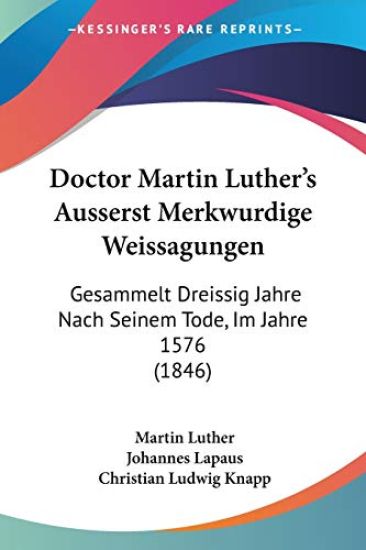
Doctor Martin Luther's Ausserst Merkwurdige Weissagungen
Martin Luther; Johannes Lapaus; Christian Ludwig Knapp
KESSINGER PUBLISHING CO
2009
pokkari

An Den Christlichen Adel Deutscher Nation Von Des Christlichen Standes Besserung
Martin Luther; Karl (EDT) Benrath
Kessinger Pub
2009
pokkari