
Kirjojen hintavertailu – 12 903 735 kirjaa ja 27 kauppaa

Kirjailija

Martin Trow

Kirjat ja teokset yhdessä paikassa: 3 kirjaa, julkaisuja vuosilta 1994–2010, suosituimpiin kuuluu The New Production of Knowledge. Vertaile teosten hintoja ja tarkista saatavuus suomalaisista kirjakaupoista.

3 kirjaa

Kirjojen julkaisuvuodet: 1994–2010.

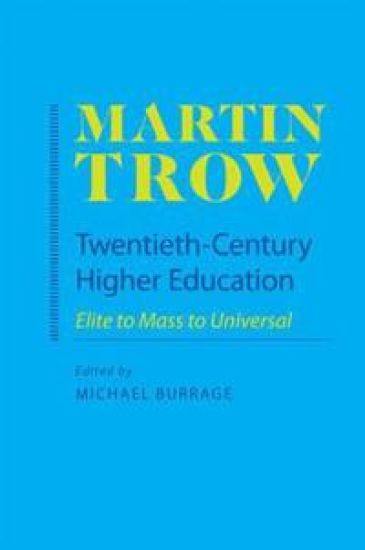
Twentieth-Century Higher Education

Twentieth-Century Higher Education

Martin Trow

Johns Hopkins University Press
2010
sidottu
Distinguished by their sharp insights, eloquence, even humor, the writings of Martin Trow on the development of higher education have helped define the field. Collected here are his most influential essays, tracing the arc and evolution of his prolific scholarly career over more than four decades. Trow is well known for his pioneering work on the transition from elite to mass to universal higher education, and scholars worldwide continue to use his conceptual framework for analyzing and comparing institutions. As both a sociologist and a public policy analyst, Trow hoped his analyses of higher education would help influence public policy. He believed that understanding how higher education had developed-its peculiarities in a particular society and the direction of change within it-would lead to wiser policy choices. Martin Trow began compiling this collection before his death in 2007. Editor Michael Burrage, along with Trow's friends and colleagues, worked to carry out Trow's wishes, writing introductions to the essays which situate them in their context and which continue each contributor's conversations with Trow during his lifetime. Those seriously interested in the emergence of mass higher education, and the debates surrounding it, will appreciate finding many of Trow's groundbreaking works-including three articles never before published-in a single volume.
Twentieth-Century Higher Education

Twentieth-Century Higher Education

Martin Trow

Johns Hopkins University Press
2010
pokkari
Distinguished by their sharp insights, eloquence, even humor, the writings of Martin Trow on the development of higher education have helped define the field. Collected here are his most influential essays, tracing the arc and evolution of his prolific scholarly career over more than four decades. Trow is well known for his pioneering work on the transition from elite to mass to universal higher education, and scholars worldwide continue to use his conceptual framework for analyzing and comparing institutions. As both a sociologist and a public policy analyst, Trow hoped his analyses of higher education would help influence public policy. He believed that understanding how higher education had developed-its peculiarities in a particular society and the direction of change within it-would lead to wiser policy choices. Martin Trow began compiling this collection before his death in 2007. Editor Michael Burrage, along with Trow's friends and colleagues, worked to carry out Trow's wishes, writing introductions to the essays which situate them in their context and which continue each contributor's conversations with Trow during his lifetime. Those seriously interested in the emergence of mass higher education, and the debates surrounding it, will appreciate finding many of Trow's groundbreaking works-including three articles never before published-in a single volume.
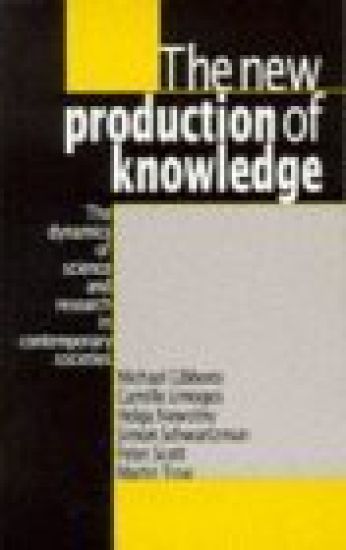
The New Production of Knowledge

The New Production of Knowledge

Michael Gibbons; Camille Limoges; Helga Nowotny; Simon Schwartzman; Peter Scott; Martin Trow

SAGE Publications Ltd
1994
nidottu
In this provocative and broad-ranging work, the authors argue that the ways in which knowledge - scientific, social and cultural - is produced are undergoing fundamental changes at the end of the twentieth century. They claim that these changes mark a distinct shift into a new mode of knowledge production which is replacing or reforming established institutions, disciplines, practices and policies. Identifying features of the new mode of knowledge production - reflexivity, transdisciplinarity, heterogeneity - the authors show how these features connect with the changing role of knowledge in social relations. While the knowledge produced by research and development in science and technology is accorded central concern, the authors also outline the changing dimensions of social scientific and humanities knowledge and the relations between the production of knowledge and its dissemination through education.